
Six to twelve months after a small business buys an AI tool, the conversation tends to sound the same. Someone says the AI gave them a confidently wrong answer. Someone else says they can’t tell where its information is coming from. A third person says it works for one department and not the others. By then the budget is spent, and few people are quite sure what it bought. We have lived this conversation in our own business, and you probably have too.
It is easy to decide the tool is the problem. The tool is usually fine. What it was dropped into is the problem: a business whose knowledge lives in the founder’s head, in a shared drive of documents that haven’t been sorted since a training session five years ago, and in fifteen or twenty software accounts that rarely talk to each other. Picture a basement full of unsorted boxes. Most of what the business knows is down there somewhere. Finding the right box under deadline is hard, it is often unclear which version is current, and the person who knew where things were may have left two years ago. Point an AI tool at that basement and it answers from whatever box it happens to open, in the same confident tone.
AI readiness for small business comes down to two things the tool usually can’t supply for itself.
78 seconds: the two disciplines, in the explainer’s own words.
What the business knows
The first is the knowledge side: the policies, the procedures, the templates, the past cases, the definitions of your own terms. Most owners have this material. What they don’t have is a version of it that a person, or an AI, can retrieve and trust.
What turns the pile into something usable is mostly editorial work, not technology. For each topic, someone decides which document is the real one and marks the rest as superseded. Documents carry a date and say what they replaced. Stale material gets retired. When the business gives a different answer this quarter than last quarter, there is a record of why.
You can feel what happens without it. The AI pulls a draft alongside the final, quotes a method from a role that no longer exists, or states a number that looks like it came from the books and didn’t. Staff tend to stop trusting it, and the tool quietly goes unused.
What the business is doing right now
The second is the data side: the record of what the business is currently doing. Your customer is in the CRM, the invoice is in the accounting system, the ticket is in the support tool, and no one system typically holds all of it. The value sits in the joins, and the joins usually don’t exist.
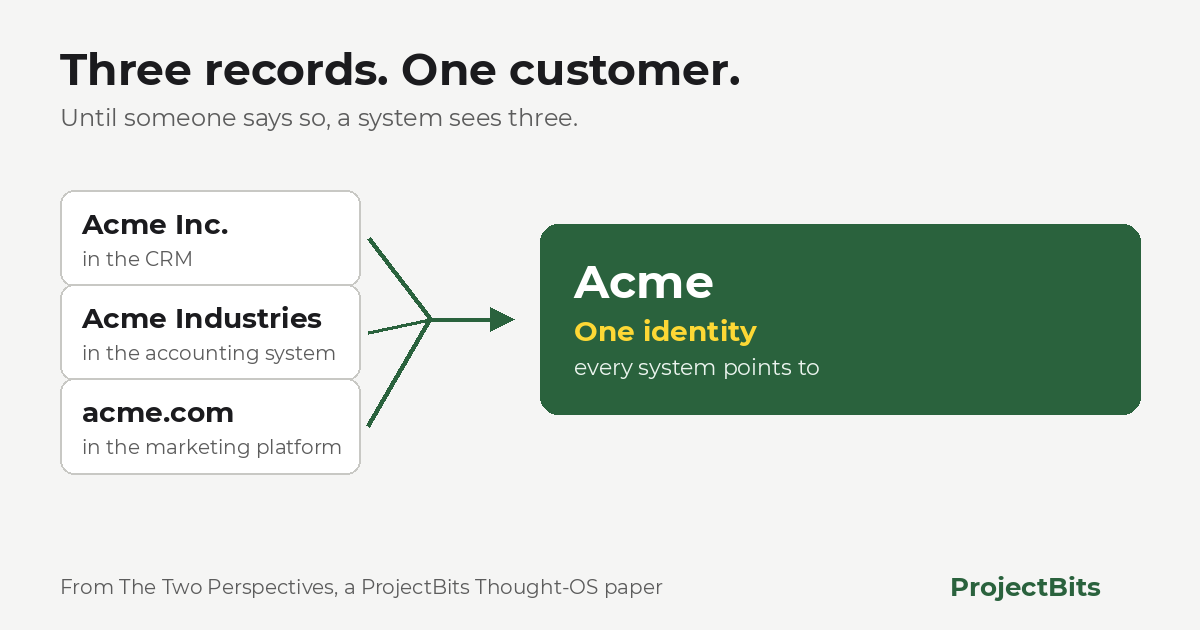
The paper I wrote on this uses a company I’ll call Acme: Acme Inc. in the CRM, Acme Industries in the accounting system, acme.com in the marketing platform. A person sees one customer. A system sees three. Until someone declares them the same and gives them one identity the other systems can point to, the question “what do we have on Acme?” has three partial answers, and whichever one the system retrieves becomes your answer.
Why one without the other doesn’t hold
A business that fixes just the knowledge side gets an AI that can tell you how you approach pricing but not what you charged a similar client last year. Method with no specifics is good advice in nicely phrased sentences. A business that fixes just the data side gets dashboards that are accurate and that few people interpret, because what counts as good, and what should trigger action, was rarely written down. People tend to check them less each month until they stop.
And a business that fixes neither and buys the subscription gets both failures at once. The line from the paper that carries the rest: AI does not create discipline. It exposes whether discipline already exists.
What this looks like on our own side
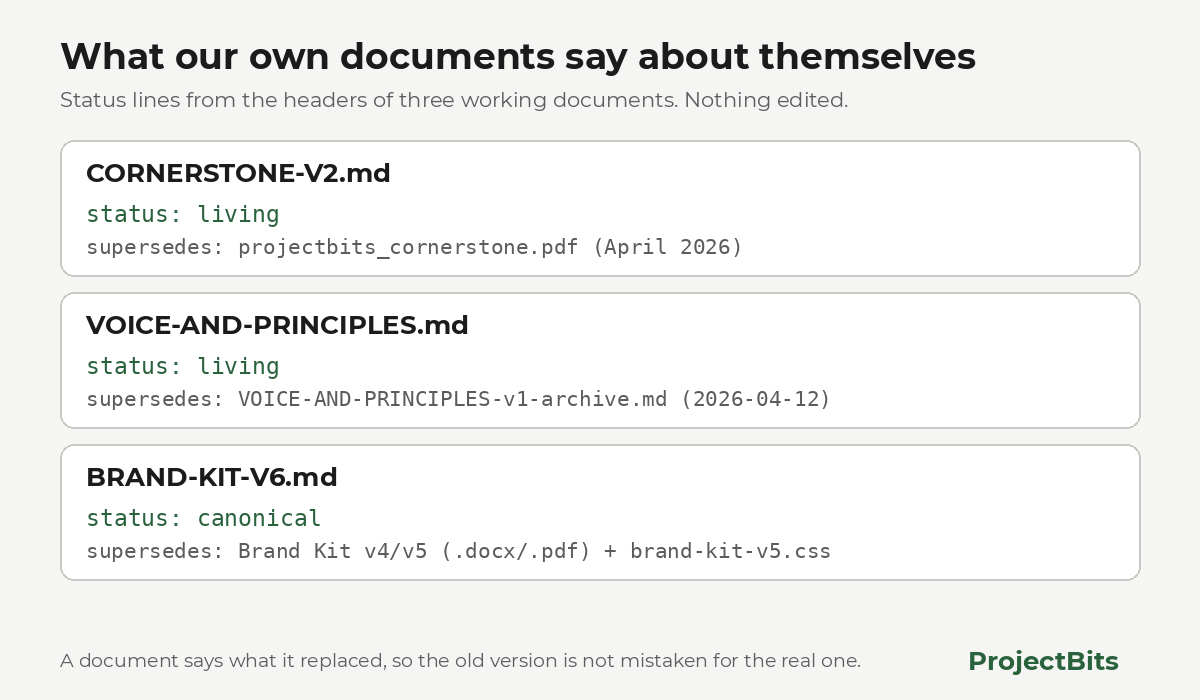
Here is what we run on ourselves. The marketing strategy, the methodology library, our working sessions, and client correspondence live in one searchable library that the AI tools read from, built the way this post describes. As of the start of October it holds about 298,000 searchable passages across thirteen collections. Working sessions are logged with a topic and a summary, 748 of them since late November, and new work starts by querying the earlier work. Our documents also say what they replaced. The current cornerstone document says in its header that it supersedes the April PDF, and the voice document points back to the version it replaced.
That marking is the first half of the job. We checked the second half while writing this, and it wasn’t finished: our file index still held 34 passages from the April PDF, the one we had marked superseded. The marking existed. The exclusion hadn’t reached the file index. We removed those passages on October 20, added the file to the exclusion list so a later index run skips it, and kept a backup in case we got it wrong. That is exactly the failure this post is about, and finding it took a query, not a hunch. The gap sounds small. It is the difference between an AI that answers from the current position and one that answers from whichever file it happened to find. How we keep a record of what the AI actually did is a separate post: Can You Prove What Your AI Did to the Books Last Night?.
Our contacts get the same treatment: people in the CRM, leads from outreach, meeting participants and email senders are reconciled to one identity each, so asking what we have on a person or a company usually returns one answer.
What it doesn’t do
It doesn’t decide which problem is worth solving. That is a separate discipline, and a business can do all of this and still point the AI at the wrong job. It also isn’t finished on our side. The loop we designed to capture the questions people actually ask, score them, and feed the gaps back into the corpus exists as a specification. The pieces that are running are the meeting-transcript intake and the corpus; the scoring and gap tracking are still design. We’re working through them in sequence, the way we would with a client.
And it doesn’t call for an enterprise budget. A workable starting point for a small business is a documented method, one canonical source for its top thirty operational questions, dates on its documents, a regular review with a named owner, and a single database fed daily from accounting, the CRM, and one or two operational systems. The paper’s estimate is that this is reachable inside a quarter with focused effort. The first pass, the audit, often turns up value before any AI exists, because it shows you where the business’s knowledge lives mostly in people’s heads.
If you were handed the basement tomorrow, what would you find first: the document that is supposed to be the real one, or the customer listed three different ways?
If you’d like to see where your business sits before spending anything, the readiness check takes about ten minutes and twelve questions. The full argument, with the working floor spelled out, is in The Two Perspectives.
Are You Ready to Take Control of Your Business Finances?
Your financial dream is yours to name. Your numbers show how far along you are.
Most back-office problems don’t live where owners look first. They aren’t in the tool or in the person. They sit in the handoffs and decisions nobody ever made explicit. Before you spend anything, you can see where your books stand: each part gets a number, what has plateaued is named, and every finding comes with its receipts. You leave with a clear picture you can act on, whether you work with us or not.
You start with a no-obligation look at where your books stand this month. Take the readiness check, about ten minutes and twelve questions, or apply for the Tax Ready Assessment. The thinking behind it is in the book, Tax Ready Bookkeeping.