
Every owner has lived this one.
A decision is waiting on you. An approval. A sign-off. A yes or a no. And until you give it, the work just sits there. Nobody can see where it stands. And if something falls over while it’s waiting — a server reboots, a tool restarts, a person forgets — the half-finished work can quietly vanish.
You’ve felt the three failure modes, even if you never named them:
- “I don’t know where that stands.” Said about an approval, a proposal, an onboarding, a follow-up. The work started. Where is it now? Nobody can say in under a minute.
- “It fell through the cracks.” The handoff that never happened because no one got notified.
- “We can’t prove what we did.” The audit, the dispute, the bank question — and the trail has to be reconstructed three months later from email archives, if it can be reconstructed at all.
These aren’t technology problems. They’re visibility problems. And they show up in every owner-operated business — AR follow-up, contract approvals, client onboarding, change requests, the back-and-forth that takes days because it waits on a person.
Why the obvious tool doesn’t fix it
The instinct is to reach for a workflow tool — the kind with boxes and arrows. And for triggering things and sending notifications, those tools are excellent.
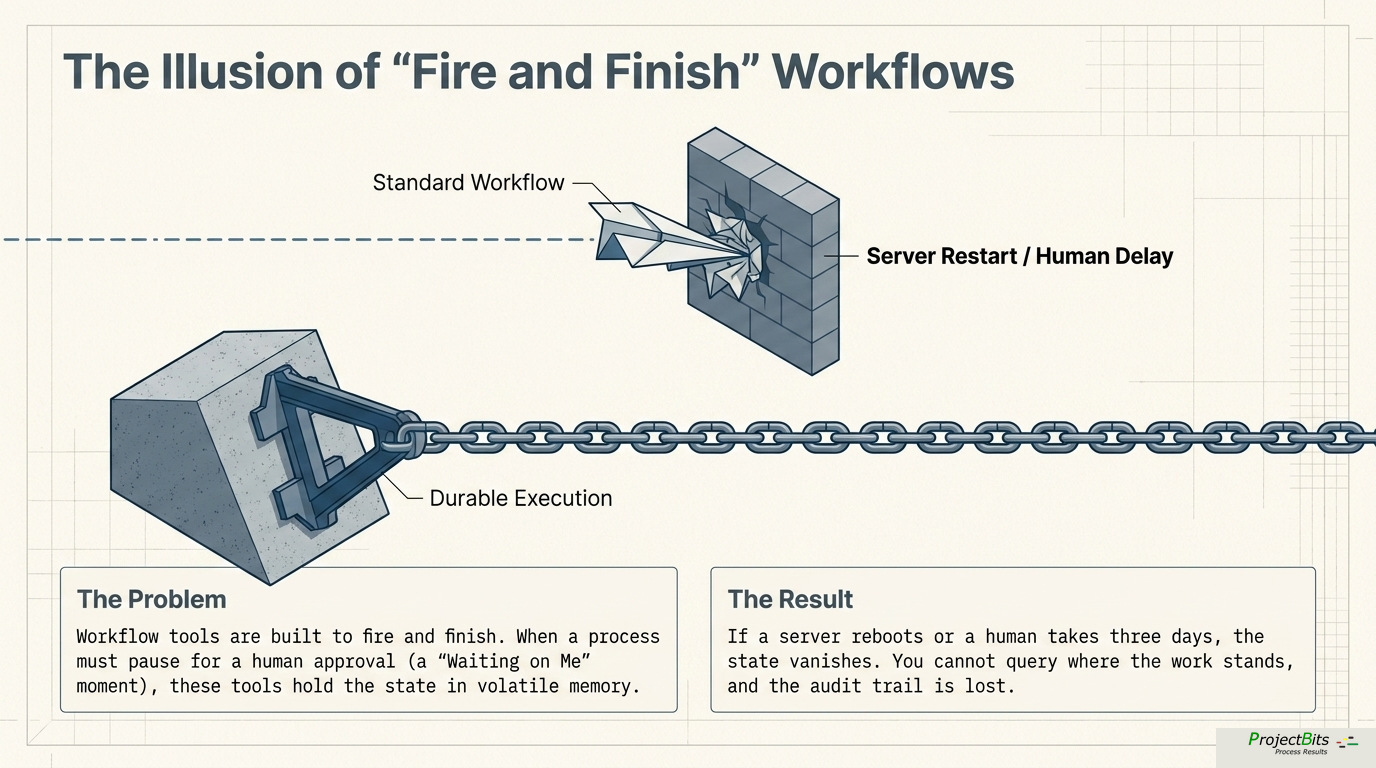
But a workflow runner is built to fire and finish. It runs a sequence and moves on. It was never built to hold a position for three days, survive a restart, and remember exactly where it was. So when it restarts mid-wait, the in-flight work becomes unreliable — and you still can’t ask the simplest question: show me every case waiting on an approval right now.
The work that defines an owner’s day — the work that waits on a human — is exactly the work these tools weren’t designed to hold.
The fix: put the truth where truth belongs
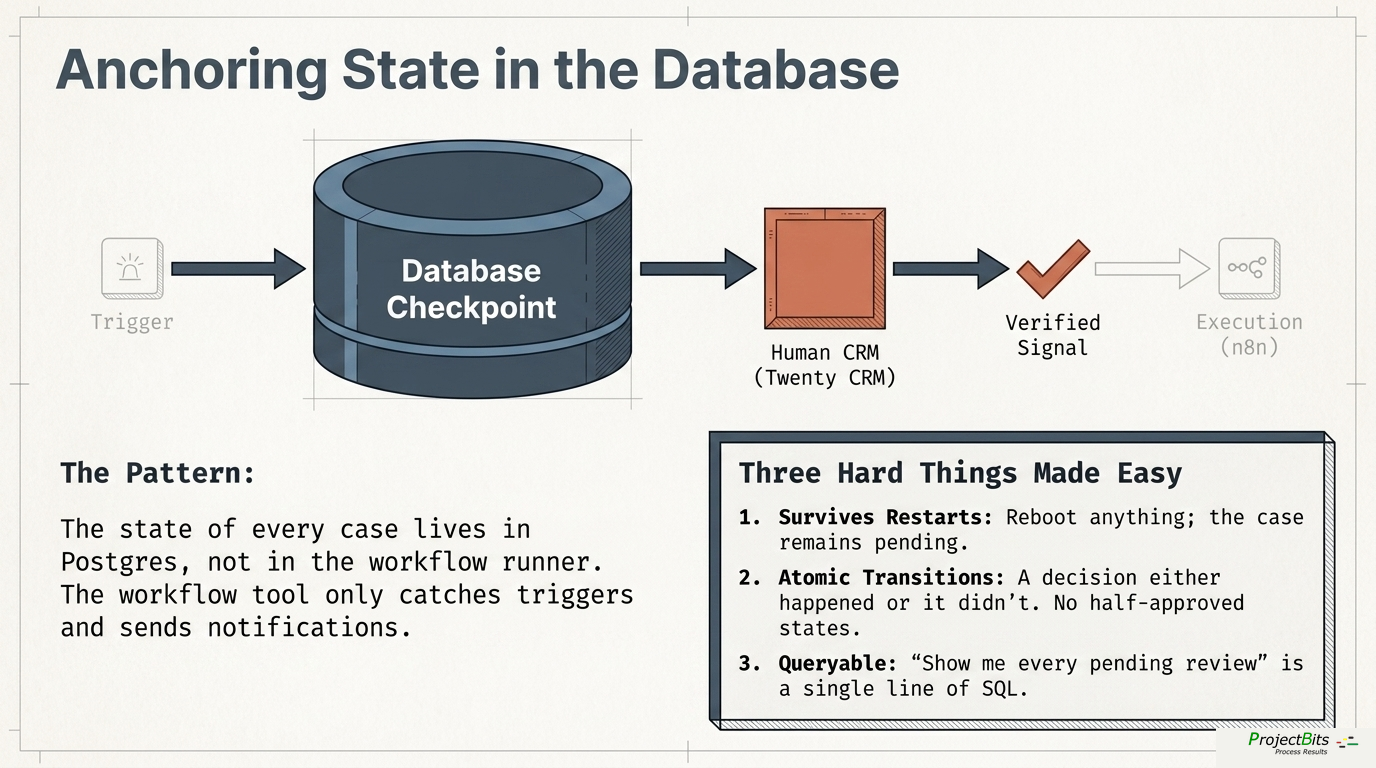
The pattern is straightforward, and it runs on infrastructure most businesses already have. The state of every case lives in the database, not in the workflow tool. Each case checkpoints its state before it waits. The workflow tool moves to the edges, where it’s great — catching the trigger at the start, sending the notification at the end. The state in the middle is held by the database as the authoritative source of record.
Three hard things become easy:
- It survives a restart. Reboot anything; the case is still exactly where it was.
- Transitions are atomic. A case is never half-approved. The decision either happened or it didn’t.
- It’s queryable. Show me every case in pending review is one line. There they are.
You decide where you already work — in your CRM, not some unfamiliar dashboard. One click: approve, or reject. That click is delivered as a verified signal, so only a real decision from you can move the case. The database records who decided and when, the case picks itself back up and finishes the job, and that record stays — written as a byproduct of the work, not reconstructed later.
The part that compounds: the trace file
Every step the case took is logged — initiated, review requested, approved (and by whom, including any overrides), executed, complete — each one named and dated. And it doesn’t stay buried in a database. It renders as a report you can actually hand to a partner, an auditor, or your bank — the trace file for that case, in plain language.
That report isn’t just a log. It’s measured evidence of how your process actually runs — where cases wait, where they stall, who decided what, and where they went off track. Not a diagram of how you think it works. A map of how it really works, built from the work itself. Over time, that evidence is what lets the system improve — and what lets you prove the improvement.
The impact
Work that waits on a person doesn’t have to be work that disappears.
- Nothing falls through the cracks — the database holds every waiting case, visibly.
- The decision stays yours — the system surfaces what needs you, and acts only on what you’ve approved.
- The audit trail writes itself — no reconstruction, no scramble, no “we think this is what happened.”
The decision stays yours. The state stays safe. The trail writes itself.
This is the durable-execution pattern from The Managed Initiative — the governing layer made concrete on our own business-development pipeline. If you want to see what it looks like against your own operation, the conversation starts here:
Book a 20-minute conversation →
ProjectBits Consulting · The Tax Ready Bookkeeping™ team