
Scaling People With Policy, Process, and AI
Key Concept
The goal isn’t to replace people with systems. It’s to make people more effective with better systems.
The New Hiring Question: “Do we need a human, a bot, or some combination—and what specs should either one follow?”
Figures (Full Resolution)
Figure 10.1: Rails vs Ramps Onboarding
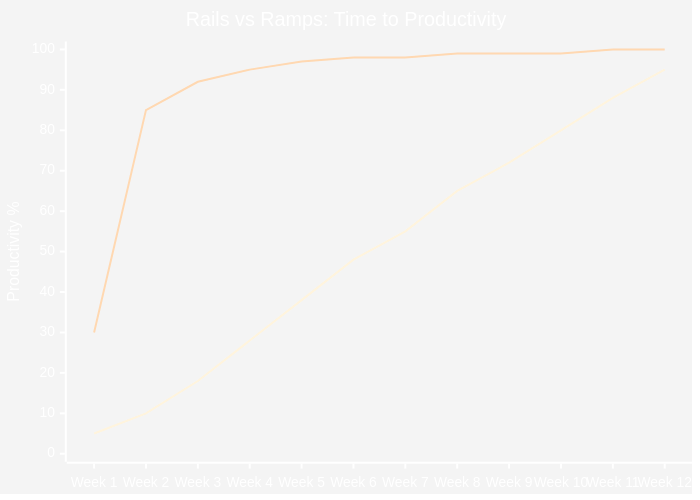 Traditional ramp-based onboarding takes 12 weeks. Rail-based onboarding with guided workflows achieves productivity in 2 weeks.
Downloadable Resources
Templates & Guides
- Onboarding Playbook Template (PDF) – Framework for building AI-guided rails
- AI-Infused SOP Format Template – Embed training in workflows
- Job Description + Rules Template – Connect roles to policies
- Rails vs Ramps Comparison Guide – Understand the difference
- Delegation Matrix Worksheet – Human vs bot decisions
Quality Is Conformance to Spec
Philip Crosby’s insight becomes critical when blending human and AI workers:
| Worker Type | Spec Unclear | Spec Clear |
|---|---|---|
| Human | Exercises judgment (inconsistent) | Follows spec (consistent) |
| Bot/AI | Cannot function | Executes precisely |
| Best Outcome | Variable quality | Predictable quality |
The businesses that scale successfully define specs clearly enough that either a trained human OR a well-configured bot can execute them—and produce the same quality output.
Rails vs Ramps: The Training Revolution
Traditional Ramp (12 Weeks to Productivity)
Week 1-2:   Read the manual. Shadow Jennifer.
Week 3-4:   Handle simple invoices with supervision.
Week 5-8:   Gradually take on more. Make mistakes. Get corrected.
Week 9-12:  Finally productive, but still asks questions.
Result: 12 weeks, high senior staff burden, 23% error rate, some new hires quit.
Rail-Based Onboarding (2 Weeks to Productivity)
Day 1 AM:   30-minute system overview video
Day 1 PM:   Begin processing. System guides each step:
            - Suggests vendor match (confirm or correct)
            - Suggests category (confirm or correct)
            - Shows required documentation (upload prompt)
            - Routes to appropriate approver (automatic)
Day 1 End:  45 invoices processed. 2 policy exceptions handled correctly.
Day 5:      200+ transactions, 94% first-pass accuracy
Day 10:     Fully productive. Handles routine work independently.
Result: 2 weeks, 4 hours training time, 6% error rate, zero turnover.
AI-Infused SOPs
Traditional SOP: “Verify vendor exists, confirm amount matches PO, code to appropriate category, route for approval if over $500.”
AI-Infused SOP: The staff member opens an invoice. The system:
| Step | Traditional | AI-Infused |
|---|---|---|
| 1. Vendor | Look up manually | System suggests match |
| 2. PO Match | Compare documents | Auto-comparison (if connected) |
| 3. Category | Remember rules | AI recommends based on history |
| 4. Approval | Remember thresholds | Auto-routes if needed |
| 5. Complete | Hope it’s right | System validates |
The human confirms, adjusts if needed, moves on. The “SOP” is embedded in the workflow, not a separate document nobody reads.
Job Descriptions That Include Rules
Traditional Job Description
“Responsible for accurate expense coding.”
What does “accurate” mean? How do you measure it? What happens when it’s not?
Rules-Connected Job Description
“Responsible for expense coding that meets Tax Ready standards: – 95%+ consistency rate – Zero suspense account usage – Documentation within 10 days
System monitors accuracy and surfaces exceptions for review.”
The employee knows: – What “good” looks like – That the system is measuring – That exceptions surface—not hide
This isn’t surveillance. It’s clarity.
The Override Conversation
When the system blocks something, teach proper escalation:
1. READ the block message
   └── What specifically is the issue?

2. FIX if you can
   └── Missing documentation? Upload it.
   └── Wrong category? Correct it.

3. ESCALATE if you can't
   └── What you tried
   └── What the system said
   └── Why you think it's legitimate

4. DOCUMENT if override approved
   └── Reason recorded in audit trail
Overrides aren’t bad—but they should be rare and documented.
Case Study: 12 Weeks to 2 Weeks
Client: Regional accounting firm, 22 staff
Before (Ramp-Based)
| Metric | Before |
|---|---|
| Time to productivity | 12 weeks |
| Senior staff training time | 15-20 hours per hire |
| Error rate (first 90 days) | 23% |
| Turnover during training | 2 of 5 hires quit |
After (Rail-Based)
| Metric | After | Improvement |
|---|---|---|
| Time to productivity | 2 weeks | 83% reduction |
| Training time | 4 hours per hire | 80% reduction |
| Error rate (first 90 days) | 6% | 74% improvement |
| Turnover during training | 0 | 100% improvement |
Managing Partner: “We stopped trying to transfer 20 years of tribal knowledge in training. We embedded the knowledge in the system.”
Becoming the Architect
From The E-Myth: Work on your business, not just in your business.
| Role | Focus | Time Spent |
|---|---|---|
| Brick Layer | Doing the work | In the business |
| Architect | Designing systems | On the business |
The architect doesn’t lay every brick. The architect designs buildings so anyone following the plans can lay bricks correctly.
Key Question: “How would someone else do this correctly if I weren’t here?”
If you can’t answer that question clearly, you’re not ready to scale.
Pro Tips
Written Policies Enable Delegation: > Written policies don’t just improve compliance—they let you delegate confidently. When the “right way” is documented, you can hand work to junior staff, contractors, or offshore resources without sacrificing quality. The policy becomes the training.
Key Employee Leaves? > When a key employee leaves, don’t panic about what’s “in their head.” If your policies are documented and your systems enforce them, the transition is about access handoff—not knowledge archaeology.
Key Takeaways
- The hiring question has changed: “Human, bot, or both—and what’s the spec?”
- Quality is conformance to spec—same standard for humans and bots
- Rails beat ramps: Guided workflows beat manuals nobody reads
- AI-infused SOPs embed training in daily work
- Job descriptions connected to rules create clarity, not surveillance
- If you can’t articulate the spec, you’re not ready to scale
Your Next Step
Identify one process that depends on “tribal knowledge”—information that exists only in someone’s head. Document it well enough that a new person could follow it.
Want help building AI-guided rails? Apply for a complimentary Tax Ready Assessment – we’ll show you what rail-based onboarding looks like for your processes.