
ProjectBits Thought-OS™
The business operating system for deliberate process and predictive outcomes.
Our advice
Start with Paper Zero — find yourself first.
Before the frameworks land the way they’re meant to, see which of the five financial personas is running your business today — Which Financial Persona Is Running Your Business? is the recognition on-ramp: find yourself first, then read on. From there, The Two Perspectives names the disciplines — knowledge governance and operational data integration — that determine whether AI produces operating intelligence or expensive theater. The papers below build from that diagnosis to the lab result that tests it.
Reading order
- ★ Which Financial Persona Is Running Your Business? — find yourself first, then read on. ~13 minutes.
- The Two Perspectives — the AI-readiness diagnostic. ~16 minutes.
- Tax Ready Bookkeeping + The AI Stack — the bookkeeping-specific application. ~29 minutes.
- The CFO Operating System — the Stage-4 advisory layer; what clean books are for. ~15 minutes.
- ProjectBits Thought-OS™ — the full methodology umbrella. ~9 minutes.
- AI Debt: The Tax on Small Business — the cost of deploying AI without naming the decisions first. ~22 minutes.
- The Five Questions Test — the lab result: why clean books beat AI infrastructure. ~22 minutes.
- The Hill-Climbing Machine — the ecosystem view: what Satya Nadella got right, and the SMB foundation he skipped. ~20 minutes.
- The Third Perspective — People, Preparation & Readiness; the human discipline behind the harness, for change-management professionals. ~30 minutes.
- The Managed Initiative — the governance capstone: run an AI initiative the way product teams run products, translated for the $5M–$25M owner. ~30 minutes.
- Signal Clarity. Owner Amplification. — the owner’s time is fixed; the return on it is not. The governing layer that amplifies the owner’s judgment, proven on the practice’s own pipeline. ~28 minutes.
- The Trust Stack — an append-only record, rules written as code, managed secrets, an approval gate and observability: the single path every use of AI should pass through. ~30 minutes.
- The Provenance Ledger — what tax-ready books require beyond immutability: a record with two clocks and rules written as code. ~31 minutes.
What do we do?
ProjectBits Thought-OS™ is the methodology that has evolved to guide ProjectBits engagements, books, and programs. It is not a checklist, a software platform, or a single framework. It is a structured way of thinking about how a business turns messy reality into trustworthy decisions — applied to one operational domain at a time.
A business owner’s day produces an enormous amount of raw signal: invoices, transactions, customer messages, marketing impressions, vendor communications, employee questions. Most of that signal disappears into folders, inboxes, and apps that don’t talk to each other. Decisions get made anyway — on instinct, on guesswork, on the loudest voice in the room.
Thought-OS™ is the alternative. It treats each operational domain — books, finances, marketing, operations — as a process container that should run deliberately and produce predictive outcomes.
Three ways to see the same idea
Like an operating system
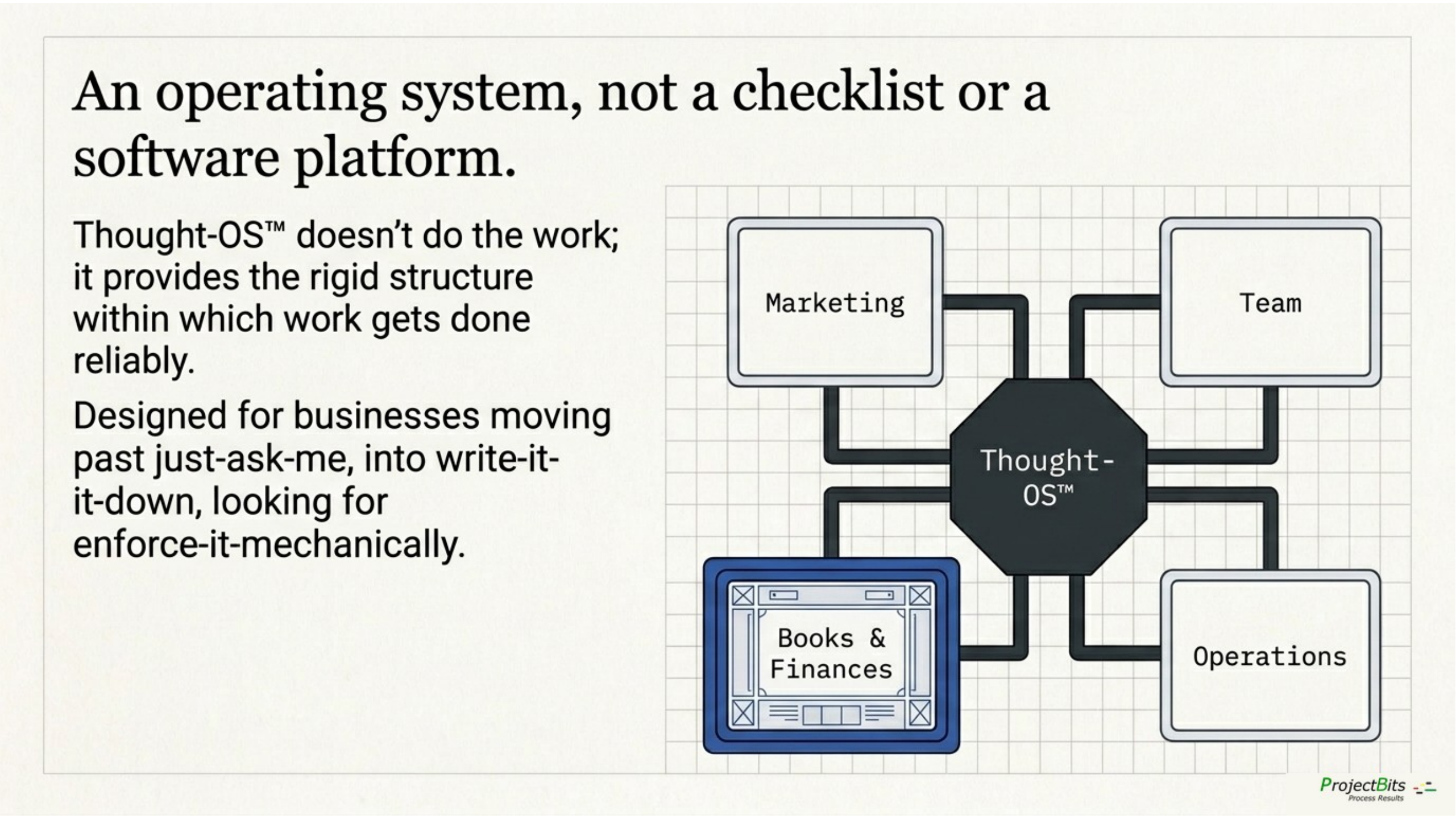
Thought-OS — an operating system, not a checklist or software platform.
Thought-OS™ doesn’t do the work; it provides the structure within which the work gets done reliably. Layered with reasoning, the structure produces outcomes that are both repeatable and what you expect.
Like a disciplined portfolio
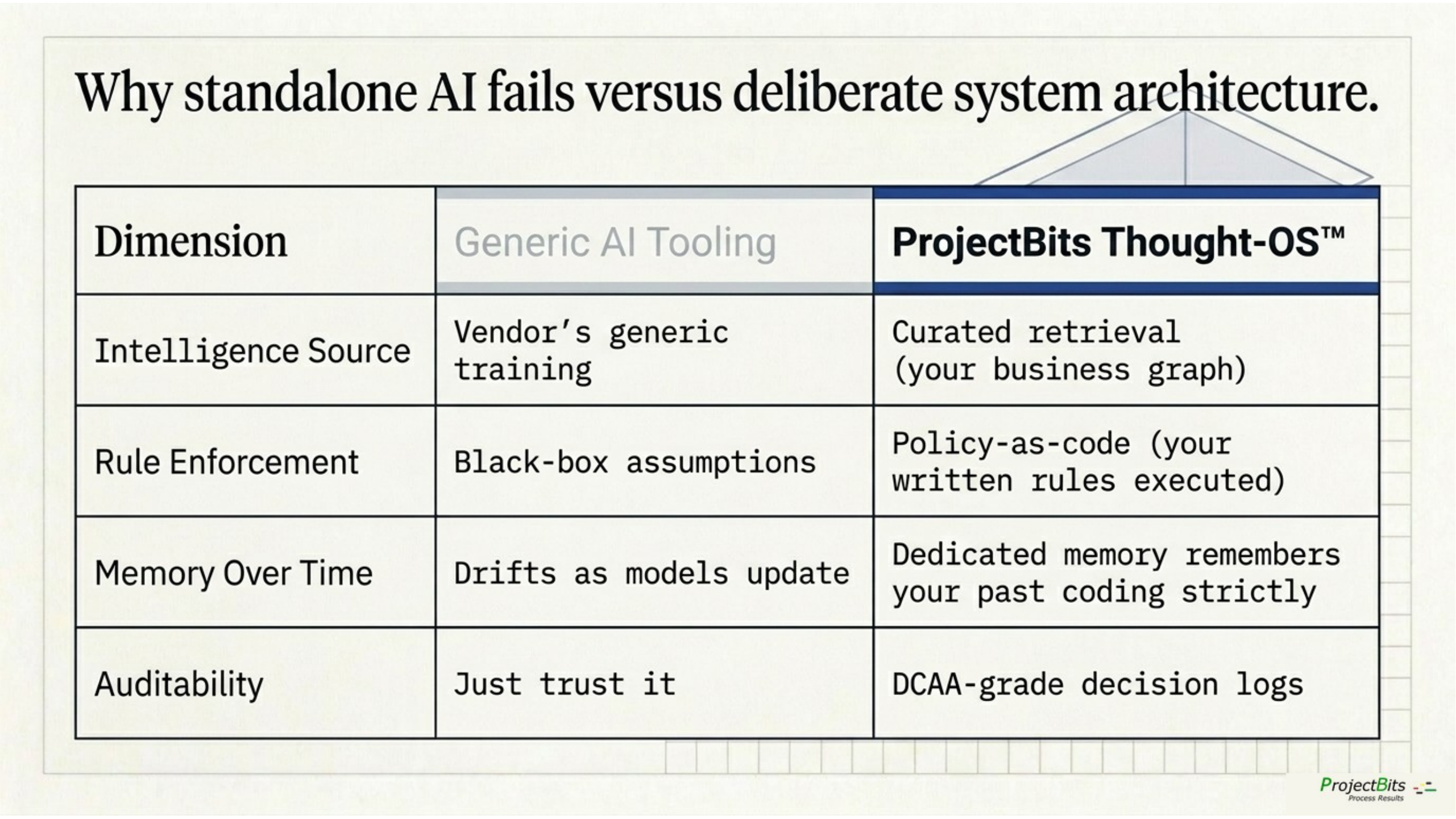
The disciplined-portfolio view — generic AI tooling vs Thought-OS structural discipline.
Thought-OS™ asks an owner to run their business by intent, by structure, by measurement, by review. The owner of a portfolio doesn’t make every decision in the moment from instinct; they have a policy, a rebalancing cadence, and a way to tell signal from noise.
Like a grist mill
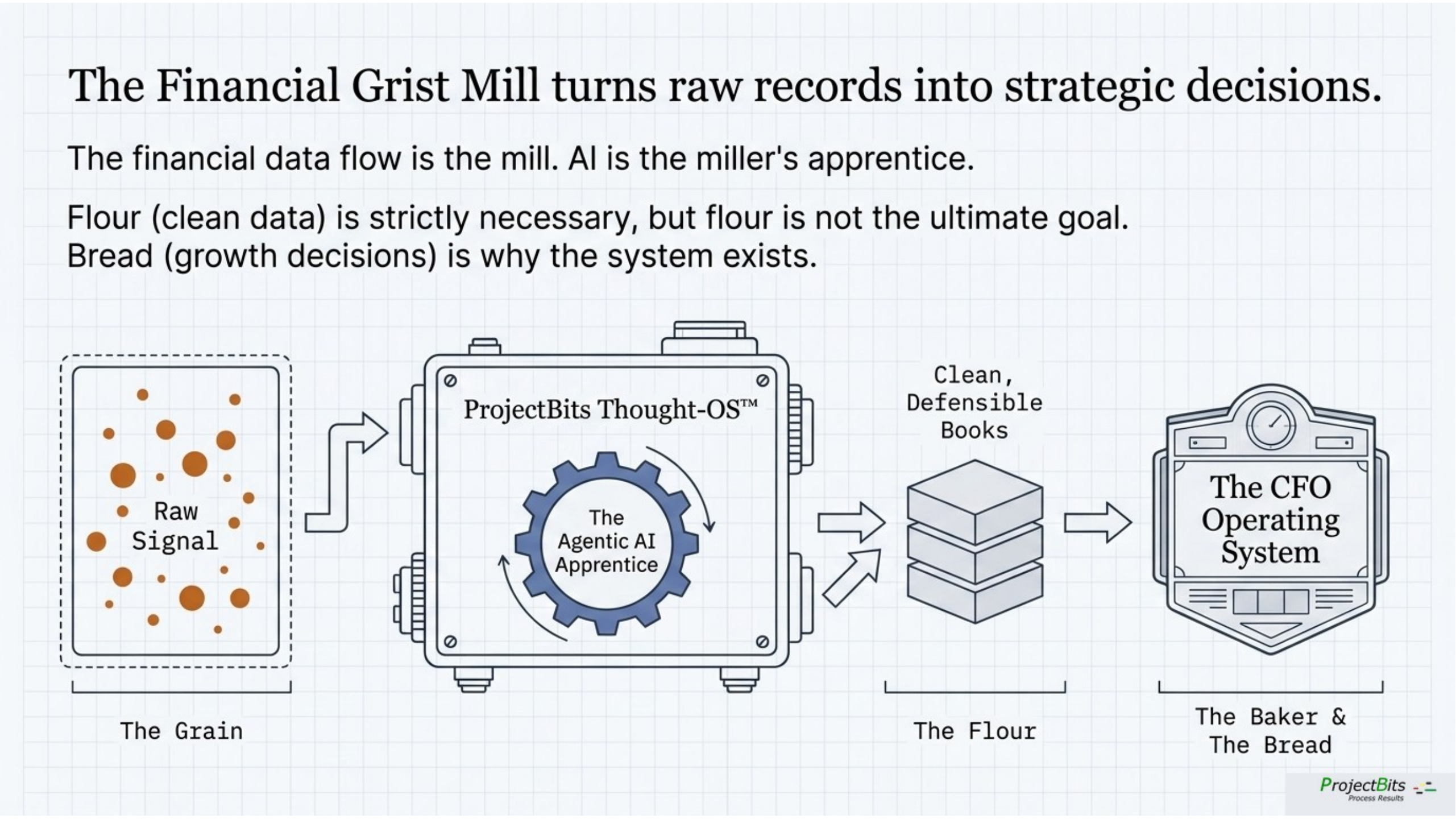
The grist mill — grain to flour to bread, with the baker explicit.
The financial data flow is the mill. AI is the miller’s apprentice. Raw transactions come in like grain. The four-stage flow turns them into something usable — insight a CFO can bake into decisions. Most “AI bookkeeping” products ship you the oven and forget the mill.
How do we do it?
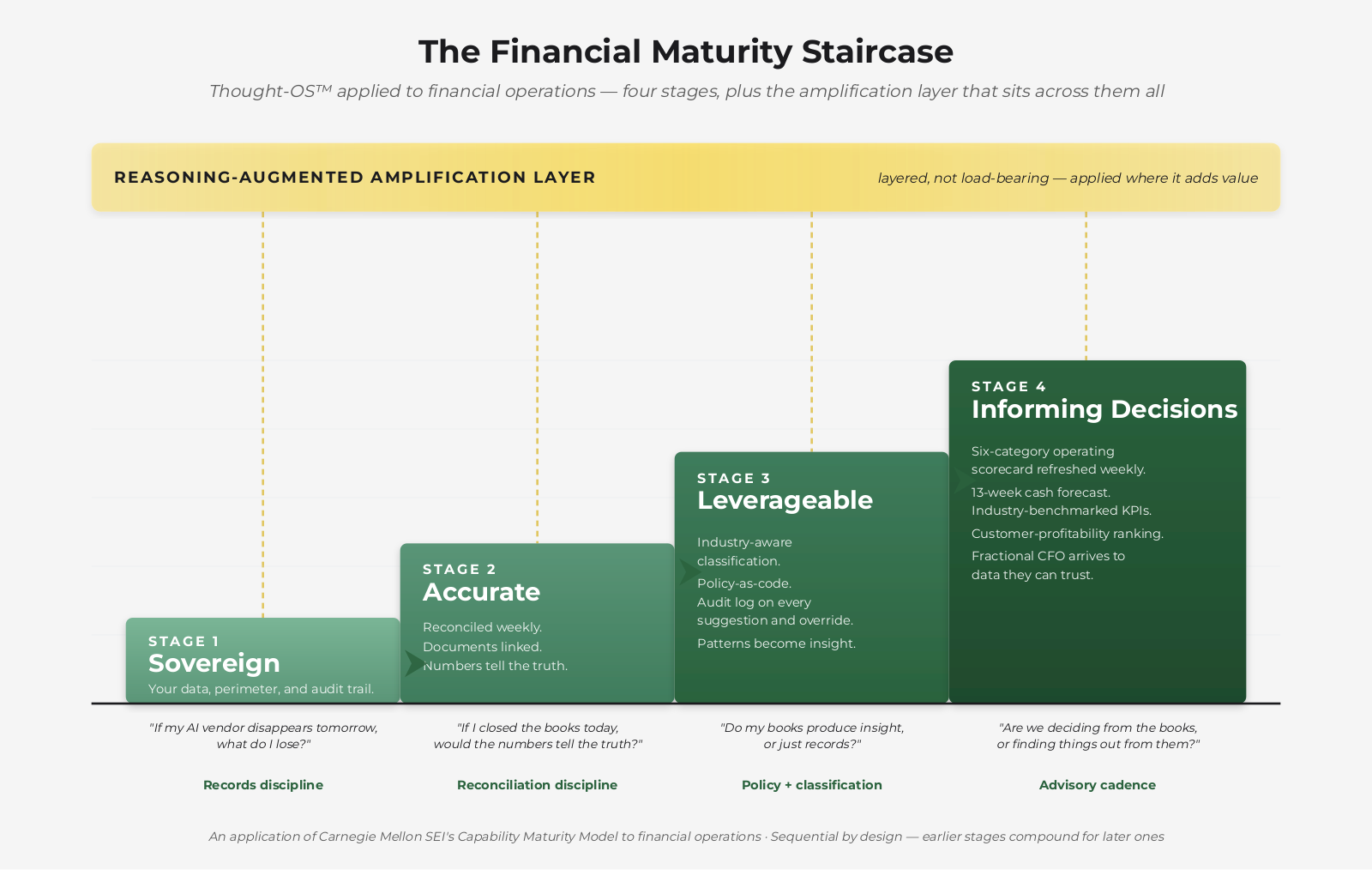
The Financial Maturity Staircase
In financial operations, Thought-OS™ runs the Financial Maturity Staircase — ProjectBits’ application of the Capability Maturity Model to financial operations. The CMM was developed by Carnegie Mellon’s Software Engineering Institute in the late 1980s and 1990s. The pattern — sequential, measurable progress from chaotic toward optimizing — has since been adopted across IT, security, project management, and other operational domains. Thought-OS™ applies that same pattern to financial operations.
The Staircase has four stages, plus a fifth element that amplifies all of them. The stages are sequential by design — skipping ahead tends to compound earlier gaps — but the work within each stage is specific to the domain.
Stage 1 — Sovereign
Your data, your perimeter, your audit trail, portable on demand.
The buyer test: “If my AI vendor disappears tomorrow, what do I lose?”
Stage 2 — Accurate
Reconciled weekly, dimensionally classified, documents linked, monthly benchmark score.
The buyer test: “If I closed the books today, would the numbers tell the truth?”
Stage 3 — Leverageable
Industry-aware classification, reconciliation engine, policy-as-code, audit log capturing every AI suggestion and every human override. The patterns in the results become insight.
The buyer test: “Do my books produce insight, or just records?”
Stage 4 — Informing decisions
A six-category operating scorecard — Cash · Growth · Delivery · Profitability · Process · Traction — refreshed weekly.
The buyer test: “Are we making decisions from the books, or finding them out from them?”
For the more granular diagnostic — where most owners actually sit on a 7-step scale — see Where Are You on the Financial Maturity Staircase?
The first job of Thought-OS™ is to identify which problem you actually have before recommending action.
The amplification layer — Reasoning-Augmented
A fifth element, the Reasoning-Augmented amplification layer, sits on top of the Staircase. It is layered, not load-bearing — reasoning makes some capabilities practical that otherwise wouldn’t be, but the methodology runs on its own when needed.
Reasoning shows up across the stages in concrete, shippable ways:
- OCR + structured extraction at the source — receipts and bills arrive as clean data, not paper to be re-keyed
- AI-assisted classification — transaction categorization and account-pattern matching guided by learned patterns rather than rote rules
- Outlier and anomaly detection — exceptions get surfaced for review rather than buried in averages
- Policy-as-code — written policies translated by Sonnet at design time into Rego policies enforced by OPA at runtime
- Embedded platform AI — QBO already ships multiple AI agents; the methodology is designed to compose with platform-level intelligence rather than work around it
- Predictive analytics — period-over-period pattern recognition, forecasting, and report highlighting
The concepts are portable. As AI evolves and new capabilities and vendors emerge, the methodology absorbs them without being rebuilt around them.
Who do we do it for?
The owners we work best with share a pattern: they run operational software that generates a lot of financial activity, they keep the books in QuickBooks Online, they can’t afford a controller but shouldn’t be doing the bookkeeping themselves, and their business is complex enough that generic bookkeeping produces bad advice.
Primary — Professional Services on QBO
Consulting practices, advisory firms, fractional CFO/CTO shops, agencies, boutique professional firms — and MSPs as a tech-services flavor of professional services running ConnectWise, HaloPSA, SuperOps, or similar PSA tools. Owner-operated, 5–30 person firms, $750K–$10M revenue.
What they feel: PSA, time-tracking, and QuickBooks speaking different languages. Margin per client is a guess. Tax time is a three-week archaeology project.
Secondary — Trades & Field Service
Service businesses running ServiceTitan, Housecall Pro, Jobber, or similar. Crew-based, owner-operator or small GM team. High job volume, $1M–$10M revenue.
What they feel: Busy and broke at the same time. They can’t tell which jobs actually made money last month. Bonding and lending conversations are painful because the financials don’t hold up.
Tail — Financial Services & Real Estate
Small wealth-management firms, RIAs, fractional CFO practices serving non-VC-backed firms, and real-estate operations bookkeeping (operations only — not 1031/cost-seg specialty). $750K–$10M revenue.
What they feel: Compliance and audit pressure higher than peers. The books need to stand up to a regulator, a lender, or a partner-in-residence at any moment.
The signal that cuts across all three
Independent of vertical, the owners we engage best with share a moment of recognition: they wrote policies for their team as the business grew, and they’re not sure those policies are being followed. That’s the inflection point Thought-OS™ is designed for — past just-ask-me, into write-it-down, looking for enforce-it-mechanically.
Who we don’t serve — and say so
We turn down work we can’t do well. That list includes audits and attest work requiring a CPA signature, complex multi-state sales tax compliance, international tax, litigation support, payroll administration at scale, venture-backed CFO work with institutional investor reporting, 1031/cost-seg specialty real-estate work, nonprofits, and “just the bookkeeping, no advice.” Being explicit about the no is a trust move.
Can we provide receipts that it adds value?
We hold ourselves to the same scorecard we hold your books to.
Lessons learned from messy real-world work
The methodology didn’t come from a whiteboard. It came from 20 years of consulting engagements where the problems were real, the budgets were tight, and the deadlines didn’t move. A few of the receipts that informed how Thought-OS™ is built:
73 → 9 days
Invoice processing
REIT with 230+ leases and 800+ legal entities. Annual savings: ~$350,000. The reconciliation discipline in Thought-OS™ traces directly to this work.
Zero
Production failures
5 major CPM platform version upgrades over multiple years — institutional continuity that survived personnel changes on the client side. The audit-trail and policy-as-code discipline traces here.
47 → 91
Assessment score
Out of 100. After QBOA workflow implementation. The score moves because we measure it.
Our infrastructure, measured against a public 7-layer production-grade framework
We don’t ask clients to trust a system we wouldn’t grade ourselves on.
48% → 61%
Production-grade maturity
March 2026, driven by two specific deployments — LangFuse observability and k6 load testing. Measured the gap, shipped the fix, re-scored.
97%
Classifier accuracy
On the categories our practice actually uses (mxbai-embed-large, k=3 nearest-neighbor).
36 hr → 5 min
Monthly reconciliation
Three-pass matching across bank ↔ QBO ↔ payment processor. A measurement, not a marketing claim.
Industry benchmarks for context
- CPA.com: practices with 50%+ revenue from defined niches see 38% higher median CAS revenue and 51% higher net revenue per client.
- Cherry Bekaert: 72% of professional services firms cite data integration as their top pain point.
- Pilot.com: fractional CFO market is $3K–$12K/month; messy books drive higher costs.
The receipts above span the work that prepared us to build this practice and the infrastructure that runs it today. As current Tax Ready Bookkeeping™ engagements in Pro Services, Trades, and FS-RE reach measured outcomes, their stories will join these. We show the work that’s actually done and let the receipts compound — that’s the practice’s discipline applied to its own marketing.
Can we help you grow in maturity?
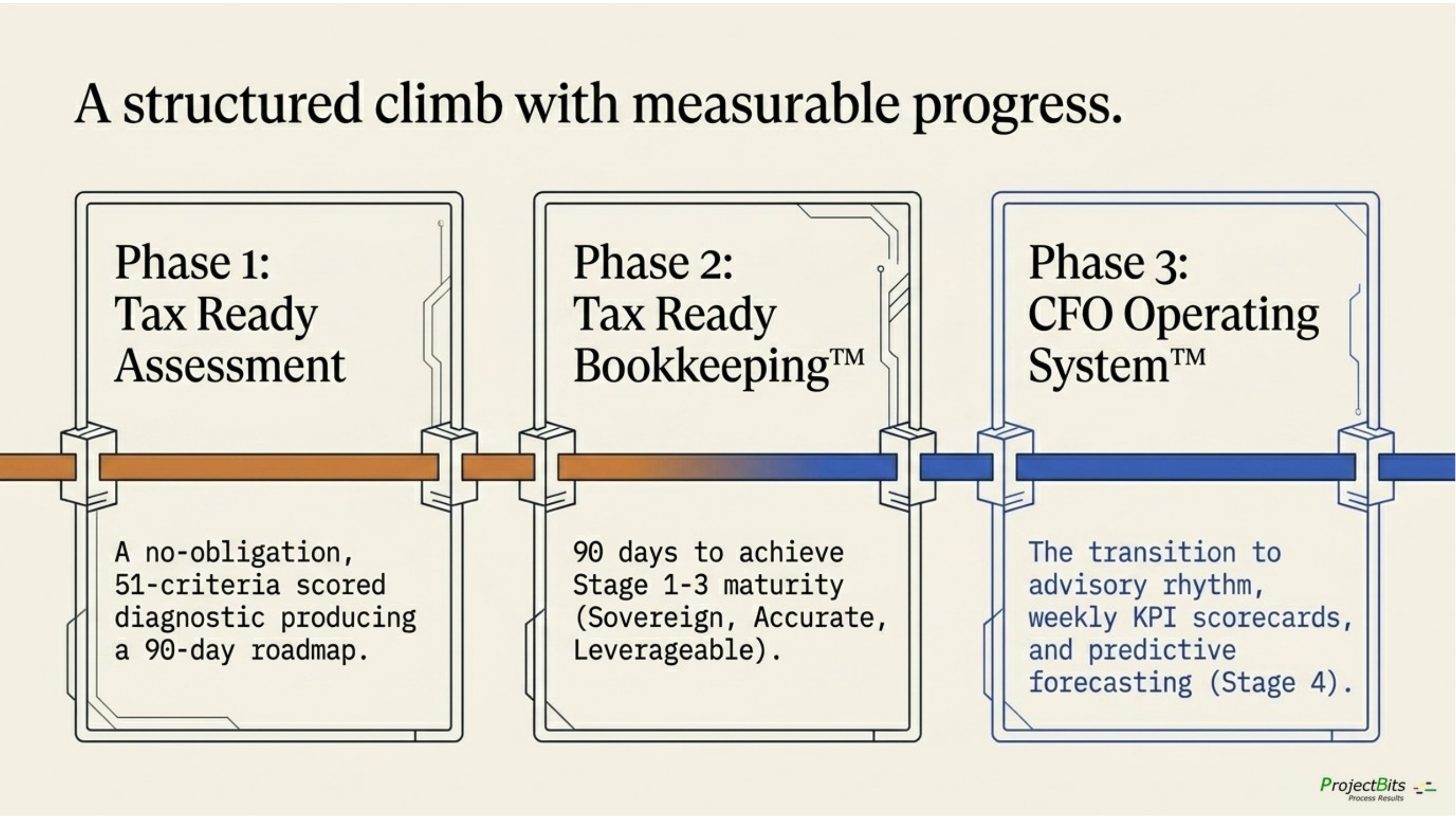
The three-phase engagement arc — Assessment, Bookkeeping, CFO Operating System.
Thought-OS™ isn’t a one-time fix. It’s a structured climb. The methodology is designed so a business owner can engage at one stage and grow through the next ones — measurably, with dated progress artifacts the client holds in their hand.
The journey
Start: the Tax Ready Assessment
No obligation. A scored diagnostic across 51 criteria in 9 categories. Places your business on the Financial Maturity Staircase, surfaces the specific gaps that matter most, and produces a 90-day roadmap. Yours to keep whether or not you engage further — the diagnostic is real on its own.
Stages 1–3: Tax Ready Bookkeeping™
Book 1 and the program that turns the methodology into monthly practice. Books you own that reflect reality and are structured to support decisions, with the amplification layer running across them. Available on Amazon; program details at projectbits.com/taxready/.
Stage 4: The CFO Operating System™
Book 2 (forthcoming) and the program that takes you from clean books to advisory rhythm. Decisions made on cadence against trustworthy financials — weekly KPI scorecard, monthly close review, quarterly traction, annual planning — with reasoning-augmented forecasting, anomaly-aware reporting, and AI-assisted scenario analysis.
Future domains. Each major operational domain gets its own Maturity Staircase and its own Thought-OS™ — marketing, operations, and beyond — with the same amplification layer applied where it adds value.
What this is designed to unlock
Most fractional CFO engagements stall in the first 60 days because the CFO arrives to books that are three months behind. Reconciliations are stale. Categorizations are inconsistent. Policies live in a binder. The first 30 days become cleanup. The client’s reaction: “I’m paying CFO rates for bookkeeping work.”
The Thought-OS™ journey is designed to change that. By the time a client reaches Stage 4, the methodology aims to deliver a CFO who arrives to a system that has already produced its own findings — industry-benchmarked KPIs, classifier-flagged disagreements, reconciliation freshness maps, policy fire trends, customer profitability rankings — so the first conversation isn’t “let me look at your books” but “the system flagged these three things — let’s start with which one matters most to your business this quarter.”
That’s the bridge from Stage 3 to Stage 4 we’re building toward — and the difference between paying CFO rates for cleanup and paying CFO rates for advisory. By design is the right phrase. Every engagement teaches us something the design didn’t anticipate, and the methodology takes those lessons. That’s the difference between a system that was built once and one that keeps working.
Want to dig deeper?
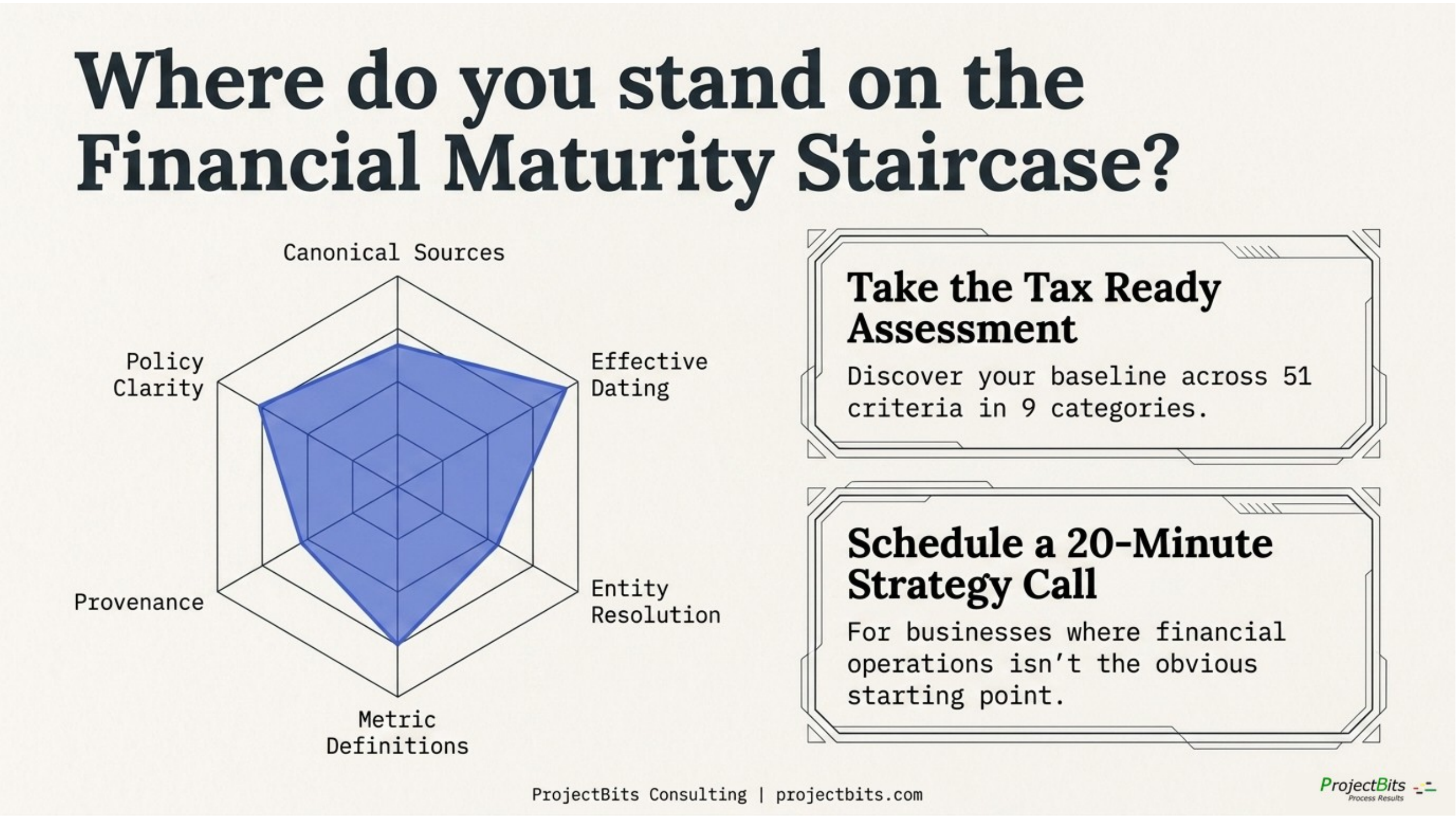
Where do you stand? A six-axis diagnostic with two next-step paths.
A few places to start, depending on how you like to learn.
Read
Where Are You on the Financial Maturity Staircase? — the 7-step diagnostic that places your business on the journey.
Download
Tax Ready Bookkeeping™ on Amazon — Book 1 of the methodology, 90 days to clean books.
Watch
The QuickBooks Tax-Ready explainer video shows the methodology applied to a real QBO file.
This page will grow as we publish more — case studies, demo videos, and methodology essays.