

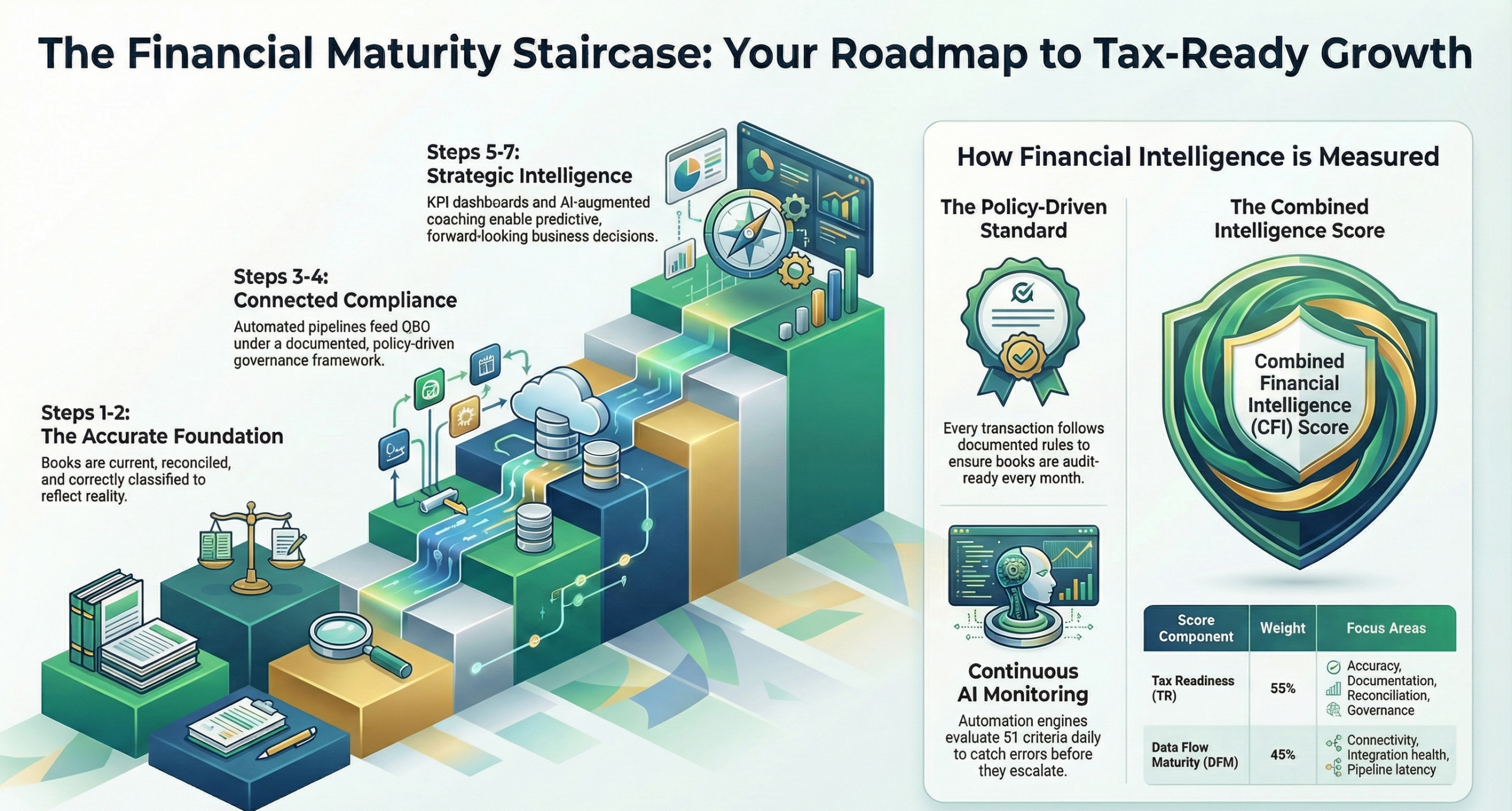
Most small business owners don’t know where they stand financially — not because they’re careless, but because nobody ever showed them the steps between “my books are done” and “my books are actually working for me.” The Financial Maturity Staircase is a framework that changes that. It maps seven clear steps from basic recordkeeping to data-driven decisions, and it gives you a clear picture of where you are today, what you’re missing, and what the next level of financial maturity unlocks for your business.
Whether you run an MSP, an IT services firm, or a professional services business, the staircase applies. It’s not about how big you are — it’s about how much your financial data can do for you right now.
Steps 1–2: The Accurate Foundation
Step 1 — Recorded
Transactions exist in QuickBooks Online. They may be incomplete, late, or miscategorized — but there’s a record. At this step, you have a checkbook, not a financial system. No reliable decisions are possible because the data isn’t trustworthy. Tax time is a reconstruction project.
Self-check: Do you have transactions older than 30 days sitting in your bank feed’s “For Review” tab? Do you check your bank balance instead of your P&L to know how the business is doing? If yes, you’re at Step 1.
Step 2 — Accurate
Books are current, reconciled, and correctly classified. The numbers reflect what actually happened. At this step, basic financial decisions become possible — is there enough cash to pay this bill, did we make money this month, what did we spend on payroll?
Self-check: Have you reconciled every bank and credit card account in the last 30 days? Is your year-end close a routine or a scramble? If your CPA still asks for cleanup work, you haven’t fully reached Step 2.
Most small businesses live at Steps 1 or 2 longer than they should — not from laziness, but from not knowing what the next step looks like or what it costs to get there. This is where professional bookkeeping earns its first and most fundamental return.
Steps 3–4: Connected Compliance
Step 3 — Connected
All revenue streams, payment processors, and operational systems feed into QuickBooks Online through validated, monitored integrations. Revenue from Stripe, your PSA (ConnectWise, HaloPSA, SuperOps), your POS, or your field service tool all arrives accurately and on time.
Self-check: Does your billing system agree with your books? If you run an MSP, do your ConnectWise invoices match what’s in QBO? If you manually export and import data between systems, you haven’t reached Step 3.
Connectivity turns QuickBooks from a tax compliance tool into a business intelligence platform. The same data that files your taxes now tells you which part of your business is profitable.
Step 4 — Compliant
Goals are defined, policies are encoded, and every month the books are evaluated against those standards. The score is not an opinion — it’s the output of a documented compliance check across 51 criteria in five domains: Accuracy, Documentation, Reconciliation, Data Flow Integrity, and Control.
Self-check: Do you have written accounting policies? Has anyone ever scored your QuickBooks file against a defined standard? Could you hand your books to a lender tomorrow without a disclaimer?
Compliance is not bureaucracy. It’s the difference between financial data you can act on and financial data you have to second-guess.
Steps 5–7: Strategic Intelligence
Step 5 — Visible
Financial and operational data are synthesized into dashboards, KPIs, and trend analysis that give you a continuous view of business performance — not just at month-end. You have leading and lagging indicators. You get alerts when something moves outside expected range.
Self-check: Do you know your gross margin by service line right now — not last month, but this week? Can you see your cash position trending over the next 30 days without opening a spreadsheet?
This is where financial management starts to feel like running a business instead of surviving one.
Step 6 — Predictive
Historical data is clean enough and connected enough to support forward-looking models. Rolling cash flow forecasts, revenue projections, and scenario planning become continuously updated outputs, not one-time exercises.
Self-check: Can you answer “What happens to cash if our largest client churns?” with a model, not a guess? Do you have a 13-week cash forecast that updates automatically?
Prediction is only possible when the past is accurate, the present is visible, and the connections between cause and effect are understood. Every step below this one is infrastructure for this one.
Step 7 — Coached
The data, the predictive models, and the compliance framework are synthesized by a human-plus-AI advisory layer that doesn’t just report what’s happening — it recommends specific actions, tracks whether those actions were taken, and measures whether they produced the expected result.
Self-check: Does your bookkeeper or CFO tell you what the numbers mean — and what to do about them? Or do they just hand you reports?
This is the destination. Not perfect books — a business that learns from its own data, adjusts continuously, and moves toward its goals with increasing precision.
Where Do You Stand?
Most of the business owners we work with start somewhere between Step 1 and Step 3 on the Financial Maturity Staircase. That’s normal. The value of the staircase isn’t judgment — it’s clarity. When you know which step you’re on, you know exactly what’s blocking the next one and what it unlocks.
We built a free Tax Ready Scorecard that maps to the staircase. Download it, score your own QuickBooks file, and see where you land. No pitch, no pressure — just an honest picture of where your books stand today.
If you want a professional assessment with specific findings and a 90-day roadmap, book a free 20-minute conversation. We’ll look at your file together and tell you exactly which step you’re on and what it takes to move up.
Are You Ready to Take Control of Your Business Finances?
Hidden QuickBooks issues can quietly erode profits, distort decision-making, and create headaches when tax time arrives. At ProjectBits Consulting, our Tax Ready Bookkeeping service gives you expert-level oversight from certified QuickBooks ProAdvisors who know exactly where to look—and how to fix what they find. We help uncover problems early, restore confidence in your financial data, and ensure your books stay accurate and tax-ready all year long.
Don’t wait until tax season to find costly surprises. Get proactive with a professional bookkeeping assessment that identifies gaps before they become risks. Apply now for your Tax Ready Assessment or explore the practical strategies in our book, Ready to Take Control of Your Business Finances, to learn how to keep your numbers working for you.