
Somewhere in your business there is a written policy. Who approves a purchase. How a new vendor gets set up. What happens when a customer pays late.
You wrote it, or someone did, because the business had grown past the point where you had time to answer every question yourself. Then it went into a folder, and the business kept moving.
So here is the question the folder cannot answer: is anyone following it?
Most owners reach this moment as they scale. First the business runs on “just ask me.” Then it grows, and the answers get written down. Then comes the uncomfortable part, which is noticing that writing it down and doing it are two different things. The next step is to begin to enforce it mechanically, so the policy is checked every time and not just when someone remembers it exists.
That climb, from ask-me to write-it-down to enforce-it, is what we mean by an operating system for a business.
An operating system doesn’t do the work
Thought-OS is the name for how we run it. It is not a checklist, a software package or a single framework. A computer’s operating system doesn’t write your documents. It provides the structure inside which the work gets done the same way going forward.
Applied to a business, that means treating each area, the books first, as a process container. Raw activity goes in: invoices, transactions, messages. The container runs deliberately, and what comes out is something you can trace to its source and plan with.
The picture we keep returning to is a grist mill. Raw transactions are the grain. The mill turns them into flour: books you can defend. The decision you bake from them is the bread. Most AI bookkeeping process designs ship you the oven and skip the mill.
Two places you can already see it
The last two papers each showed this on one concrete piece of the business.
On the ledger, a rule you wrote decides whether a transaction posts on its own or waits for a person, and each call leaves a record. The model proposes. The rule decides.
On the forecast, each period shows why the model expects its number, by source and by assumption, and anything the books cannot support yet is marked pending instead of guessed.
Same shape both times: a proposal, a written rule or a visible source, and a record you can open afterward. That shape is the method. The ledger and the forecast are just where we pointed it first.
A staircase, not a leap
The method climbs in stages, and the order matters. Skipping ahead tends to compound whatever gap was left behind.
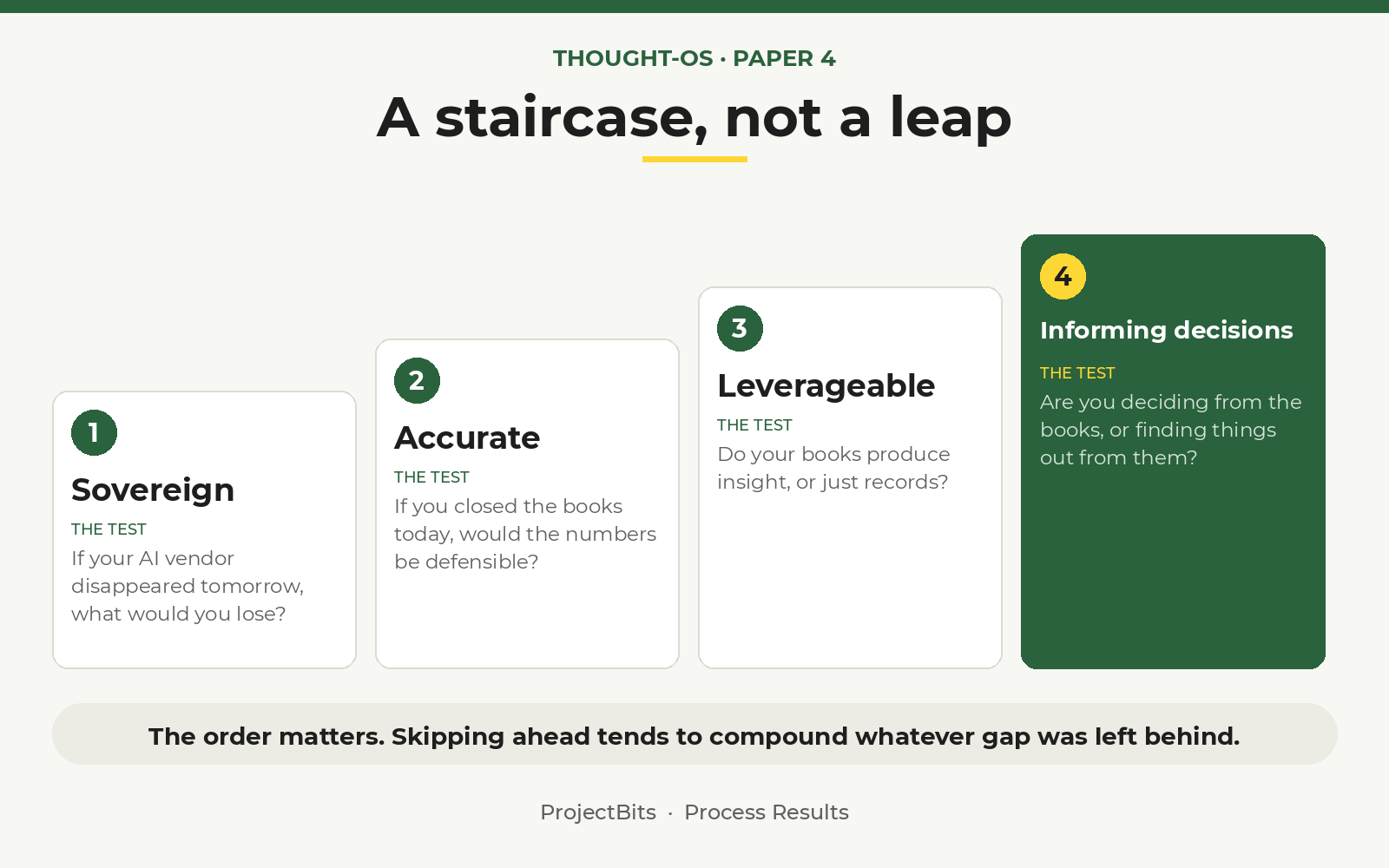
The first stage is sovereign: your data, your perimeter, your controls and audit trails, portable when you need it. The test is simple. If your AI vendor disappeared tomorrow, what would you lose?
The second is accurate. If you closed the books today, would the numbers be defensible?
The third is leverageable, where written policies are enforced by rules and every AI suggestion and every human override is logged. The test: do your books produce insight, or just records?
The fourth is informing decisions. Are you making decisions from the books, or finding them out from the books?
Most owners are not sure which step they are on. That is a fair place to start, and it is why the first move is a diagnosis, not a purchase.
What isn’t built yet
We would rather tell you which parts run today than draw a diagram where everything does.
The reasoning layer, the AI that helps with classification, anomaly spotting and forecasting, sits on top of the method. It is layered, not load-bearing. The method is designed to keep working if a particular tool changes, and it takes in new capabilities without being rebuilt around them.
The method is also meant to travel to other areas of a business, such as marketing and operations, each with its own staircase. That is the direction, not something we are claiming today.
Where to start
You don’t need to adopt anything to find out where you stand. Our no-obligation Tax Ready Assessment scores your books against the staircase, names the biggest gaps, and gives you a 90-day roadmap you keep whether or not we work together.
The full methodology, with the reading order for every paper, is on the Thought-OS page.
If a policy in your business were checked automatically tomorrow, which one would you want it to be?