

Guest post by Lori Zeoli · xpLORIZE AI Advisor
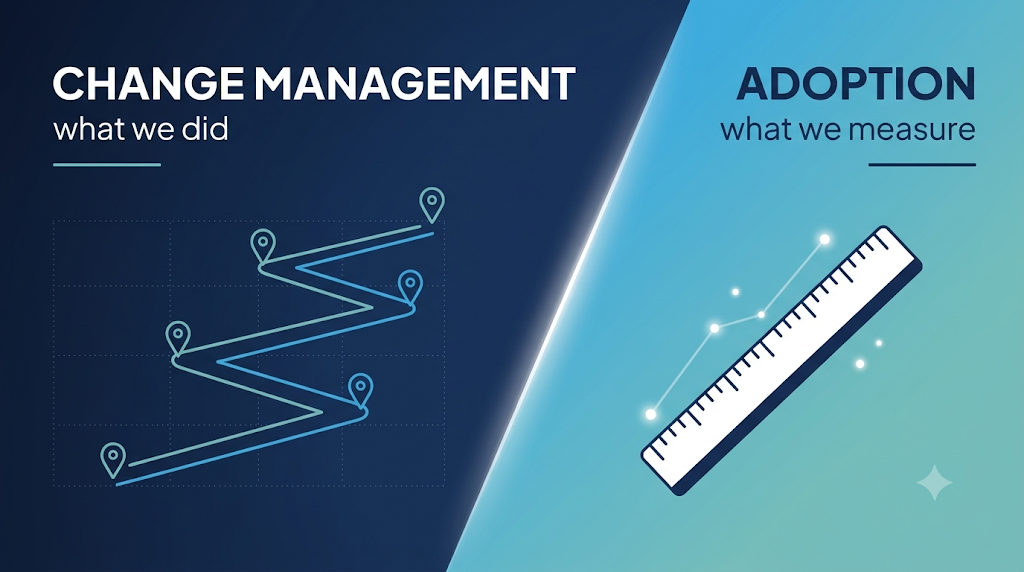
Let’s cut to the chase. Change management is what you do. Adoption is how you know it worked. Period.
Change management is a discipline. It is the body of principles, theory, and skill that make up one specific area of expertise: understanding how people and organizations respond to change.
Within the discipline of change management are methodologies. The earliest dates back to 1947 (Kurt Lewin’s model), through the organizational frameworks of the 1980s–90s (McKinsey, Kotter), and on to the individual-based frameworks that emerged in the mid-1990s through today (Prosci). The point I am making? The discipline of change management has stayed the same, but the models have evolved, rightfully so.
Change Management in Today’s AI-Driven Market
Now, let’s first define what an AI-driven world looks like. From what I see, it is an environment where AI tools are changing the way work gets done (for example, searching for information using a prompt in ChatGPT or Claude instead of asking Google), or where AI tools are doing the work for us behind the scenes (for example, automation).
What makes it different from previous tech rollouts is this critical attribute: AI tools being introduced in the market have the capability to replicate human decision making and are trainable to be our “second brains.” Layer this attribute with an extraordinary pace of change, and you have the perfect storm of market disruption.
Thus, in an AI-driven market, you need to recalibrate the change management approach for it to succeed. Here is what that looks like using the Prosci ADKAR (Awareness, Desire, Knowledge, Ability, Reinforcement) methodology.
Awareness: In the past, this milestone was easier to reach via a strong communication plan. Today, this is where leaders and people get stuck. Because the concept of AI is hard to grasp and the pace it’s evolving at is so fast, it’s hard to pinpoint where the change is. And if it’s hard to pinpoint the change, it’s harder to establish the right communication plan for the individuals affected by it.
Desire: In the past, this milestone was accomplished when people understood why they needed to use a new software tool. Today, this milestone is harder to accomplish because the friction is no longer about “why and how do we need a new tool,” but has become fear-based friction: “Will using and training this tool eventually mean it learns my job and takes over my position?”
Knowledge: In the past, this milestone was accomplished by giving people the opportunity to learn the new software tool, through training courses, computer-based learning, and so on. Today, this is harder to do because the features you’re learning today may no longer be relevant in two weeks, once a newer and better feature hits the market.
Ability: This milestone is probably the one that’s the same to reach, whether the tool arrived pre-AI or in the current AI era. Practice and repetition are the key to reaching this milestone, regardless of the tool.
Reinforcement: In the past, this milestone was about reaching a stable state so that the deployment of a new tool would be successful. Because of the rapid changes in AI tool features, reinforcement now needs to be reviewed in faster sprints.
AI Adoption
The success of AI tool adoption depends on the execution of the change management process. Are people using the AI tools correctly? Are they working differently? Are there performance improvements within the organization?
The Bottom Line
The discipline of change management stays the same. Recalibrate existing change management methodologies to fit the needs of a fast-moving, AI-driven world. Measure the success of AI tool adoption by looking at organizational success (productivity, competitive position), team success (output quality, delivery speed), and individual success (task-level confidence and independence).
Behavior change is the evidence that adoption happened, but it is not the same as proof that adoption paid off. The question that actually matters is: did the adoption add value to the business? That is a whole story on its own.
Lori Zeoli is the founder of xpLORIZE AI Advisors, helping organizations prepare their people for AI adoption. Learn more.