


Why small businesses are paying for AI enthusiasm instead of AI results.
Most small businesses don’t have discretionary capital. Every dollar spent on a project is a dollar not available for payroll, an equipment repair, or a customer opportunity. That constraint isn’t a weakness — it’s actually a discipline enforcer. Or it should be.
Something strange is happening right now. The same owner who agonizes over a $3,000 equipment purchase or contracted service is signing up for AI tools and initiatives without a business case, without defined KPIs, and without a kill switch. The justification? “Everyone else is doing it” — and the fear of being left behind does the rest.
The data is not kind to that reasoning.
The ROI numbers are brutal
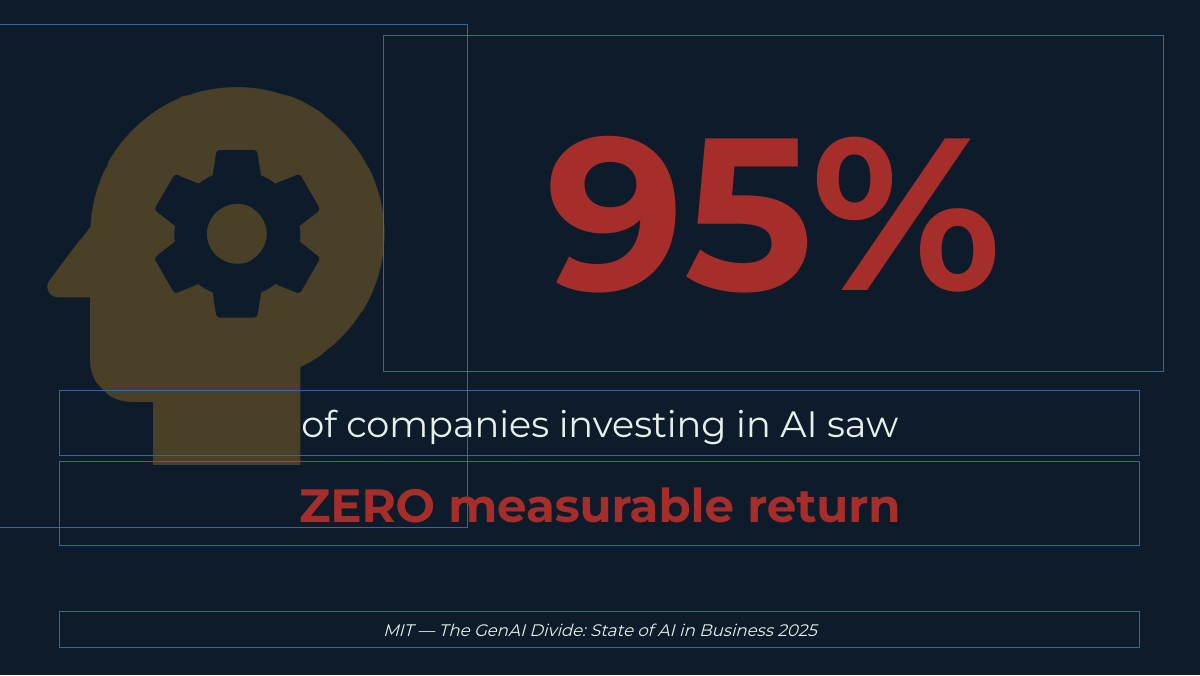
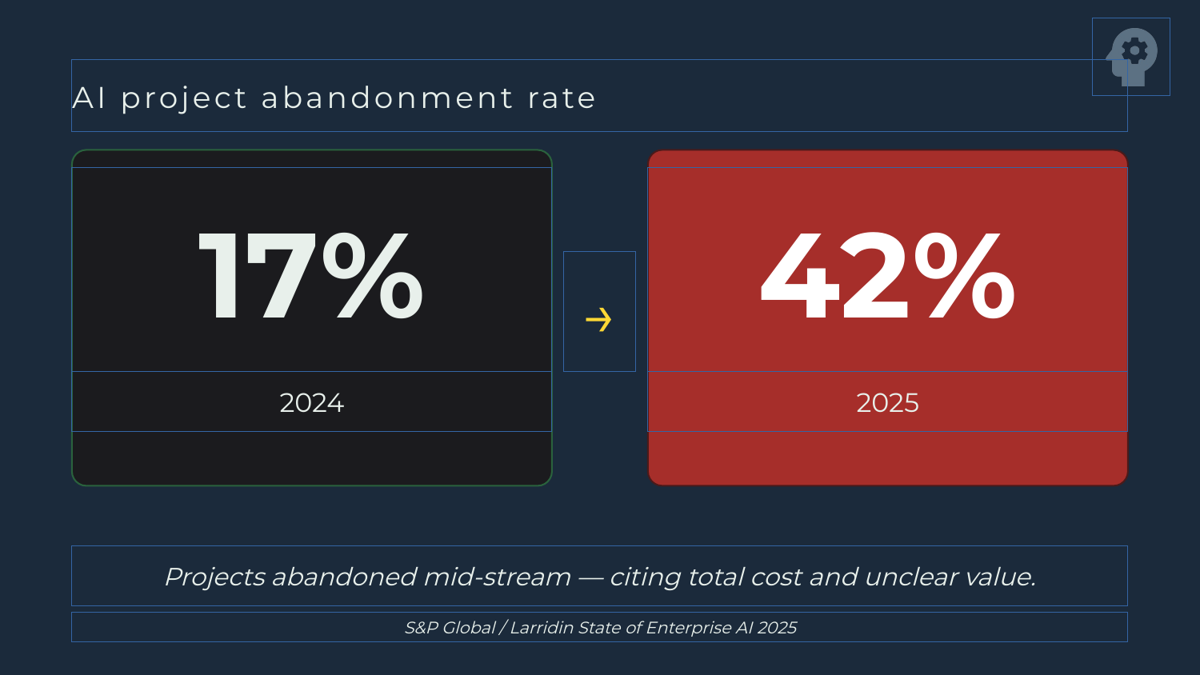
MIT’s “The GenAI Divide: State of AI in Business 2025” found that U.S. businesses have collectively poured $35–$40 billion into internal AI initiatives — and 95% have seen zero measurable return. The abandonment rate jumped from 17% to 42% in a single year, with companies citing “total cost and unclear value” as the reasons. Two-thirds of organizations couldn’t establish ROI metrics before they started spending. As Constellation Research put it plainly: FOMO isn’t a strategy, and hope isn’t either.
Here’s the structural problem: AI purchases are bypassing the same scrutiny that protects every other line of the budget. What starts as competitive instinct ends in overlapping pilots, unused licenses, and initiatives that quietly die without ever being declared dead.
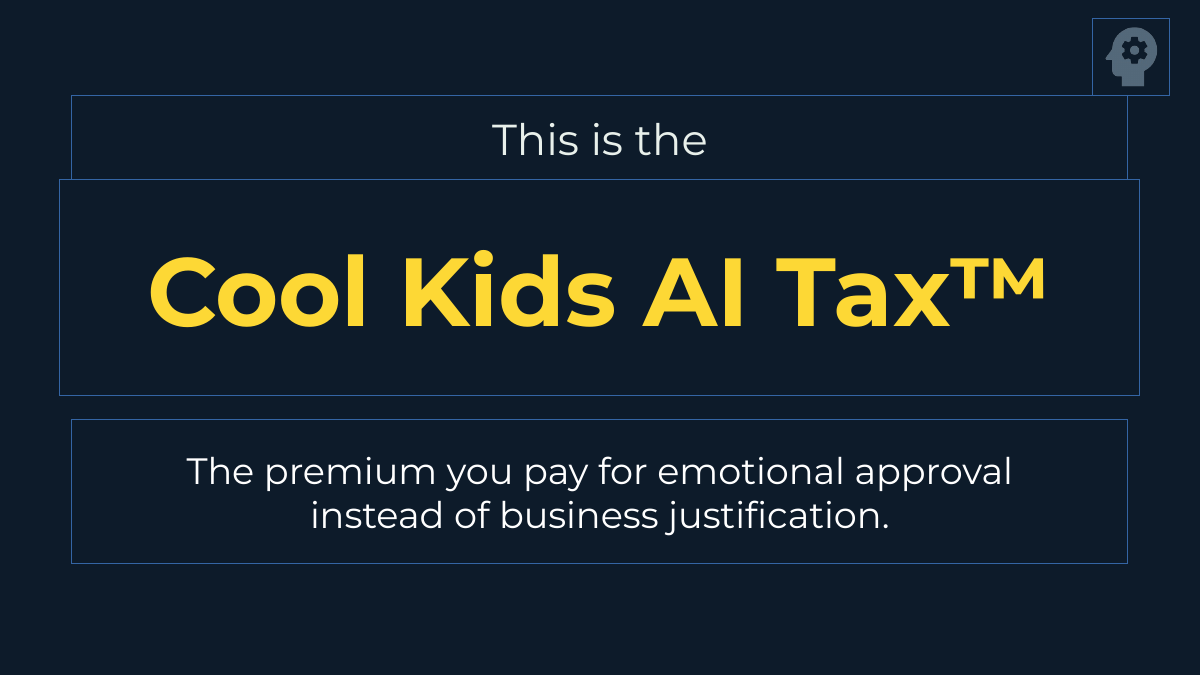
This is what I call the Cool Kids AI Tax™ — the premium you pay for emotional approval instead of business justification.
Your cash constraint is the antidote
A 30-person firm spending on a chatbot is not running the same financial calculus as a 500-person firm spending on robotic process automation. The return scales with volume. The big enterprise ROI numbers in case studies simply don't transfer — a 150% median ROI figure came from large financial-services firms automating high-volume, repetitive processes, where time saved translates directly into cash. An owner-operated business is in a different situation entirely.
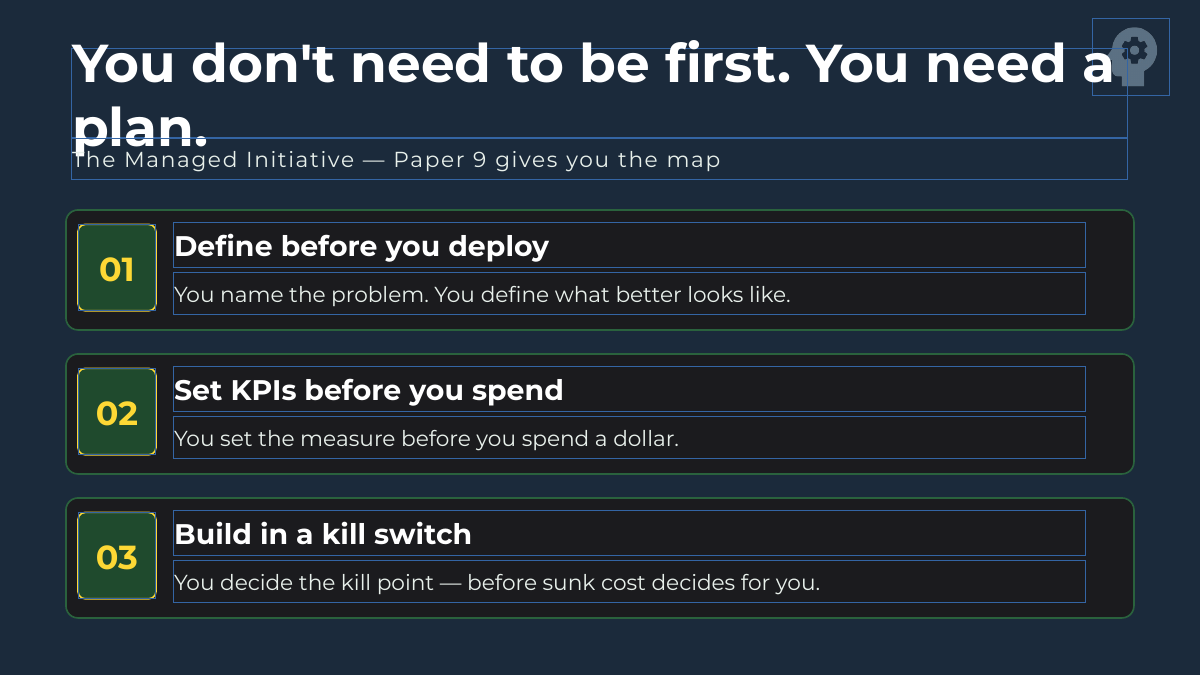
The fix is a managed initiative. In Paper 9 of the ProjectBits Thought-OS™ reading order, I lay out a governance framework built on a simple premise: AI initiatives are product-development problems, not technology purchases. That means they need what product teams have always needed — a defined problem statement, scoped work, a harness that controls autonomy relative to confidence, and explicit criteria for when to stop.
The five disciplines
- Define before you deploy. What process is broken? What does improvement look like in measurable terms? Not "we want to use AI for invoicing" — "we want to reduce invoice categorization errors from 12% to under 3%."
- Decompose the work. A big AI vision is not a project. Break it into phases with gate conditions.
- Delegate with a harness. Match the autonomy you give AI systems to the confidence you've earned through evidence — not enthusiasm.
- Iterate and measure. Set your KPIs before you start, not after you've already spent.
- Build in a kill switch. If override rates don't improve after Sprint 3, escalate. Capital should compete.
The 5% of businesses seeing real AI results share one pattern: they picked one pain point, executed with discipline, and partnered smartly. They didn't try to be first. They tried to be right.
Small businesses don't have the runway to learn the expensive way. The constraint that feels like a disadvantage is actually your best governance tool — if you use it. Don't pay the Cool Kids AI Tax™.
Go deeper: The Managed Initiative — Paper 9 in the ProjectBits Thought-OS™ reading order — walks through the full governance framework: process discovery, scope definition, the fit-signal versus execution-signal diagnostic, and the governance artifact stack. Read it at projectbits.com/insights/the-managed-initiative.
Sources: MIT, "The GenAI Divide: State of AI in Business 2025"; Gartner; S&P Global; Constellation Research; IBM; MIT Sloan / Medium analyses.