
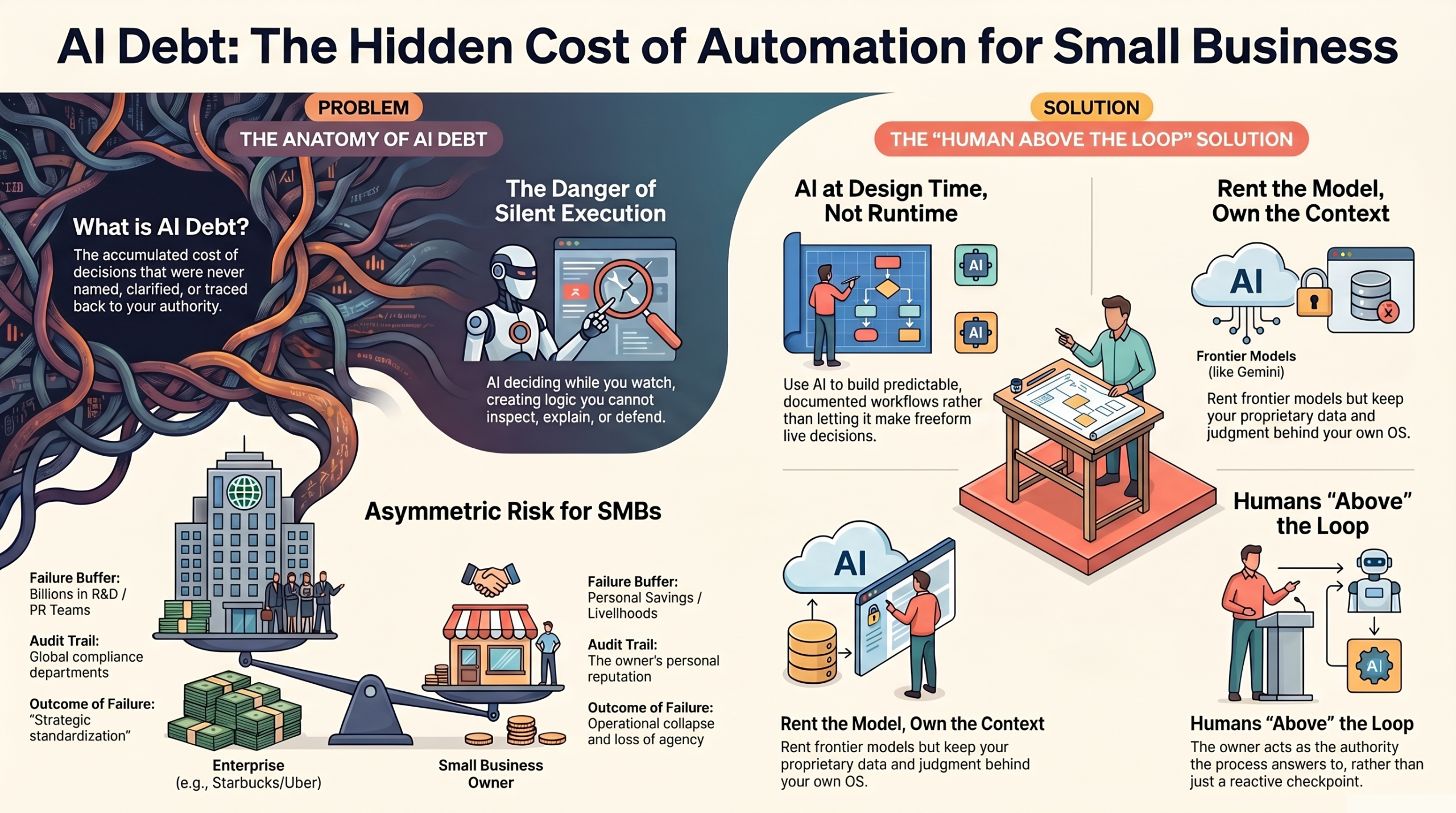
Bottom line up front: AI Debt is the accumulating cost of decisions that were never named, never clarified, and never traced back to anything you agreed to. Every time you say yes to an AI initiative without demanding traceability, transparency, and a clear audit trail, you are deciding — whether you realize it or not — whether you remain the authority your business answers to. That decision may never get surfaced in the engagement process. You need to surface it yourself.
Our advice
Start with Paper Zero — find yourself first.
Before the frameworks land the way they’re meant to, see which of the five financial personas is running your business today — Which Financial Persona Is Running Your Business? is the recognition on-ramp: find yourself first, then read on. From there, The Two Perspectives names the disciplines — knowledge governance and operational data integration — that determine whether AI produces operating intelligence or expensive theater. The papers below build from that diagnosis to the lab result that tests it.
Reading order
- ★ Which Financial Persona Is Running Your Business? — find yourself first, then read on. ~13 minutes.
- The Two Perspectives — the AI-readiness diagnostic. ~16 minutes.
- Tax Ready Bookkeeping + The AI Stack — the bookkeeping-specific application. ~29 minutes.
- The CFO Operating System — the Stage-4 advisory layer; what clean books are for. ~15 minutes.
- ProjectBits Thought-OS™ — the full methodology umbrella. ~9 minutes.
- AI Debt: The Tax on Small Business — the cost of deploying AI without naming the decisions first. ~22 minutes.
- The Five Questions Test — the lab result: why clean books beat AI infrastructure. ~22 minutes.
The Decision Apple Made — And the One You Have to Make Too
At WWDC 2026 on Monday, Apple announced a decision that had been taken long before anyone arrived at Apple Park.
Not a stumble. Not a surrender. A decision — made deliberately, internally, after a hard reckoning with a capability gap they could not close on their own. After two years of missed deadlines, a $250 million settlement for advertising a Siri that did not yet exist, and an engineering team that discovered their own Private Cloud Compute servers were too slow to run a trillion-parameter model at scale, Apple’s leadership named the tradeoff, clarified the terms, and committed to the outcome long before Craig Federighi walked on stage.
They would rent the part of the AI stack that can be rented — the model, now Google Gemini, running on Google’s infrastructure, on Nvidia Blackwell B200 GPUs — and keep the part that cannot be rented: the context. The unsaved address in your texts. The standing Thursday dinner in your calendar. The accumulated, private, un-API’d record of a person’s life that lives behind the operating system and that no third-party app can touch.
Monday was the announcement. The decision had been named, clarified, and agreed upon long before the keynote. That is precisely what made it land cleanly — not the reveal, but the clarity that preceded it.
The infrastructure chain behind that announcement is worth understanding, because it is the clearest unvarnished picture of what AI actually looks like in 2026. The code powering iOS 27 was likely written with assistance from Claude — Anthropic’s AI model, which Apple integrated into Xcode for its engineers. The intelligence running Siri is Google Gemini. The heaviest queries route to Google’s data centers. Google has committed $920 million per month to SpaceX — Elon Musk’s company, which merged with his xAI in February 2026 — for compute capacity starting October 2026. Anthropic, the maker of Claude, has also signed a deal to rent all compute capacity at SpaceX’s Colossus data center. The hardware throughout is Nvidia.
The company that built its brand on privacy and vertical integration now has every significant AI competitor — and Elon Musk — somewhere in its supply chain. This is not a criticism of Apple. It is the most unflinching picture of what AI infrastructure looks like today — and arguably the most improbable convergence in recent technology history. Nobody fully controls the chain. The question is whether you at least understand yours.
You face the same decision Apple faced. The model is not a simple commodity — frontier models, meaning the large commercial AI systems like Claude, GPT-4, and Gemini trained at massive scale and updated continuously, differ meaningfully in reasoning depth, accuracy on financial tasks, and reliability on complex documents. The debates about which is better are real. But for the small business owner, model selection is rarely the decision that determines outcome. The decision that determines outcome is whether the context is governed, the process is documented, the audit trail is defined, and the human oversight points are named before anything gets deployed.
The context is not a commodity. It is your client relationships, your financial history, your operational data, your accumulated judgment about how your business works. That is the irreplaceable part of your AI stack. And unlike Apple — which had the runway to make this decision deliberately, internally, and on their own terms — most small business owners are making their equivalent decision in real time, in a proposal meeting, without the internal clarity that makes the outcome defensible.
Apple made their decision with $111 billion in quarterly revenue, a legal team, and fifteen years of operating system access. You are making yours with the business you built — financed through personal sacrifice, and in many cases through life savings that had no guarantee of return — the clients who depend on you, the employees whose livelihoods depend on the business you keep running, and whatever ended up in the proposal someone handed you last week.
The question is not whether to rent the model. That is often the right call. The question is whether you have done what Apple did — named the tradeoff clearly, clarified what you are keeping, and made that decision before the engagement starts rather than discovering it afterward.
What AI Debt Actually Is
Every small business owner understands compliance. Taxes. Legal requirements. Risk protection. Licensing. Employment obligations. You carry these whether the year was good or bad, whether you planned for them or not, whether anyone reminded you or not. The consequences of getting them wrong are not abstract. Fines. Penalties. Personal liability. In the most serious cases, criminal exposure. Non-compliance does not just cost money. It can cost your business, your reputation, your employees’ livelihoods, and your freedom. The owner’s name is on everything — and ignorance of the obligation has never been a defense.
AI Debt works the same way — with one critical difference. Your compliance obligations send notices. AI Debt doesn’t.
It doesn’t show up as a line item on your credit card or a failed transaction in your bank feed. It arrives six months after you said yes — in a workflow nobody can explain, an automation that worked in the demo and fails on your actual data, a scope that was never clearly defined, a tradeoff that was never explicitly named or clarified, an engagement that has closed, and a business that is doing things you didn’t authorize and can’t trace.
Like a compliance obligation, you owe it regardless of whether you understood what you were agreeing to. Unlike a compliance obligation, there is no extension, no installment plan, no regulatory agency to negotiate with, and no professional who can file an amendment. The liability lands entirely on you — in your operations, your client relationships, the livelihoods of the employees who depend on your business staying healthy, your reputation, and your books.
The parent concept is technical debt, coined by software engineer Ward Cunningham in 1992. Cunningham was trying to explain why seemingly working code still needed to be rewritten. His formulation was precise: “Shipping first time code is like going into debt. A little debt speeds development so long as it is paid back promptly with a rewrite. The danger occurs when the debt is not repaid. Every minute spent on not-quite-right code counts as interest on that debt.”
AI Debt is the same mechanism applied one level up — not to code, but to the decisions about whether, what, and how to deploy AI inside a business. The software engineer who ships not-quite-right code at least knows the shortcut was taken. The small business owner who says yes to a poorly scoped AI project often does not know a shortcut was taken at all — because nobody in the room named it, clarified it, or asked who would carry it if it compounded. The debt accumulates in places the owner cannot see, in decisions that were never surfaced, and in obligations that were never made explicit.
Technical debt is often incurred without intention. AI Debt in small business is frequently incurred without awareness — not just of the shortcut, but of the obligation itself. And at the center of that obligation is one thing: your agency over the business you built.
Whose Intelligence Are You Actually Using?
Before the question of whose infrastructure your AI runs on, there is a more foundational question the industry has spent two years avoiding: whose intellectual property built the intelligence in the first place — and was it obtained legally?
The frontier models powering the AI tools being sold to small business owners today were trained on vast corpora of human knowledge — books, articles, news, academic papers, creative works, professional content accumulated over lifetimes. Much of that content was not just used without permission. It was bootlegged. Deliberately obtained through channels specifically designed to circumvent the rights of the people who created it.
The legal reckoning is now documented and specific. A class action established that AI models had been trained on books downloaded from pirate libraries — shadow libraries built for the explicit purpose of bypassing copyright protections. The settlement, the largest AI copyright settlement in history at $1.5 billion, required not just payment but destruction of the datasets containing the infringing works. The New York Times, CNN, Reddit, and dozens of other publishers have filed similar suits. Five major publishing houses including Elsevier, Hachette, and Macmillan sued Meta in May 2026 for training Llama on more than 267 terabytes of material from pirate sites — with copyright management information deliberately stripped from the works to conceal where they came from.
This matters for the small business owner in a way that goes beyond ethics. When courts require removal of bootlegged content from training corpora — and they already have — the model changes. The reasoning patterns learned from that content are gone. The model does not know what it no longer knows. It will still answer the same questions. It will answer them with the same apparent confidence. But the depth, nuance, and reliability of its reasoning in affected domains will be different — and you will have no way to know which answers changed, by how much, or when.
You are building workflows on a model whose intelligence was partly built on contested and potentially bootlegged content. Those workflows depend on the model’s current capability. That capability may be quietly degraded — not by a version update you can see and test, but by a legal settlement that removes training content on a schedule determined by litigation, not by your production calendar. The model does not announce what it forgot. It just answers differently. Perhaps not quite as helpfully. Perhaps not quite as accurately. And the gap is invisible until your client notices one.
There is a further dimension that rarely gets named or clarified. Every query your business sends through an AI system contributes — directly or indirectly — to making that model smarter. The capability ceiling rises. The price of access to that ceiling rises with it. The content that made the model smart is being retroactively priced through litigation and licensing deals. You will pay for access to that intelligence again at whatever rate the market sets after the legal dust settles.
The owner who has not governed their context and built a proprietary knowledge base is not just losing agency today. They are subsidizing the infrastructure that will charge them more for that agency tomorrow — while carrying the risk that the intelligence they depend on may be quietly reshaped by a courtroom they will never enter.
Whose intelligence are you using? Was it obtained legally? What happens to your workflows if the answer changes? These questions deserve to be named and clarified before any engagement starts — and before any workflow is built on a capability that may not be as stable as the demo suggested.
The Agency Question
The pressure to adopt AI is real. It comes from every direction — your industry association, your LinkedIn feed, your competitor who just automated their invoicing, the vendor who promises to get you running in thirty days. The message is consistent: get in now or get left behind. So you open the door.
What the hype does not tell you is that AI without a well-defined problem and a grounded operational context does not just underdeliver — it creates obligations. Broken workflows that nobody documented before they were automated. Automations nobody can explain because the logic was never written down or clarified before it was handed to a machine. Tools making decisions inside your business while you were running your business — decisions that were never named, never clarified, never reviewed, and never traced back to anything you agreed to.
When an AI agent starts making design and execution decisions inside your business, the question is not whether you understand the technology. The question is whether you are still the one driving.
Silent execution means the AI is deciding and you are watching. A workflow gets created. Data gets routed. Logic gets embedded in a tool you cannot open and inspect. One day something breaks, a client asks a question you cannot answer, and you realize the business is doing something you did not authorize and cannot explain.
Transparent execution means you are driving and the AI is extending your reach. Every decision has a source. Every output has a rationale. If something is wrong, there is a thread to pull.
Most small business AI deployments today are silent. Not because the technology requires it — but because the engagement process that preceded it did not require those questions to be answered, and most owners do not yet know to demand them.
The Debt You Brought to the Table
There is also an honest conversation to have about the owner’s role in creating the conditions for AI Debt — and it starts before any engagement begins.
Most small businesses run on undocumented processes. The owner knows how things work. Key employees know their piece. But the actual logic — how a job gets priced, how a client gets onboarded, how a reconciliation exception gets handled, how a judgment call gets made at the edge of a workflow — lives in people’s heads, not on paper. It is tribal knowledge, built over years, invisible to anyone who was not there when it formed.
Before you can govern a process, you have to be able to see it. Before you can hand it to AI, you have to be able to describe it. A workflow that only exists in the owner’s memory is not a workflow — it is a dependency. When AI is introduced into an undocumented business, it does not automate a process. It invents one. The output may look like what you intended. It may even work most of the time. But the logic underneath is the AI’s logic, not yours — and the gap between those two things is where errors accumulate silently and agency drains away.
Documentation is not a compliance exercise. It is a control exercise. When your processes are written down — steps explicit, decision points named, exceptions accounted for — you have something to hand to an AI system, something to measure output against, and something to audit when the output is wrong. Without it, you have no baseline. Without a baseline, you have no way to know whether the AI improved your process or replaced it with something you never agreed to.
Most owners built their businesses by doing, not documenting. The knowledge is real and the judgment is hard-won. But AI cannot inherit tribal knowledge. It can only work from what is explicit. The gap between what is in your head and what is on paper is, structurally, the first source of AI Debt — before the first proposal is written, before the first demo is run.
AI does not create operational discipline. It exposes whether discipline already exists.
The question to ask before any AI engagement is not just “what problem are we solving.” It is “have we written down how we solve it today — in enough detail that someone who was not there could follow it, verify it, and audit it?” If the answer is no, that is the work that comes first.
Humans Above the Loop
There is a design principle that separates AI deployments that preserve owner agency from those that erode it.
The starting point is Human in the Loop — Oracle’s definition is precise: the deliberate placement of human oversight at specific decision points within an otherwise autonomous workflow, where the cost of an AI error exceeds the cost of a human intervention. For a small business owner that boundary is not hard to locate — it is wherever the output touches a client, a financial record, a compliance obligation, the livelihoods of your employees, or a decision that cannot easily be undone.
But Oracle’s Katrina Gosek argued in January 2026 that even this framing sells the owner short. The evolution she proposed — from human in the loop to human above the loop — is not semantic. It is structural.
Inside the loop means you are a checkpoint in a machine workflow. A validator. The last mile of execution. You are reacting to what the AI produced. Above the loop means you are the authority the process answers to. You set the direction. You define the boundaries. You determine what the AI is permitted to do and where it must stop and wait. The AI executes underneath you. You are not inside the machine. The machine operates within the boundaries you established.
One position is reactive. The other is authoritative.
Humans above the loop is the operating posture of an owner who has named the decisions, clarified the boundaries, documented the processes, and defined the oversight points before anything gets deployed. It is the owner who did what Apple did — made the decision before the announcement, not during it.
The practical question before any AI workflow goes into production: have you defined, in writing, where the AI operates autonomously, where it must pause for human review, and what it is never permitted to do regardless of what it concludes? If those boundaries are not named and clarified before the engagement starts, the workflow is designed around deployment speed — not your authority.
The promise of agentic AI is speed and scale. The barrier is trust. And trust — for the owner of a firm built on the quality of their work, the reliability of their numbers, and the livelihoods of the people they employ — is not an abstraction. It is whether you can stand behind every output, explain every decision, and correct every error before it compounds into something your client notices or your books cannot reconcile.
Humans above the loop is not a constraint on AI capability. It is the governing posture of an owner who has decided — clearly, explicitly, before the engagement starts — that the business runs on their judgment, extended by AI, not replaced by it.
Enterprise Companies Can Absorb This. You Cannot.
Two stories from the same period show why the stakes are categorically different for a small business owner.
In September 2025, Starbucks CTO Deb Hall Lefevre published a blog post announcing an AI-powered inventory system across more than 11,000 North American locations. The language was triumphant. Eight times faster counts than manual methods. 99% accuracy. She called it “a farewell to manual tallies — and a hello to smarter, more seamless operations.”
Nine months later, the blog post was deleted. The system was retired. Workers had spent nine months recounting everything the AI miscounted — wrong milk types, missing bottles, items the system could not see. One employee told Fortune the tool “started off not particularly accurate and got less accurate over time.” Starbucks reframed the shutdown as a move toward “consistency and execution at scale.” Not a failure. A strategic standardization.
Meanwhile, Uber burned through its entire 2026 AI coding tools budget in four months — not from a failed project but from unchecked adoption driven by internal leaderboards that ranked engineers by AI tool usage with no corresponding measurement of output. When the COO finally asked if it was working, the answer was: “That link is not there yet. Maybe implicitly there’s more getting shipped, but it’s very hard to draw a line between one of those stats and producing 25% more useful consumer features.” Uber is now comparing AI token costs directly against the cost of hiring engineers. Budget gone. ROI case unproven.
Both companies absorbed their failures. Starbucks had a global communications team, a legal department, and a stock price up 24% regardless. Uber had a $3.4 billion R&D budget to absorb the reckoning. The CTO who wrote the deleted blog post still has her job.
Now imagine that same arc at your firm. An AI project that half-worked for six months before it didn’t. Employees who lost time — and whose jobs may have been quietly reshaped by a system nobody fully understood. A client who got a wrong answer and noticed. A referral partner who heard about it. A vendor fee that kept billing while results kept disappointing. No press statement. No communications team. No R&D reserve. Just you, holding the bag on a scope that was never clearly defined, a tradeoff that was never explicitly named, and your own reasonable decision to trust it.
That is not a technology failure. That is an asymmetric risk the engagement design transferred to you — and that nobody disclosed at the outset.
You Are Not Being Asked a Question. You Are Being Asked to Make Five Decisions.
Most AI engagements are optimized for getting started. The discovery is light. The demo is compelling. The scope gets defined around what the technology can do rather than what the business actually needs. The debt accumulates on the owner’s side of the ledger — often before anyone intended it to.
Before you sign off on anything, you need to understand what you are actually agreeing to — because the engagement process may not surface these decisions for you.
Each one is a point where you either stay above the loop or get pulled inside it.
Decision 1: You are deciding this is the right problem. Not just the problem AI can solve — the problem your business actually needs solved right now. When an engagement starts from a capability rather than a constraint, the tool finds the problem rather than the problem finding the tool. Ask the harder version: How did this become urgent? Did the business surface it — a measurable cost, a recurring failure, a constraint you have carried for months? Or did the demo surface it? Real urgency has a cost you can calculate. Manufactured urgency is the FOMO pressure loop dressed as opportunity. If you cannot articulate why this outranks the other problems you are carrying, the priority got set by the conversation, not the business — and that is worth examining.
Decision 2: You are deciding the capability is sufficient. Not based on the demo — based on your data, your edge cases, your clients. Frontier models are not interchangeable. They differ meaningfully in how they reason over complex financial data, handle edge cases, and stay accurate over long documents. We have run AI against financial data classification, reconciliation, and policy conversion using serious local hardware — a 24GB GPU card running dedicated inference. The results are often not good enough for client-facing work regardless of which model we used locally. The right framework is not which model wins the benchmark. It is whether the capability matches the purpose, at the speed the workflow requires, with an ROI that survives contact with real data.
Decision 3: You are deciding you can absorb the downstream cost of being wrong. AI applied to internal drafting where a human reviews everything carries different stakes than AI applied to financial data that flows to a tax return, a bank covenant, or a business valuation. What happens to your client relationship, your compliance position, and your reputation if this output is wrong? That question should determine the model tier, the oversight design, and the audit trail requirement — before the engagement starts.
Decision 4: You are deciding to accept silent execution — unless you demanded otherwise. Every decision the system makes without a traceable rationale is a decision you authorized without knowing it. A workflow is created. A classification is applied. An exception is handled. None of it named. None of it clarified. None of it reviewed. None of it yours — until something goes wrong, at which point all of it is. If the audit trail is not defined and clarified before the engagement starts, the system will be making decisions inside your business that you cannot inspect, explain, or defend. This is where agency is lost most quietly — not in a failure, but in the accumulation of decisions nobody named and nobody clarified.
Decision 5: You are deciding you can absorb the exit. Nobody calculated the unwind cost before the proposal went out. Starbucks made their exit with an enterprise balance sheet and a PR team. Uber had a $3.4 billion R&D budget. You are making your exit decision with your balance sheet. What has been created that you now depend on? What does it cost to unwind it? What does your business look like on the other side of a project that half-worked for six months and then didn’t?
The On-Premise Decision
The Mac Mini pitch deserves direct treatment because it is being actively sold to small business owners as a solution to everything above.
The pitch: buy the hardware once, own your data, eliminate subscriptions, no vendor dependency. One-time cost. Full control. Privacy protected.
Apple just answered that pitch at billion-dollar scale. They built Private Cloud Compute — genuine privacy engineering — and still routed their heaviest queries to Google’s infrastructure because their own hardware was too slow. The model is Google’s. The privacy architecture is Apple’s. Both things are true simultaneously. Apple made an explicit decision about what they were keeping and what they were renting. Their privacy claim is defensible precisely because that decision was named, clarified, and governed before anyone announced it.
The small business owner running local inference faces the same tradeoff — usually without the same clarity. The privacy benefit is genuine. The capability gap is equally genuine. Local models cannot hold enough of your business in their working memory to reason reliably about the things that matter most in financial work. A full client history, a chart of accounts, a policy document, a transaction log, and a reconciliation exception report cannot all fit simultaneously into the working memory of a small local model. Even where they technically fit, smaller models lose the thread across long documents in ways frontier models do not. Privacy protects your data from leaving the building. It does not protect your clients from answers the model reached without seeing the full picture.
The decision Apple made — rent the model, own the context — is available to you. Cloud inference through a frontier provider, with proper data governance, contractual protections, and explicit decisions about what context you are keeping, is often the more defensible choice than local inference that cannot clear the production quality bar. What makes any AI deployment defensible is not where the model runs or which logo is on the invoice. It is whether you made an explicit decision about what you are keeping, how it is governed, and what the AI is and is not permitted to do with it — before anything gets deployed.
Whose model are you running? Whose infrastructure powers it? Whose intellectual property built the intelligence inside it? And what will access to that intelligence cost you tomorrow, after the legal settlements are paid and the licensing infrastructure is built? These questions do not disappear with on-premise deployment. They just get harder to see.
The Framework That Protects You
The framework that makes Tax Ready Bookkeeping™ work is the same framework that makes AI deployment safe for a small business.
Traceability. Transparency. Audit trails.
Every entry has a source. Every decision has a rationale. Nothing happens silently that cannot be explained later — to a banker, an auditor, an acquiring party, or yourself at 11pm when something does not add up. This is not a compliance posture. It is a confidence posture. And it is the first thing that erodes when AI is deployed without accountability — when agents are making decisions the owner cannot see, trace, or explain.
The Financial Maturity Staircase™ moves a business from reactive to proactive. From being acted upon by your financial data to acting on it. From watching what your business does to driving what it does. AI deployed without transparency does not accelerate that climb. It removes the ladder. The owner ends up more dependent, less informed, and less capable of making decisions than before the engagement began.
That is the compliance cost nobody named and nobody disclosed. You paid for a tool that was supposed to give you leverage and got a business that runs without your full understanding. The interest on that compounds every month the system stays in place — and the currency it charges is your agency.
The Architecture That Pays
There is a constructive answer to everything above — and it is worth naming clearly, because the post has diagnosed the problem at length and the owner deserves more than a warning.
The answer is predictive workflows. Not AI making live decisions inside your business processes. AI used at design time to build deterministic, auditable execution paths that run predictably — with humans above the loop, not trapped inside it.
The distinction is the most important one in practical AI deployment and the least discussed in the SMB AI conversation.
AI at design time uses the model’s reasoning capability where the cost of a miss is lowest — before anything touches a client. You use AI to design the workflow, define the decision rules, map the exceptions, write the policy logic. The model helps you think. You clarify, validate, and own the output. The result is a documented, testable, auditable process that runs deterministically without the model present in the critical path.
AI at runtime without governance puts the model in your live business processes, making freeform decisions in real time — each one invisible, each one unaudited, each one a silent accumulation of AI Debt. This is what Starbucks built. The model was making inventory decisions in production with no predictable execution path and no human positioned above it.
The practical architecture for a small business looks like this: use AI to design and document your workflows — the decision trees, the exception handling, the policy logic, the edge cases. Have a human validate and own every output before it goes into production. Then execute deterministically, with audit trails that do not depend on the model being present, unchanged, or legally uncompromised. If a court orders training data removed and the model’s capability shifts, your documented workflows still run. Your audit trails still hold. Your clients still get consistent answers.
This is also the answer to the bootlegged intelligence problem. If your critical business logic lives in documented policies and deterministic execution rules — not in the live output of a model whose training corpus is subject to legal challenge — then a settlement-driven capability change does not silently degrade your production operations. The model is upstream of your workflows, not embedded in them.
The CFO Operating System™ is built on exactly this architecture. Tax Ready Bookkeeping™ produces the clean financial data substrate. Documented processes define the decision logic. AI assists at design time — classifying, drafting, converting policy to executable rules. Deterministic execution handles the production workload with full audit trails. The model extends your judgment. It does not replace it. And when the model changes — because they will change, because the legal and commercial landscape of AI is shifting faster than any engagement contract accounts for — your business keeps running on the logic you documented, validated, and own.
This is what humans above the loop looks like in practice. Not a governance philosophy. An architecture.
Before You Sign Off
The most expensive AI project is not the one that fails loudly. It is the one that half-works long enough to create dependencies, then fails quietly — leaving behind workflows nobody owns, logic nobody understands, and a business that has drifted from the owner who built it.
You are making five decisions every time you say yes to an AI initiative, whether you realize it or not. An engagement designed with your interests at the center will surface all five before anything gets built. One optimized for speed will hand you a signature line and a start date.
Know which kind you are in.
AI applied with discipline, to the right problem, with the right capability tier, a transparent audit trail, predictive workflows where practical, and humans positioned above the loop, genuinely pays. The question was never whether to open the door. It is whether — as your AI program unfolds, decision by decision, workflow by workflow — you are the authority it answers to.
That is the only decision that matters.
If you want the constructive counterpart to this post — the disciplines that make AI investment pay off rather than compound — start with The Two Perspectives, a position paper on AI readiness for small business covering the knowledge governance and operational data foundations that determine whether your business is ready to extract value from AI. Currently being expanded to include people readiness as a third perspective. projectbits.com/insights/ai-readiness
Don Lovett is the founder of ProjectBits Consulting, a fractional CFO and bookkeeping firm serving small businesses in the $500K–$5M range. He is the author of Tax Ready Bookkeeping and the developer of the CFO Operating System™. He writes about financial governance, AI in practice, and what the numbers actually mean for the owners who built them.