~28 minute read
Signal Clarity. Owner Amplification.
Why the Owner’s Time Is Fixed and the Return on It Is Not
Our advice
Start with Paper Zero — find yourself first.
Before the frameworks land the way they’re meant to, see which of the five financial personas is running your business today — Which Financial Persona Is Running Your Business? is the recognition on-ramp: find yourself first, then read on. From there, The Two Perspectives names the disciplines — knowledge governance and operational data integration — that determine whether AI produces operating intelligence or expensive theater. The papers below build from that diagnosis to the lab result that tests it.
Reading order
- ★ Which Financial Persona Is Running Your Business? — find yourself first, then read on. ~13 minutes.
- The Two Perspectives — the AI-readiness diagnostic. ~16 minutes.
- Tax Ready Bookkeeping + The AI Stack — the bookkeeping-specific application. ~29 minutes.
- The CFO Operating System — the Stage-4 advisory layer; what clean books are for. ~15 minutes.
- ProjectBits Thought-OS™ — the full methodology umbrella. ~9 minutes.
- AI Debt: The Tax on Small Business — the cost of deploying AI without naming the decisions first. ~22 minutes.
- The Five Questions Test — the lab result: why clean books beat AI infrastructure. ~22 minutes.
- The Hill-Climbing Machine — the ecosystem view: what Satya Nadella got right, and the SMB foundation he skipped. ~20 minutes.
- The Third Perspective — People, Preparation & Readiness; the human discipline behind the harness, for change-management professionals. ~30 minutes.
- The Managed Initiative — the governance capstone: run an AI initiative the way product teams run products, translated for the $5M–$25M owner. ~30 minutes.
- Signal Clarity. Owner Amplification. — the owner’s time is fixed; the return on it is not. The governing layer that amplifies the owner’s judgment, proven on the practice’s own pipeline. ~28 minutes.
Bottom line up front: the owner’s time is fixed — no framework, hire, or technology changes the hours available to the person who built the business. What changes is the ratio. One hour spent encoding a governing decision into policy governs hundreds of subsequent decisions, carrying the owner’s signal — their specific ICP, standards, and dream — into situations the owner will never personally touch. That is amplification, not time saved. And signal clarity is the discipline that ensures what gets amplified is the owner’s actual judgment rather than the organizational noise that accumulates when nobody encoded the original. This paper describes the governing layer that produces both — and it runs on the ProjectBits business development pipeline right now. The receipts exist. Paper #10 in the Thought-OS™ reading order.
Don Lovett, Fractional CFO & Managing Principal · ProjectBits Consulting · June 2026
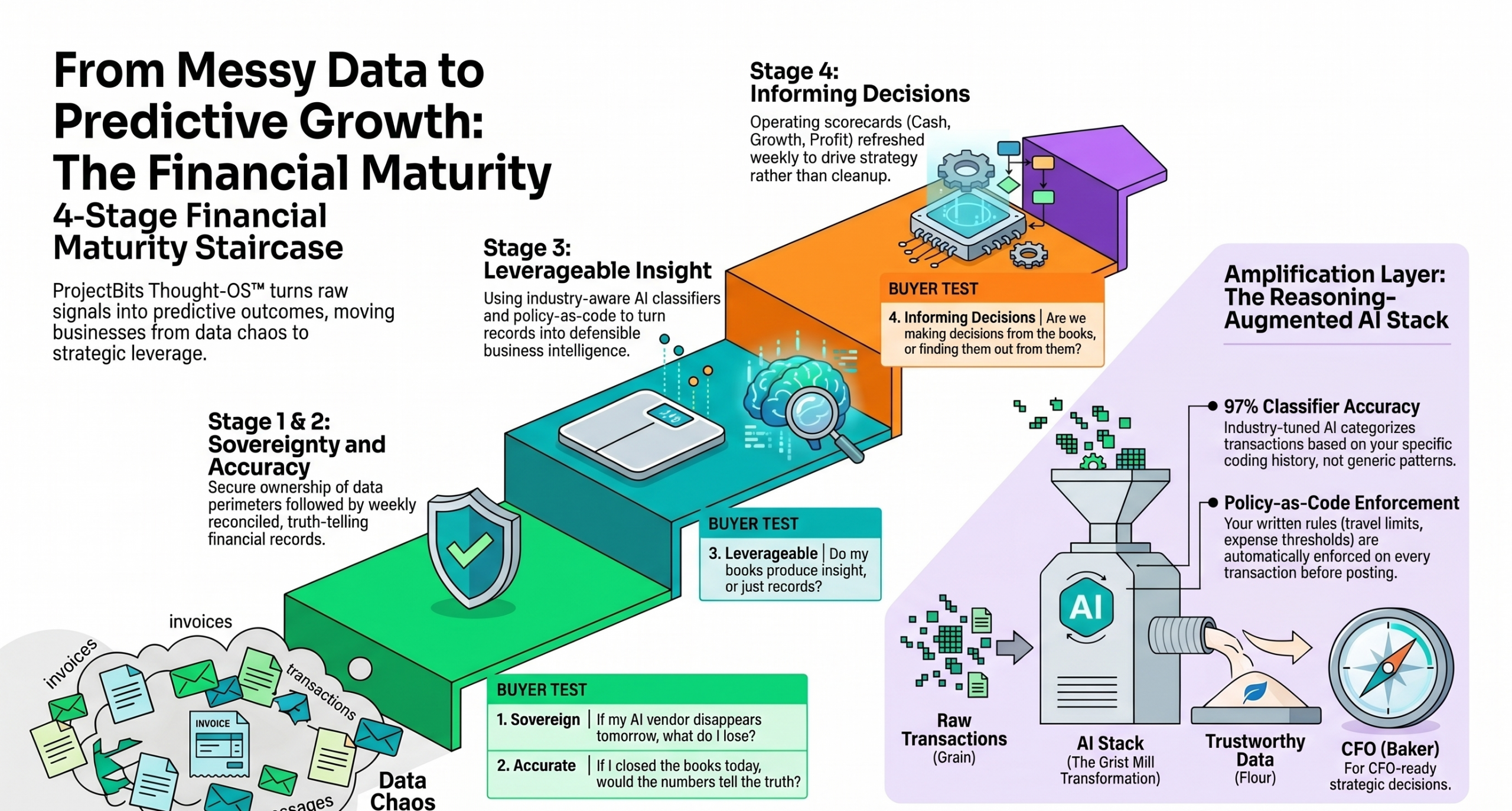
The Financial Maturity Staircase and its Amplification Layer: the reasoning-augmented stack that carries the owner’s encoded judgment — policy-as-code enforced on every transaction — so one hour of governing decisions reaches decisions the owner never personally makes.
There is no productivity technique, no hiring decision, no technology deployment, no business improvement framework that changes the number of hours available to the person who built this business. The constraint is absolute. Every owner of every owner-operated business between five hundred thousand and twenty-five million dollars in revenue works with the same fixed input. They have since the first day. They will until the last.
What changes is the ratio.
One hour of the owner’s time invested in the right place — encoding a governing decision into policy, building the framework that allows others to act with the owner’s judgment rather than their own approximation of it, designing the system that learns from each cycle and improves without requiring the owner’s continuous presence — that one hour governs hundreds of subsequent decisions. The owner’s judgment reaches situations the owner will never personally encounter. The owner’s signal — their specific ICP, their specific standards, their specific dream — is carried forward into every interaction the governing system touches.
The owner’s time is not saved. It is amplified.
That amplification is the return this paper is about. Not efficiency. Not scale. Not artificial intelligence as a category. Amplification — the specific mechanism by which the owner’s fixed time investment produces governed outcomes that compound indefinitely. And signal clarity — the discipline that ensures what gets amplified is the owner’s actual judgment rather than the organizational noise that accumulates around it when nobody has encoded the original.
One hour governing hundreds of decisions. The owner’s signal carried forward into every situation the system touches. Not saved. Amplified.
Most owner-operated businesses amplify the owner’s time already. They do it through people, through tools, through processes. The problem is not that amplification is absent. The problem is that the amplification is carrying noise as well as signal — the organizational approximation of what the owner would want, accumulated through the telephone game of management layers, inconsistent execution, and undocumented decisions that lived in someone’s head and left with them when they left.
Signal clarity is the governing discipline that ensures what the amplification carries is the original. The owner’s earned judgment. Their specific criteria. Their actual dream. Encoded with enough precision that the system can apply it consistently in the owner’s absence and improve it through each iteration.
This paper describes the governing layer that produces both. The architecture that amplifies the owner’s time and the discipline that keeps the amplified signal clear. It runs on the ProjectBits Consulting business development operations right now. Same methodology the practice builds for clients, applied first to its own operations. The receipts exist.
Nine parts. Begins with the dream — because amplification is only valuable if the signal it carries is connected to something the owner actually chose. Moves through the governing layer, the delegation learning, the continuous improvement cycle, scaling and growth, the GRC architecture, and the owner’s own development. Ends where it begins: with the owner’s time. Fixed. And with the return on that time. Not.
The Signal in the Scramble
The owner’s day produces an enormous amount of incoming signal. Calls from clients. Questions from employees. Decisions that require approval. Exceptions to processes that do not quite cover the current situation. Problems that could be handled by someone else if anyone knew what the owner would decide. Problems that genuinely require the owner’s judgment and are getting fifteen minutes when they deserve two hours.
All of it arrives at the same apparent urgency. All of it demands the same attention. The owner processes it, responds, decides, approves, redirects, explains, and begins again. The signal and the noise are indistinguishable in the stream because there is no filter. Everything that reaches the owner reaches them because the business has no mechanism to separate what requires the owner from what merely requires a decision — and in the absence of that mechanism, everything routes to the owner because the owner is the only reliable decision point in the system.
This is the signal problem underneath the time problem. The owner is not simply running out of hours. They are running out of signal-to-noise ratio. The consequential decisions — the ones that determine the direction of the business, the health of the key relationships, the strategic position against competitors — are getting the same fractured attention as the routine ones. The owner’s best judgment is being applied to forty decisions a day when it should be reserved for the four that actually require it.
The Hidden Cost
The financial cost of this condition does not appear on any statement. It is not captured in labor costs, overhead, or SG&A. It is the cost of the owner’s cognitive load — the accumulated weight of being the decision point for an entire organization — expressed in the quality of attention that reaches the decisions that deserve it most.
The strategic conversation is interrupted by the operational question. The relationship moment is cut short by the approval request. The creative thinking that would produce the next level of the business gets crowded out by the problem-solving required to keep today’s business running. Not because the owner lacks discipline. Because the system routes everything to them and they have no governing layer to route it elsewhere.
Every hour spent making a decision that should be governed by policy is an hour not invested in encoding that policy. And the decision will need to be made again next week, next month, next year — fresh, from the same starting point, consuming the same cognitive resources — because it was never encoded. The scramble is self-perpetuating. The ungoverned business requires the owner’s constant presence precisely because it has never been designed to function without it.
The scramble is not a workload problem. It is a signal architecture problem. Everything reaches the owner because nothing has been designed to reach anyone else.
The Amplification That Already Exists
Every business amplifies the owner’s time. The employee who handles client calls is amplifying the owner’s communication capacity. The process that handles recurring billing is amplifying the owner’s administrative capacity. The CRM that tracks the pipeline is amplifying the owner’s memory. Amplification is not the question. The question is what the amplification is carrying.
In an ungoverned business, the amplification carries a degraded signal. The employee handling client calls is approximating what they think the owner would say — informed by training, observation, and their own judgment about what seems right. The approximation is often close. Sometimes it is significantly wrong in ways that are invisible until a client relationship breaks. The process handling recurring billing is applying rules that were written at a specific moment and may no longer reflect the owner’s actual governing intent.
The owner, sensing this, compensates by staying involved. They check the client calls. They review the billing exceptions. They audit the CRM entries. The amplification produces outputs the owner then has to verify — which means the amplification is adding volume without reducing the owner’s involvement proportionally. It is a noise amplifier wearing the clothes of a time saver.
The governing layer changes what the amplification carries. When the owner’s judgment is encoded in policy — specific criteria, specific thresholds, specific conditions that trigger one response rather than another — the amplification carries the original signal rather than an approximation of it. The employee operating within a governing framework is not approximating. They are applying the owner’s encoded judgment. The difference is not marginal. It is the difference between a telephone game and a policy file.
The Time That Is Already Being Spent
The owner who hears the argument for building the governing layer and responds that they do not have time for it is making an accounting error.
Consider a single decision type: the ICP evaluation. Whether a new prospect is genuinely likely to become a good client is a judgment every professional services owner has developed over years of experience. They know, within the first fifteen minutes of a discovery conversation, whether the fit is real. That judgment is earned and valuable. It is also being applied manually, freshly, to every prospect that enters the pipeline.
Encoding that judgment into a governing framework takes approximately two hours the first time. Done carefully, with enough precision that the framework can be applied consistently without the owner’s involvement for clear cases. The break-even point is twelve prospects. Most professional services practices evaluate more than twelve in a month. After the break-even point, every additional prospect the framework evaluates without requiring the owner’s direct involvement is the return on the two-hour investment. The return does not depreciate. It compounds.
The Signal Architecture Question
Before asking how to save time, ask what your time is currently carrying. If the answer is forty decisions a day arriving with equal urgency, the problem is signal architecture. The governing layer is the filter that routes high-signal decisions to the owner and handles low-signal ones within policy. The owner’s time does not change. What changes is the ratio of signal to noise in what reaches them — and therefore the quality of attention available for the decisions that deserve it.
The Dream
In 1946, Masaru Ibuka set up an electronics shop in a bombed-out department store building in Tokyo. Eight engineers. A starting capital worth roughly fourteen hundred British pounds today. The company’s first product, an electric rice cooker, failed. They kept going.
His engineers experimented with ferric oxide compound, heating it in a frying pan. That produced a magnetic paste which they brushed by hand onto strips of paper. They kept refining the process until they had Japan’s first tape recorder — one hundred pounds of machine, built from improvised materials, in a country that had just lost a war.
Thirty years later, Masaru Ibuka made a personal request to Sony’s engineers. He wanted to be able to listen to music on long flights. The engineers built him what would become the Walkman — one of the most influential consumer products of the twentieth century, which eventually reached hundreds of millions of people.
The frying pan and the Walkman are the same dream. The company was the means. The sound was the point.
Ibuka was not building toward a lifestyle outcome. He was not optimizing for market share. He was building toward a specific thing he believed should exist — recorded sound that could reach people wherever they were — and he was willing to heat magnetic paste in a kitchen pan until he got it right. The dream was corrective. The world did not yet have the thing he was trying to make. He was going to make it.
That is not the story business improvement literature usually tells. The standard story is aspirational: here is where you want to go, here is the plan, here is the framework. Ibuka’s story is something more fundamental. He was not climbing toward an outcome. He was climbing away from a world where the thing he believed should exist did not yet exist. The dream was the correction.
The Three Forms of the Dream
The owner-operated businesses in the ICP for this practice — legal, medical, IT and managed services, trades — carry dreams that take three distinct forms. Understanding which form is operating in a specific owner matters because each produces a different relationship between the owner and the governing layer. The amplification serves a different signal in each case.
The Corrective Dream
The owner is building what should have existed. They watched something fail — a business, a practice, a financial relationship — that would not have failed if the governing layer had been in place. And they are building the version where it does not fail.
The physician who left a practice group because nobody could answer basic questions about where the money went. The IT services owner who lost a major client because nobody saw the margin erosion coming until it was too late. The trades company owner who watched their parent’s business close not because the work was poor but because the financial picture was invisible until the bank called. The attorney who saw a colleague lose their practice to a billing dispute that clean records would have resolved in an afternoon.
These owners are not building toward financial independence as an abstraction. They are building toward the specific version of the business where the thing they witnessed cannot happen. The governing layer is not an investment in their success. It is the structural response to an experience that has already told them exactly what an ungoverned business costs.
For these owners, signal clarity is not a methodology preference. It is the whole point. The signal that was absent — the clear financial picture, the margin visibility, the traceable audit trail — is exactly what the governing layer produces. Building it is the corrective act.
The Vindication Dream
The owner is proving something. Usually something that was told to them — implicitly or explicitly — about what they could not do, could not build, could not become.
The first-generation business owner whose family expected them to work for someone else. The woman who opened a trades company in a field where she was told the work was not for her. The owner who left a corporate environment where their ideas were called impractical, their judgment unready, their ambition inappropriate.
The business is the argument. Every year it operates successfully is a sentence in the rebuttal. For these owners, the governing layer carries a specific signal: competence. The precision of the ICP criteria, the cleanness of the financial records, the demonstrability of the methodology — these are not operational preferences. They are the evidence. The governing layer is the architecture that ensures the business cannot be dismissed as lucky or informal or dependent on the owner’s personality rather than the owner’s systems.
Signal clarity for the vindication dream owner means the business produces evidence that stands on its own. Not the owner’s charisma. The records.
The Legacy Dream
The owner is building something that outlasts them. Specific — a specific inheritance, a specific community, a specific next generation that the owner is building for. The owner who is building to hand something to their children that their children can actually operate without them. The owner who is building something a future partner or acquirer will value for what it actually is — a governed system with institutional memory — rather than for the owner’s continued presence.
For these owners, the governing layer is the transfer mechanism. The institutional capital — the encoded judgment, the decision log, the policy files, the event history — is what makes the inheritance real rather than nominal. You cannot hand someone else a business that depends entirely on your personal knowledge. You can hand them a governed system that carries that knowledge forward.
You cannot hand someone a business that depends entirely on your personal knowledge. You can hand them a governed system that carries that knowledge forward.
The Common Thread
Three different dreams. One common requirement.
In all three cases, the governing layer is not primarily about efficiency. It is about ensuring that the specific thing the dream is trying to achieve — correct the wrong, prove the point, build what lasts — is actually achievable rather than undermined by operational chaos before it gets there.
The corrective dream owner needs the governing layer because without it the thing they are correcting will recur in their own business. The vindication dream owner needs it because without it the business is not demonstrably governed — it is personality-dependent. The legacy dream owner needs it because without it there is nothing to transfer.
And in all three cases, the governing layer must carry a signal that is specific to this owner’s dream, not a generic business improvement framework. Signal clarity means the ICP criteria reflect this owner’s actual experience of who their best clients are. The decision log reflects this owner’s actual governing reasoning. The policy files reflect this owner’s actual judgment, encoded with enough precision that the system can apply it without the owner being present for every instance.
The amplification is only valuable if it is carrying the right signal. The right signal is the dream. The governing layer is what keeps them connected.
The Frying Pan Standard
Ibuka’s engineers did not have magnetic recording tape. They made it — from ferric oxide heated in a frying pan, brushed by hand onto strips of paper. The dream was specific enough to sustain that. The governing layer argument is not that building it is easy. It is that a dream specific enough to sustain the building is the only signal worth amplifying. The owner who cannot state their dream with the specificity that would let them heat paste in a frying pan for it does not yet have the signal the governing layer needs to carry.
The Governing Layer
The Financial Maturity Staircase is ProjectBits’ application of Carnegie Mellon’s Capability Maturity Model to financial operations. The CMM captured a pattern that has proven durable across domains: capability develops in stages, each stage has specific practices that must be stable before the next stage’s practices are meaningful, and skipping stages creates a deficit that eventually forces a return to the foundation.
Applied to financial operations, the Staircase has four stages. Read through the lens of signal clarity and owner amplification, each stage is not primarily a financial milestone. It is a milestone in the quality and reach of the signal the owner’s time investment produces.
The Staircase as Amplification Architecture
Stage 1 — Sovereign
Your data, your perimeter, your audit trail, portable on demand. The buyer test: if my AI vendor disappears tomorrow, what do I lose?
In amplification terms, Stage 1 is the prerequisite for any amplification worth having. An owner who does not own their data cannot encode their judgment into a governing system that belongs to the business — because the substrate that would carry that judgment belongs to someone else. The vendor’s terms of service govern. The owner’s policies do not. Stage 1 is where the owner claims the signal. The data belongs to the business. The audit trail belongs to the business. The amplification that follows is built on something the business owns, not something it rents.
Stage 2 — Accurate
Reconciled weekly, dimensionally classified, documents linked, monthly benchmark score. The buyer test: if I closed the books today, would the numbers tell the truth?
In amplification terms, Stage 2 is where the signal becomes trustworthy. An owner cannot amplify a signal they cannot trust. If the financial data is not reconciled, decisions made from it are decisions made from noise. The amplification of an inaccurate signal produces wrong outcomes at scale — confident wrong answers, consistently, by people who believe they are applying the owner’s governing judgment to data that does not reflect reality. Stage 2 is where the signal is cleaned.
Stage 3 — Leverageable
Industry-aware classification, reconciliation engine, policy-as-code, audit log capturing every AI suggestion and every human override. The buyer test: do my books produce insight, or just records?
Stage 3 is the amplification inflection point. This is where the owner’s judgment gets encoded into policy — where the implicit becomes explicit, where the knowledge that lived in the owner’s head becomes a governing rule the system can apply consistently in the owner’s absence. The audit log at Stage 3 is the signal preservation mechanism. Every suggestion and every override is captured. The governing layer does not just produce decisions. It produces a record of how decisions were made that the continuous improvement cycle can read, learn from, and use to refine the framework.
Stage 4 — Informing Decisions
A six-category operating scorecard — Cash, Growth, Delivery, Profitability, Process, Traction — refreshed weekly. The buyer test: are we making decisions from the books, or finding them out from them?
Stage 4 is the signal compounding stage. The data produces insight rather than records. The scorecard surfaces signal rather than noise. The ratio of owner involvement to governed outcomes is at its highest here. The encoding done at Stage 3 is paying dividends without requiring additional encoding investment. The signal placed at Stage 3 reaches further at Stage 4 than it did when it was first encoded. That is the amplification compounding.
The Three Tests
The Hill-Climbing Machine, Paper 7 in the reading order, introduces three tests for whether the governing foundation is present for amplification to produce governed outcomes rather than accelerated noise.
The Sovereign Control Test
Does the business own its data, its policy, and its audit trail — or is it renting them? Sophistication is not sovereignty. The signal cannot be amplified from a substrate the business does not own. The vendor can change the terms. The owner cannot change what they do not own.
The Tamper-Evident Audit Trail Test
Can the business prove what happened, when, and why — from individual transactions to governing decisions — without relying on any single person’s memory or any vendor’s continued operation? The audit trail is tamper-evident not because it is technically difficult to alter but because altering it requires simultaneously altering corroborating records across multiple systems. This is signal integrity. The amplification carries what actually happened, not what anyone wants the record to show.
The Policy-as-Code Test
Are the business’s operating rules written down in a form that can be applied consistently, enforced mechanically, and improved through evidence — or do they live in someone’s head and drift with every personnel change? Policy-as-code is the encoding discipline that ensures the signal being amplified is the owner’s actual governing judgment, not an organizational approximation that has degraded through the telephone game of management.
Fit-by-Purpose Architecture
The governing layer is only as durable as the architecture it runs on. The most consequential architectural error in SMB technology is assembly from defaults: choosing tools because they are widely used rather than because they fit the specific purpose, accepting the vendor’s data model as the governing substrate rather than building one that reflects the business’s specific governing intent.
Fit-by-purpose architecture serves the signal. It does not define it. Five properties distinguish it from assembled-from-defaults systems in the context of signal clarity and owner amplification.
Signal Purity
A system built from generic tools produces noisy signal. The event log contains everything the tools decided to log, in whatever format served the vendor’s broadest possible customer base. A fit-by-purpose system produces signal specific to the decisions the business actually makes. The vocabulary is controlled. The event types are declared. The signal is clean because the system was designed to produce clean signal — not because noise was filtered out after the fact.
Teiyu Goto, the designer who created the VAIO logo for Sony, encoded this idea in four letters. The VA forms an analog sine wave — continuous, rich, but subject to degradation as it travels. The IO represents binary code — 1 and 0. The transition from left to right, reading the logo, is the transition from signal that degrades to signal that does not. Binary does not degrade because at every transmission point the signal is classified, noise is stripped, and only the precise value passes forward.
The governing layer does the same thing to the owner’s judgment. The analog original — implicit, contextual, full of nuance that resists precise articulation — is encoded into a policy precise enough that at each decision point the signal is either within bounds or outside them, and anything ambiguous is escalated rather than approximated. The VA becomes the IO. The implicit becomes the encoded. The signal that was degrading through every layer of organizational interpretation becomes the signal that reaches every governed decision with the same precision it had when the owner stated it.
Clean signal compounds. Every analysis cycle on clean signal produces more reliable findings than the previous cycle. The governing layer gets better at its job because the input it is working with was designed to carry the owner’s signal precisely — not salvaged from a vendor’s generic output and interpreted against a framework it was never meant to serve.
Policy Coherence
When the governing policy lives in a single, authoritative location and every component calls the same policy engine, a change to the policy propagates instantly and completely. The signal the amplification carries is always coherent with the current stated intent. An assembled-from-defaults system distributes policy across tool configurations, workflow conditions, email templates, and human memory. It drifts. The amplification carries whatever each tool’s local configuration says the policy is — which may differ from what any other tool says, and almost certainly differs from what the owner actually intends.
Institutional Memory That Transfers
When governing decisions are recorded with their rationale at the moment they are made, the signal transfers with the record. A new partner, an acquiring organization, a successor owner does not need to reconstruct the governing logic from the current configuration. The decision log carries it. The signal the owner encoded two years ago is still readable, still attributable, still improvable. In an assembled system, that signal left with the person who held it.
Demonstrable Methodology
When a prospective client asks how the practice thinks about governed financial operations, the assembled-from-defaults answer is a framework description. The fit-by-purpose answer is the policy file, the event log, the decision audit trail. The methodology is not described. It is demonstrated. Signal clarity applied to the practice’s own positioning: the claim is verified by the record, not supported by the presentation.
Informative Failure
In an assembled system, failure produces an error from the tool that broke. The signal of what happened — which decision was made, on what basis, within what governing context — is absent. In a fit-by-purpose system, every failure produces a classified signal: here is what happened, here is the governing rule that applied, here is whether this was a process design problem or an execution problem. Failure is not a support ticket. It is a data point in the continuous improvement cycle. The signal of the failure improves the governing layer.
The Delegation Learning
The governing layer is architecture. It does not govern itself. It requires the owner to have developed specific human capabilities before it can function as designed. And the most important of those capabilities is the one most business improvement frameworks address least honestly: the ability to delegate with accountability.
The phrase has been heard in three distinct forms by owners who have tried each. Delegation with strings. Delegation without strings. Delegation with accountability. The governing layer makes the third possible. The first two are why most owners conclude, before they have tried the third, that they cannot delegate at all.
The Delegation Spectrum
Delegation With Strings
Assignment with supervision. The owner hands off the task but retains the decision authority, the approval gate, the final review. The employee does the work. The owner verifies, corrects, approves. Owner time consumption drops marginally. The employee’s capability does not develop because they are never trusted with the full decision. The owner remains the governance system, one step removed. The string is doing governance work. It is the only governance mechanism in place. Remove it and the governance disappears.
Delegation Without Strings
What most business books advocate. Trust your people. Get out of the way. The advice fails in practice not because the principle is wrong but because it ignores the prerequisite: the person receiving the delegation needs a governing framework to replace the strings. Without strings and without a framework, the delegation produces inconsistent outcomes, builds resentment when things go wrong, and returns to the owner. The failure is misattributed. The problem was not the person. The problem was that the string was the governance, and when the string was removed, the governance went with it.
Delegation With Accountability
The owner delegates the task and the decision authority within a governing framework. The framework replaces the strings. Accountability is to the framework — specific criteria, specific thresholds, specific conditions that trigger escalation — not to the owner’s personal oversight of each output. The owner’s involvement is reserved for decisions outside the framework’s scope. This is what the harness positions are, expressed in human terms. Above the Loop is the owner. On the Loop is the governed employee. The governing framework is what makes the position difference real rather than aspirational.
Delegation with accountability requires a governing framework the delegatee can navigate by. Without it, accountability has no instrument panel — which means it has no mechanism and no meaning.
The Four Learnings
The owner who attempts delegation with accountability without having done specific internal work fails. Not because their people are incapable. Because the owner has not developed the capabilities effective delegation requires. There are four, and they are sequential.
Making Implicit Judgment Explicit
The owner who has run their business for ten years has accumulated judgment they experience as intuition. It is real and earned. It is also implicit — built from thousands of decisions whose reasoning was never captured. It lives in pattern recognition, not in policy. It cannot be delegated as intuition. It can only be delegated after it has been made explicit.
When the owner answers ‘the revenue floor is five hundred thousand dollars,’ they are discovering that they have always had a revenue floor — they just never stated it. When the owner answers ‘we do not serve nonprofits,’ they are discovering a disqualifying condition that has been operating silently in their evaluations for years. The act of articulating the judgment is the act of discovering that the judgment exists in a form that can be governed.
The governance intake interview — the structured conversation that precedes any governing system build — is this process made concrete. The most important investment of the owner’s time in the entire initiative. Not because it produces a document. Because it develops the owner’s capacity to express their governing judgment with enough precision that someone or something other than the owner can apply it.
Tolerating Variance Without Intervening
When a delegated decision comes back differently than the owner would have made it — not wrong, just different — the owner’s instinct is to correct it. This instinct destroys delegation. The employee learns their judgment is wrong by default. They stop exercising judgment and start approximating what they think the owner would want. Delegation with accountability becomes delegation with invisible strings: the owner gets none of the benefit of delegation and all of the friction of management.
The governing layer helps with this distinction. When a decision was made within the framework and produced a result within acceptable bounds, the owner’s role is to assess whether the framework needs updating — not correct the output to match personal preference. The question is not ‘why did they not do it my way?’ The question is ‘does the framework need to be more precise, or did the framework perform as intended and produce a result I would not have personally chosen but that serves the business’s governing intent?’ That distinction is the second learning. It is also the second most important signal clarity discipline.
Building the Delegatee’s Capability
Delegation with accountability is a relationship over time in which the delegatee’s capability develops and the owner progressively reduces involvement as trust is established. This requires the owner to help the delegatee understand not just what the framework says but why it is designed the way it is — what the governing principles are, how to handle situations the framework does not cover.
The goal is a delegatee who can extend the framework, not merely execute within it. Carnegie Mellon’s Capability Maturity Model captures this progression. At Level 1, capability depends on individuals. Remove the person and the capability disappears. At Level 5, the organization learns continuously and capability is institutional. The delegation learning is the human dimension of that progression.
Accountability Without Punishment
When something goes wrong — when a delegated decision made within the framework produces a bad outcome — the owner’s response determines whether delegation with accountability is sustainable.
The punitive response converts failure into a signal that stops being produced. The delegatee learns that accountability means punishment when things go wrong. They stop exercising judgment. The strings return, invisible and stronger than before.
The diagnostic response treats failure as signal. Was this a framework failure — the policy produced the wrong guidance — or an execution failure — the framework was correct but not followed? If framework failure, update the framework and record the rationale. If execution failure, address the specific gap in capability. In either case, the failure is information that improves the governing layer. Signal clarity applied to failure: every bad outcome is an input to the system, not a verdict about a person.
The Organizational Transformation
The owner who has done the delegation learning is simultaneously producing an organizational transformation. The explicit policies, the accountability frameworks, the diagnostic approach to failure — these are the infrastructure for an organization that operates from its governing system rather than from its proximity to the owner.
The owner’s judgment does not disappear in this organization. It becomes institutional. The ICP criteria the owner encoded from ten years of pattern recognition govern every prospect evaluation, with or without the owner present. The scope boundaries the owner declared govern every employee consistently, without requiring the owner to restate them for each new situation. The signal the owner placed in the governing system at encoding time reaches forward indefinitely, carried by the framework, improved through each iteration, applied consistently in situations the owner will never personally encounter. The owner’s time was invested once. The amplification continues.
The Continuous Improvement Cycle
The governing layer is not built once and operated. It is built in iterations, each one informed by what the previous iteration revealed. The owner’s governing judgment cannot be fully expressed before it encounters the situations it needs to govern. Some of what the owner knows about their business only becomes articulable when the governing framework attempts to handle a specific case and handles it incorrectly. The signal the owner places in the governing layer at encoding time is as precise as the owner can make it at that moment. It is not as precise as the governing layer will eventually need to be. The continuous improvement cycle is what closes that gap.
The Sprint as Survival Strategy
The owner who is deep in the scramble cannot commit to a transformation project. Transformation projects require sustained attention over extended periods. Sustained attention is exactly the resource the scramble consumes. What the owner in the scramble can commit to is two weeks and one decision.
Not the complete governing layer. One governing decision, encoded into a framework, operated for two weeks, assessed. At the end of two weeks: did the framework fire correctly? Did the owner trust the outcomes? What did the owner learn about their own implicit judgment from the act of making it explicit? What would they do differently in the next encoding?
That is the first sprint. That is the first data point in the continuous improvement cycle. The scramble funded it. The two-week experiment returned something — one encoded decision, one learning, one small reduction in the decisions that require the owner’s involvement. The second sprint is funded by the same scramble, but the scramble is marginally smaller. The improvement is incremental. It is also relentless.
The scramble funds the improvement. The improvement reduces the scramble. Each sprint cycle makes the next sprint cycle slightly easier. The governing layer does not wait for the scramble to end. It reduces the scramble while running within it.
Signal Classification: The Process Miner
In the governing system built for the ProjectBits business development pipeline — the first live application of the Paper 9 framework — the Process Miner is the analytical tool that watches what actually happened and compares it to what was supposed to happen. It reads the event log, reconstructs the sequence of steps each contact went through, and identifies where the sequence deviated from the intended path.
When it finds a deviation, it asks one question: is this because the process design is wrong, or because someone or something did not follow the process correctly?
That classification is the most important analytical service in the governing layer. Not because the right answer is always obvious. But because the wrong intervention applied to the wrong classification makes things worse. Tightening execution discipline when the process design is the problem produces more consistent wrong outcomes. Redesigning the process when the execution is the problem produces a new design that will be executed just as inconsistently as the old one.
Peter Senge’s distinction between single-loop and double-loop learning captures the same insight. Single-loop learning corrects errors within the existing framework. Double-loop learning questions the framework itself. Most organizations only do single-loop learning — they correct errors and move on. The Process Miner is a double-loop learning mechanism built into the infrastructure. It forces the question of whether the framework is right, not just whether the execution was right. Signal classification as organizational practice.
Kaizen: Encoding the Learning
Kaizen says improvement is a daily practice — small, incremental, embedded in how the work is done rather than adjacent to it. Most businesses treat improvement episodically. Something goes wrong. They fix it. They move on. The fix is not encoded. The next time the same class of problem arises, they fix it again from the same starting point.
The governing layer makes Kaizen possible at the SMB scale. When the Process Miner identifies a process design problem, and the owner updates the governing policy, and that update is recorded in the decision log with the rationale, and the update propagates to every subsequent situation the policy governs — that is Kaizen applied to the governing layer. A small improvement, captured, encoded, applied consistently going forward. Not a project. A practice. The accumulation of those small encoded improvements is what produces the compounding advantage: hundreds of signal refinements that make the governing layer progressively more precise at carrying the owner’s actual intent.
The Sprint Review as Direction Check
The sprint review is not just ‘did the system perform as expected?’ It is ‘are we still building toward the right thing?’ That is the question the scramble permanently defers and the sprint cadence creates space to ask.
What did the system do that it should not have done — signaling a framework that needs updating? What did the system fail to do that it should have done — signaling a gap in governing coverage? And has anything changed about the direction the governing layer is supposed to carry — the dream alignment check?
The third question is the one most sprint frameworks omit. It is the most important. The business executing well against a direction that has quietly become wrong is applying excellent signal amplification to the wrong signal. Ibuka’s engineers could refine the magnetic paste indefinitely. At some point the question has to be asked: is this still what we are trying to make? The sprint review is when the owner steps back far enough to verify that the signal being amplified is still the right one.
Scaling, Growth, and the GRC Foundation
The amplification argument so far has been about the individual owner’s relationship to their fixed time. At the scale of the owner-operated business as an institution — a system that is supposed to outlast any particular set of people — the amplification argument becomes something more fundamental. An ungoverned business does not scale. It replicates the owner’s involvement at every level of growth, until the owner runs out of hours.
Why Ungoverned Businesses Hit the Ceiling
Every decision of consequence in an ungoverned business routes through the owner because the owner is the governance system. More clients means more decisions. More employees means more approvals. More revenue means more complexity. Every dimension of growth adds to the decision load routed to the owner. The owner’s hours do not grow with the business. The ceiling arrives when the growth of decision load meets the fixed constraint of owner time.
The governing layer breaks that linearity. When decisions are governed by policy rather than by the owner’s presence, the number of decisions requiring owner involvement grows much more slowly than revenue. The owner’s time is decoupled from the business’s operational volume. That decoupling is what scaling actually requires — not better software, not more headcount, not more sophisticated tools. The governing layer that allows the business to process more decisions without routing them through the owner.
The Amplification Ratio at Scale
The amplification ratio — governed decisions produced per hour of owner time invested — is the metric that determines whether a business can scale. In an ungoverned business the ratio approaches one: each decision requires approximately as much owner involvement as it would have required the owner to make personally. In a governed business at Stage 3, the encoded ICP policy handles clear cases without the owner. The encoded confidence thresholds govern which decisions escalate. The owner’s time investment at encoding produced a policy that handles volume that would otherwise have required hundreds of individual owner decisions.
At Stage 4, the ratio improves further because the governing layer has been refined through multiple sprint cycles. The initial encoding was the owner’s best approximation. The current encoding reflects ten or twenty sprint cycles of Process Miner findings and owner decisions recorded with their rationale. The signal is cleaner. The policy is more precise. The amplification ratio is higher.
Growth Forms That Require the Governing Layer
New Service Lines
A governed business can add a service line because the governing infrastructure exists to extend. Tax Ready Bookkeeping and the CFO Operating System are not two separate service lines that happen to be offered by the same practice. They are two stages of the same governed infrastructure, designed from the beginning to support the client’s progression from one to the other. The amplification architecture was built into the foundation. The new service line did not require a new governing layer. It required the existing governing layer to be extended.
Geographic Expansion
An ungoverned business is geographically constrained by the owner’s presence. The governing layer removes that constraint. When decisions are governed by policy rather than by presence, the encoded ICP criteria govern prospect evaluations in any geography. The encoded partner classification governs partner assignments anywhere. The policy carries the owner’s signal into markets the owner has never visited.
Partnership, Acquisition, and Succession
A governed business is acquirable, mergeable, and inheritable in ways an ungoverned business is not. The acquiring organization can audit the governing layer — the policy files, the event log, the decision audit trail — and understand how the business actually operates. The signal the owner encoded over years of governing decisions is legible to a future owner who was not present for any of those decisions.
The question that kills most SMB acquisition conversations is what happens to the business when the owner leaves. The honest answer for an ungoverned business: it depends entirely on who follows. The honest answer for a governed business: the governing layer continues to function. The encoded policy continues to govern decisions. The institutional memory continues to inform them. The signal transfers. The amplification continues.
GRC as Architecture
Governance, Risk, and Compliance — GRC — is a framework that large enterprises implement through dedicated departments. For the owner-operated business at five hundred thousand to twenty-five million dollars in revenue, GRC is effectively absent — not because the owner does not care, but because every GRC framework ever written was designed for an organization with the resources to treat GRC as a separate function.
The governing layer described in this paper is GRC built into the operating system rather than layered on top of it. Not a compliance report — a compliance infrastructure. Not a risk register — a risk control architecture. Not a governance policy — a governance enforcement mechanism. GRC that governs rather than GRC that reports. The distinction is between telling you what happened after the fact and determining what can happen before it does.
The three-career institutional thesis behind this methodology was learned in three contexts where GRC frameworks existed but were not implemented, or were implemented correctly but enforced only in documentation. The pattern was consistent: the compliance report said one thing. What actually happened said another. The gap between them was where the risk lived. The governing layer is designed so that gap cannot exist — because the governance is not a report of what happened but a constraint on what can happen.
The Three Risk Categories
Relationship risk: the risk that an automated action damages a client or partner relationship before human judgment can intervene. The governing layer addresses this through harness positioning — every action touching an established relationship requires human review. The signal of the relationship’s importance reaches the human before the action does.
Data risk: the risk that data is mishandled or used beyond its intended scope. The policy-as-code layer addresses this through explicit data governance rules enforced at the point of processing. The signal of what is permissible reaches the system before the data does.
Model risk: the risk that AI makes a systematically wrong decision that human review does not catch. The Process Miner’s signal classification — distinguishing process design problems from execution problems — is a model risk control. It detects when the system is producing consistent deviations from intended behavior. The signal of systematic wrongness reaches the governing layer early enough to correct it.
Compliance as Byproduct
A properly governed financial operating system produces compliance artifacts as a natural output of normal operation. The reconciliation is current because the governing layer requires it. The audit trail is complete because every action is logged. The documentation is attached because the workflow requires it. The compliance artifacts are not produced for the compliance requirement. They are produced for the governing layer. The compliance requirement happens to be satisfied by the same production. Compliance as byproduct — integrated into the governing layer rather than imposed on top of it.
The Convergence
The three concerns most organizations treat as separate disciplines — governance, security, and identity — converge at the layer where the governing framework meets the systems it governs. This convergence is not a technical matter. It is the key to understanding why governing layers that look complete on paper fail in practice, and why the amplification they are supposed to produce carries noise rather than signal.
Governance without identity verification produces a record that cannot be trusted. Any process with access to the audit trail can write ‘decision made by owner’ without the owner having made the decision. The signal the audit trail is supposed to carry — the owner’s actual governing judgment — is indistinguishable from a forgery.
Governance without security enforcement produces a policy that can be bypassed. The governing policy can state that a contact may not be culled without the owner’s explicit approval. If the system evaluating that policy can be reached by an unauthorized process, the policy is advisory rather than enforced. Advisory policies produce documentation. Enforced policies produce governance.
Security without governance context is a perimeter that does not know what it is protecting or why. It will correctly block unauthorized access and have no basis for evaluating whether authorized access is being used to serve the governing intent or to circumvent it.
These three concerns are the same concern expressed at different layers of the governing stack. Every action in the system must be attributable, bounded by policy, and resistant to forgery. Identity addresses attributability. Security addresses policy enforcement. Governance provides the policy and the audit trail that makes both meaningful. Remove any one and the signal the governing layer is supposed to carry becomes untrustworthy.
Signal Integrity in Practice
Credentials — API keys, authentication tokens — are not stored in code or configuration files that any process can read. They are stored in a secrets management system, retrieved at runtime by authorized processes only. This is not primarily a security practice. It is a signal integrity practice. When credentials are centrally managed and access is audited, the governing record can answer: which process accessed which credential at what time, and was that access authorized? Without central credential management, that question has no answer. A governing record with an unanswerable question about credential access has a gap in its signal.
Human authentication follows the same principle. When the governing system requires the owner’s approval for a consequential decision, the mechanism confirming the owner’s identity must be resistant to forgery. A hardware authentication token — a physical device that must be present for authentication to succeed — provides identity assurance the governance record can rely on. The record says the owner approved this decision. The hardware token makes that statement carry the full weight of the owner’s actual, deliberate action. Signal integrity at the authentication layer is signal integrity throughout the governing layer.
None of this requires an enterprise security department. It requires decisions about how the governing layer is built, made at the time of building rather than retrofitted after a failure. The vendor’s generic configuration optimizes for the broadest possible customer base. The deliberate configuration optimizes for the specific governing intent of this business, this owner, this dream. The difference is signal purity.
The Practice as Its Own First Client
Everything in this paper has been argued from principle. This section is argued from receipts.
The receipts standard at ProjectBits Consulting states that every capability claim must cite verifiable evidence. A production system. A simulated-data demonstration. A dated measurement with a before and an after. If the evidence does not exist, the claim does not ship.
The claim this paper makes is that the governing layer produces signal clarity and owner amplification — that it carries the owner’s signal forward at scale, improves through each iteration, and produces governed outcomes that compound indefinitely without requiring the owner’s continuous presence. The receipt is the practice’s own business development operations.
What the Governing Layer Looks Like in Production
The business development pipeline for the practice is governed by a policy file. The ICP criteria — the specific revenue range, employee count, industry vertical, technology stack, and geographic market that characterize the ideal client — are encoded in that file. When a new contact enters the pipeline, from a chamber event or a partner referral or a business card scanned at an evening function, the policy file governs the initial evaluation. Not the owner’s recollection of whether the contact seems like a good fit. The policy.
Every step in the pipeline produces an event in a unified event log. The card extracted from a chamber event, the enrichment data retrieved from the Apollo database, the ICP policy evaluation and its result, the confidence level that determined whether the outcome was automatic or required human review, the human decision if review was required, the rationale the owner provided when making that decision. Every step. Every contact. Every time.
The Product Owner decision log — separate from the event log — records every governing decision the practice’s owner has made about how the system should behave. The revenue floor adjustment made after two months of operation when the data showed that the original threshold was producing too many false negatives. The partner type classification added when a category of referral partner not anticipated in the original policy began producing high-quality referrals. The confidence threshold adjustment that reduced the volume of contacts requiring human review without meaningfully reducing the quality of outcomes. Every adjustment, dated, with the rationale that produced it.
The Process Miner runs on a regular sprint cadence. Its findings are classified as process design problems or execution problems before any response is formulated. The sprint review assesses both. The Gap Router puts the classified findings in front of the owner for decision. The owner’s decisions are recorded. The governing layer improves.
This is not a description of a planned system. It is the current operating state of the practice’s own business development operations.
The Self-Demonstration Claim
When a prospective client asks how the practice thinks about AI governance in their financial operations, the answer is not a framework slide. It is: here is the policy file that governs our own business development decisions. Here is the event log from our own pipeline, with every step traceable to the policy rule that governed it. Here is the decision log showing how the governing criteria were adjusted over time and why. Here is the Process Miner’s most recent finding and what it revealed.
The methodology is not described. It is demonstrated. The practice is its own first client, and the receipts from that engagement are the evidence that the methodology does what it claims.
The practice is its own first client. The receipts from that engagement are the evidence. Not the presentation — the record.
This is the claim that almost no professional services practice in the fractional CFO market can make. Not because the methodology is inaccessible. Because making the claim requires operating the methodology on your own business first. ProjectBits made that investment. The records exist. Signal clarity applied to the practice’s own positioning: the claim is only as strong as the record that supports it. The record exists.
The Owner’s Development
There is a return on the governing layer that does not appear in any financial model and is not captured in the amplification ratio. It is the development of the owner.
Most business improvement frameworks treat the owner as a constant. The business improves. The owner implements the improvements. The owner’s role is to execute the methodology faithfully and measure the results. The owner, in this framing, is the mechanism through which the business improves. The owner does not themselves improve through the process.
This framing is wrong in a specific and important way. The owner who has run twenty sprint cycles, made two hundred governing decisions recorded with their rationale, reviewed ten Process Miner reports and classified their findings, updated the governing policy six times based on what the data revealed, and developed the capability to delegate with accountability to people who now operate within a governing framework the owner built — that owner is not the same person who answered the governance intake interview at the initiative’s beginning.
What the Development Looks Like
The owner who completes the governance intake interview discovers things about their own decision-making they did not know before attempting to articulate it. The judgment that felt like intuition reveals itself to have structure — specific criteria, specific thresholds, specific conditions that trigger one response rather than another. That structure, now visible, can be refined, extended, and shared.
The owner who reviews the first Process Miner report discovers the difference between a system that tells you what happened and a system that asks what you want to do about it. The first report is usually humbling. The intended process and the actual process have more distance between them than the owner expected. The humbling is productive — it reveals where the governing framework’s assumptions were wrong, which is information the owner could not have obtained any other way.
The owner who has overridden thirty agent recommendations, each time logging the reason, and who reads those thirty reasons at the end of a sprint cycle — that owner sees their own decision-making patterns in a form no other mechanism produces. They see which overrides corrected genuine policy errors and which ones were personal preferences the policy was right to hold firm against. They see which types of situations consistently produce override, revealing either that the policy for those situations is wrong or that the owner’s pattern is worth encoding as a refinement.
The decision log is a learning journal. The sprint review is a reflection practice. The Process Miner is a mirror. Together they constitute a development program for strategic leadership that no external training can replicate — because the development is produced by the owner’s actual governing decisions in their actual business, not by hypothetical cases in a classroom.
The Signal That Compounds
The owner who has been governing a learning system for two years can read signal that their earlier self could not. They have developed the capacity to distinguish between a deviation that reveals a process design problem and a deviation that reveals an execution problem — and to make that distinction quickly, from the Process Miner’s output, without reconstructing the context of every individual decision. That capacity took two years of real governing decisions to develop. It cannot be shortcut.
The decision log is the evidence of this development. The owner who reads their governing decisions from two years ago and finds some of them embarrassingly imprecise has grown. The governing decisions made today reflect a more accurate model of the business, the market, and the owner’s capabilities and preferences than were available at the journey’s beginning. The signal the owner is now capable of encoding is cleaner, more precise, and more reliably connected to the actual dream.
That capacity — the ability to encode a clean signal — is itself an asset. The owner who has developed it can build a new governing layer faster than they built the first one. The second initiative takes less time than the first. The third takes less time than the second. The owner’s development compounds in the governing layer through each initiative that requires it.
The Dream, Refined
The dream that initiated the journey is not always the dream that completes it. The corrective dream owner arrives at Stage 4 and discovers the business is producing something more capable than the original correction required. The corrective act produced something generative. The vindication dream owner arrives at Stage 4 and discovers the proof is complete, and the next question is what to do with the capability the proof produced. The legacy dream owner arrives at Stage 4 and discovers the thing they built is more transferable than expected, and the people developed through the delegation learning are more capable than the original legacy dream required.
These evolutions are not failures of the original dream. They are the natural consequence of the owner becoming more capable through the act of building and governing something deliberately. The dream that initiated the journey was the best articulation available at that moment. The dream that emerges from the journey is better informed — because the governing layer produced the information that informed it, and the owner developed the capacity to read that information and act on it.
The signal is cleaner at the end of the journey than it was at the beginning. The amplification is more precise. The return per unit of owner time invested is higher. And the owner is more capable of encoding the signal that the next governing layer will carry — which means the next journey begins from a better starting point than this one did.
The Ratio
The owner’s time is fixed. That has been true since the first day of the business and will be true on the last. No framework changes it. No technology changes it. No hiring decision, no partnership, no investment changes the number of hours available to the person who built this thing.
What changes is what those hours produce.
One hour encoding a governing decision into policy produces the output of many hours of governed operation. The ratio is not one to one. It never was. The question was always whether the encoding was happening deliberately — whether the owner’s signal was being placed in the governing layer with enough precision to carry the right thing forward — or whether the amplification was running on whatever accumulated in the absence of deliberate encoding.
Noise amplified at scale is still noise. The scramble managed more efficiently is still the scramble.
The governing layer is the encoding discipline. It is the architecture that ensures what gets amplified is the owner’s actual signal — their specific ICP, their specific standards, their specific dream — not the organizational approximation of it that accumulates when nobody has made the implicit explicit. Signal clarity is not a feature of the governing layer. It is the governing layer’s purpose. Everything else — the sovereignty, the accuracy, the policy-as-code, the audit trail, the continuous improvement cycle — exists in service of that purpose.
And the amplification is not a technology claim. It is a design claim. A system designed to carry the owner’s signal forward into every situation it touches, improving through each iteration, reaching decisions the owner will never personally make with the accuracy the owner would bring if they were present — that is the design. The technology is the means. The signal is the point.
Signal clarity. Owner amplification. The ratio is the return. The dream is the direction. The governing layer is what keeps them connected.
Masaru Ibuka heated ferric oxide in a frying pan. He brushed the paste by hand onto strips of paper. He refined the process until it worked. The dream was specific enough — sound, recorded, reaching people wherever they are — that he was willing to do the work until the encoding was right.
Thirty years later, the encoding was precise enough to produce the Walkman. The same dream. A better encoding. A higher ratio. More people reached per unit of effort than the frying pan could have produced, or the first tape recorder, or any of the intermediate forms between the paste and the pocket-sized player that reached hundreds of millions of people.
The owner’s time is fixed. The encoding is not. Each sprint makes it more precise. Each iteration carries the signal further. Each improvement in the governing layer increases the ratio of governed outcomes to owner hours invested.
That is the return this paper is about. Not efficiency. Not scale. Not artificial intelligence as a category. The ratio. The specific, measurable, compounding return on the deliberate encoding of the owner’s signal into a governing layer designed to carry it forward.
Start with one decision. Two weeks. Encode it. Assess the result. Learn from what the encoding revealed. Run the next sprint.
The ratio improves. The signal gets cleaner. The amplification carries further. And the dream — the specific, personal, corrective, vindicating, legacy-building thing the owner is climbing toward — stays in sight, guided by the instrument panel the governing layer provides, for as long as the owner chooses to build.
This paper is the tenth in the ProjectBits reading order. Read the series in order at projectbits.com/method. It builds directly on The Managed Initiative (the governance capstone) and The Third Perspective (the human discipline behind the harness), and grounds its claims in the first live application of that governance — the ProjectBits business development pipeline.
ProjectBits Consulting · projectbits.com/method · Reston, VA. Tax Ready Bookkeeping™, CFO Operating System™, Financial Maturity Staircase™, and Thought-OS™ are trademarks of ProjectBits Consulting, Inc. This paper is published for practitioner and client education.