
~13 minute read
Which Financial Persona Is Running Your Business?
A ProjectBits Thought-OS™ Recognition Paper — Paper Zero
Our advice
Start with Paper Zero — find yourself first.
Before the frameworks land the way they’re meant to, see which of the five financial personas is running your business today — Which Financial Persona Is Running Your Business? is the recognition on-ramp: find yourself first, then read on. From there, The Two Perspectives names the disciplines — knowledge governance and operational data integration — that determine whether AI produces operating intelligence or expensive theater. The papers below build from that diagnosis to the lab result that tests it.
Reading order
- ★ Which Financial Persona Is Running Your Business? — find yourself first, then read on. ~13 minutes.
- The Two Perspectives — the AI-readiness diagnostic. ~16 minutes.
- Tax Ready Bookkeeping + The AI Stack — the bookkeeping-specific application. ~29 minutes.
- The CFO Operating System — the Stage-4 advisory layer; what clean books are for. ~15 minutes.
- ProjectBits Thought-OS™ — the full methodology umbrella. ~9 minutes.
- AI Debt: The Tax on Small Business — the cost of deploying AI without naming the decisions first. ~22 minutes.
- The Five Questions Test — the lab result: why clean books beat AI infrastructure. ~22 minutes.
- The Hill-Climbing Machine — the ecosystem view: what Satya Nadella got right, and the SMB foundation he skipped. ~20 minutes.
- The Third Perspective — People, Preparation & Readiness; the human discipline behind the harness, for change-management professionals. ~30 minutes.
- The Managed Initiative — the governance capstone: run an AI initiative the way product teams run products, translated for the $5M–$25M owner. ~30 minutes.
- Signal Clarity. Owner Amplification. — the owner’s time is fixed; the return on it is not. The governing layer that amplifies the owner’s judgment, proven on the practice’s own pipeline. ~28 minutes.
Bottom line up front: Most owners already know something is off with how their business handles money. They just haven’t had language for it. This paper gives you that language — five recognizable positions on a spectrum that every owner-operated business sits somewhere on. Start here: find yourself first, then read on.
Before the Framework, There Is the Tuesday
Think about last Tuesday. Not the one you planned — the one that actually happened.
Maybe it was the day you got off a job site and noticed three voicemails from vendors you thought were paid. Or the one where your bookkeeper sent a spreadsheet you didn’t open because you already had three fires and a proposal due. Or the one where you looked at the bank balance on your phone and genuinely could not tell whether that number was good or bad for where you were in the month.
Or maybe your Tuesday looked different. Maybe you knew exactly where your cash stood. But you also knew that if you were out of the office for two weeks, the person handling your AP would call you seventeen times because nothing moves without your specific approval — and you’ve never quite figured out how to change that without losing control of what goes out the door.
Neither of those Tuesdays is a failure. Both of them are signals. Signals that your business has reached a size and complexity where the financial operating system it started with — the one you built while you were also building the business — no longer fits the business you actually have.
That mismatch is not a bookkeeping problem. It is a maturity problem. And it has a map.
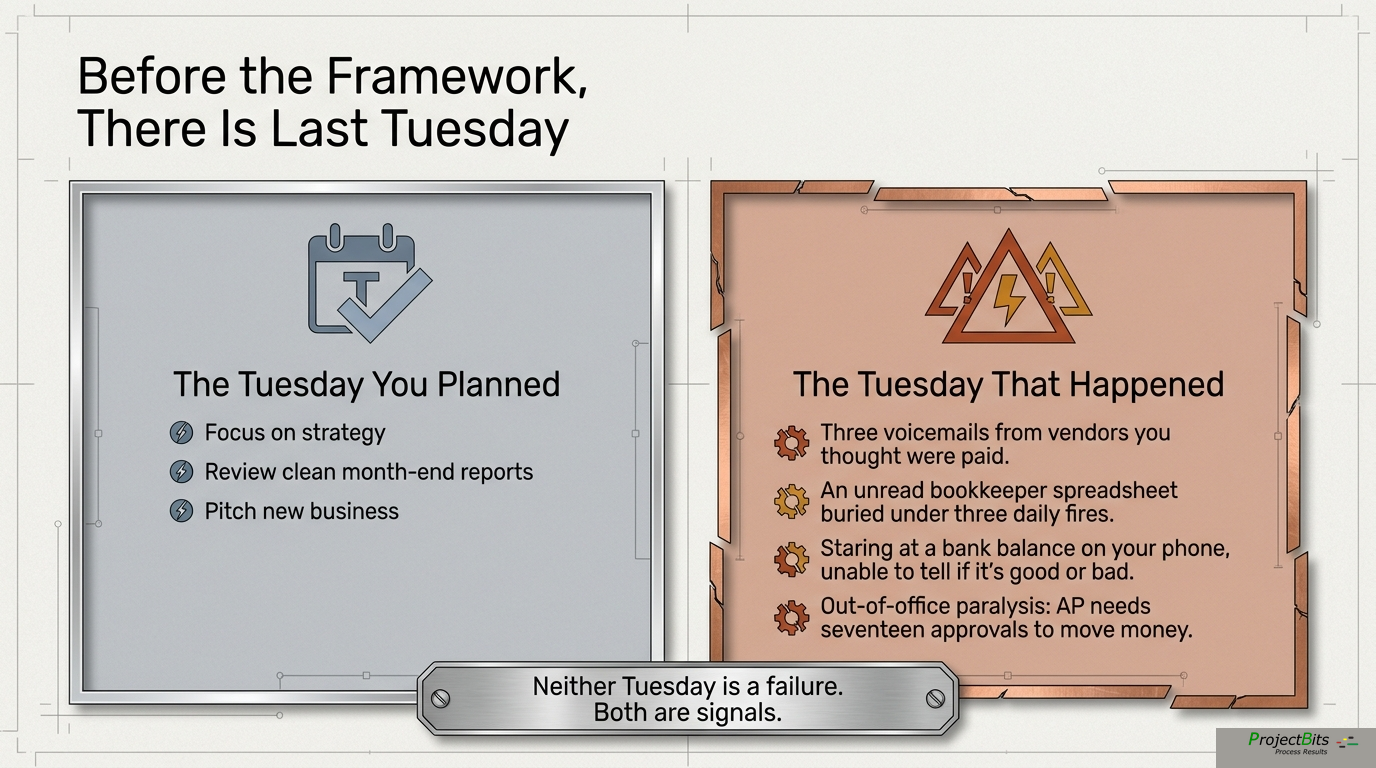
The Tuesday you planned versus the Tuesday that happened. Neither is a failure — both are signals.
Five Positions on the Spectrum
Every owner-operated business in the $500K to $25M range sits somewhere on a spectrum between two recognizable poles. Most sit somewhere in the middle — with Leia-like financial instincts in some domains and Luke-like blind spots in others.
Neither end of the spectrum is a character judgment. One is a starting point. The other is a destination. Both are normal places to be. What matters is knowing where you are — because that determines what comes next.
These five positions are the owner-facing side of the Financial Maturity Staircase — the recognition layer. You meet yourself here as a position; you climb from here as a stair. This paper is about the first part: finding yourself. The climb comes after.
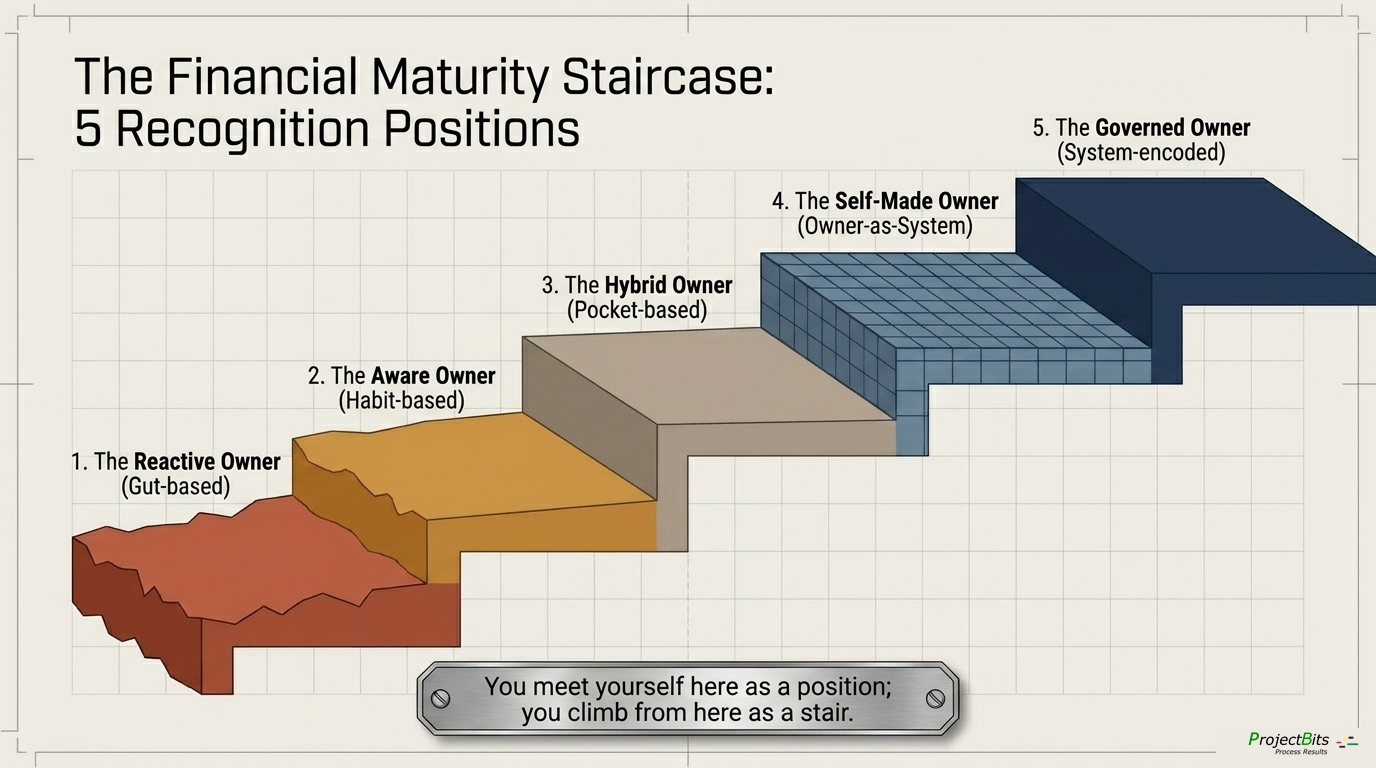
The Financial Maturity Staircase: five recognition positions, from the Reactive Owner to the Governed Owner. You meet yourself here as a position; you climb from here as a stair.
Position 1 — The Reactive Owner
What it looks like on Tuesday: You check your bank balance when something feels wrong. Invoices get approved when vendors follow up. Receipts get collected when your bookkeeper asks. Month-end close is something that happens to you, usually with a few surprises. When your CPA calls in October, you brace yourself.
Where the financial wisdom lives: In your gut, in your memory, and in whoever has been with you longest. There is no written system. There are processes — but they live in people’s heads, not on paper. If your office manager left tomorrow, something important would leave with her.
What this costs you: Time. Every financial question routes to you because there is no system that answers without you. Cash surprises happen because there is no forward visibility. Tax season is expensive because the books were never quite right all year.
The next rung from here: You stop being surprised by your own financial position. Your books close clean every month. You know what you have without calling anyone.
Position 2 — The Aware Owner
What it looks like on Tuesday: You check your balance most mornings — not always, but usually. You know roughly where your cash is. You approve invoices when they arrive but you’re occasionally behind. Receipts are mostly captured. Your books are usually close, though there’s always some cleanup before the accountant sees them. You’ve been surprised by your cash position in the last six months — once or twice, nothing catastrophic.
Where the financial wisdom lives: In your habits, mostly. You’ve developed instincts through experience — sometimes painful experience. But those instincts live in you, not in a system. When you’re traveling, the financial picture gets fuzzy. When you’re focused on a big client, the routine slips.
What this costs you: Inconsistency. Good months and chaotic months are determined partly by your attention and partly by luck. You can see the gap between what your financial operations could be and what they actually are — but you haven’t had a clear picture of how to close it.
The next rung from here: Your financial habits become system habits. The discipline you’ve built personally gets embedded in how the business runs — so it works whether you’re paying full attention or not.
Position 3 — The Hybrid Owner
What it looks like on Tuesday: You are strong in the financial domains your business model forced you to master. If you’re in IT services, you know your MRR cold. If you’re in trades, you know your job costs. If you’re in professional services, your billing and receivables are tight. But the domains your business model didn’t force discipline into — AP timing, cash gap forecasting, personal and business segregation, forward visibility beyond 30 days — are inconsistent or blind.
Where the financial wisdom lives: In pockets. Deep capability in some areas. Real gaps in others. The wisdom is genuine — it was earned, not inherited. But it covers only the part of the financial picture your daily work kept visible.
What this costs you: The gap between what you know and what you don’t know is usually where the surprises come from. The strong domain gives you confidence. The blind spot is where the cash crisis, the tax surprise, or the financing rejection eventually shows up.
The next rung from here: Your strong domains stay strong and get systematized. Your blind spots get instrumented — so the forward visibility you have in your strong domain extends to the areas that have been dark.
Position 4 — The Self-Made Owner
What it looks like on Tuesday: Your financial discipline is real and it runs deep. You developed it through consequences — a near-miss, a failed business, a cash crisis that taught you more than any course could. You know your numbers. You check them deliberately. You have informal rules that govern how money moves in your business, and those rules mostly work. What you don’t have is a system that runs those rules without you. The discipline lives in your head. If you’re out of the loop, the loop stops.
Where the financial wisdom lives: In you. Hard-won, genuine, and largely unwritten. Your team executes what you direct. They don’t always know why the rules are what they are — because the rules were never written down, never externalized, never encoded into the system itself.
What this costs you: Your time. You are the system. Every exception comes to you because the system cannot handle it without you. You have built real financial maturity but the business has not inherited it yet.
The next rung from here: The rules in your head get written into the system. Your financial discipline becomes executable policy — something the business runs on whether or not you are in the room. You move from being the system to governing it.
Position 5 — The Governed Owner
What it looks like on Tuesday: You receive a morning summary — cash position, obligations due this week, anything that needs your attention flagged specifically. You review it in three minutes. You make one decision. Everything else executes underneath you because the rules that govern it were set by you, documented, and encoded into the system. You are not in every transaction. You are above them.
Where the financial wisdom lives: In the system, which is where you put it. Your financial operating rules are explicit, enforced, and auditable. Your team knows what the system does and what they do. Exceptions surface to you by exception — not by default.
What this costs you: This position was built, not given. Owners at Position 5 were at Positions 1 through 4 before they got here. The cost was the investment — in time, in discipline, in building the system that now runs without constant intervention.
The next rung from here: The forward visibility extends further. The financing conversation happens before the gap becomes a crisis. The business becomes an asset that runs on its own logic — not on heroic owner effort.
The Domain Map
Most owners are not a clean fit for a single position across all financial domains. The truer picture is a matrix.
An IT/MSP owner might be Position 5 on MRR and subscription revenue management — the model forced that discipline early. The same owner might be Position 1 on AP workflow, because invoices always routed to them and nobody ever redesigned that.
A trades owner might be Position 4 on job costing — they learned that the hard way on a job that nearly broke them — and Position 2 on forward cash visibility, because the gap between project completion and client payment has always been managed by gut feel.
A medical practice owner might be Position 5 on insurance receivables, because the billing system made that non-negotiable, and Position 1 on personal and business segregation, because the early years blurred those lines in ways that never fully got cleaned up.
This is not a criticism of any of those owners. It is a description of how financial maturity actually develops in owner-operated businesses — domain by domain, through the discipline that consequences forced, leaving gaps where the pain was never sharp enough to demand a system.
The gaps are where the surprises come from. And the surprises are where the cost lives — in cash crises, tax exposure, financing rejections, and owner hours spent fixing problems that a governed system would have caught before they surfaced.
What the Cost Actually Is
It is tempting to count the cost of an ungoverned system in the obvious currency: hours lost, fees paid, surprises absorbed. That accounting is real, but it is not the whole ledger. It stops at what the system cost you and never reaches what it was keeping from you.
The deeper cost is the possibilities that never got pursued — not because you lacked the courage, but because the financial picture was never clear enough to know the move was possible. The hire that probably would have paid for itself. The acquisition that might have been fundable. The market that was ready when the books weren’t clean enough to prove you were. Those don’t show up on any aging report. They show up as the decade you meant to design and didn’t.
There is a distinction here worth naming, because it separates two very different kinds of missed opportunity.
Some possibilities you surrender from clarity. You knew exactly what mattered more, and you chose it without ambiguity — family, timing, the people depending on you. Those are not failures of discipline. They are evidence of what the business was actually built for. Every owner has a version of a concert they didn’t go to because something more important took priority, and there is nothing to fix there.
The possibilities that the daily discipline exists to eliminate are the other kind — the ones lost not to clarity but to confusion. The move you never made because the cash position was unknown. The opportunity that passed before you ever knew it was there, because the financial picture was too murky to see it.
The difference between those two kinds of missed opportunity is the difference between a values decision and a visibility failure. A governed financial system cannot make your choices for you. What it can do is make sure that when you miss something, it is because you chose to — not because the system failed to show you it was possible.
You should get to choose which ones you miss.
The Reflection That Positions You
Before any assessment, before any methodology, before any engagement — one moment of reflection surfaces more about where you sit on this spectrum than any diagnostic instrument:
Take a moment and reflect on last Tuesday.
Not the Tuesday you planned. The one that actually happened.
If it was a financially reactive day — invoices backing up, cash position unknown, decisions made from memory — you’re in Position 1 or 2 territory across most domains.
If you have strong financial awareness in specific areas and acknowledged gaps in others — you know your MRR cold but you don’t know what you owe in the next 30 days — that’s the Hybrid position precisely.
If it was a financially disciplined day, but the rules that governed it live primarily in your own judgment — you know how you want things handled, but when you’re not there it doesn’t always happen that way — that’s Position 4.
And if you spent the day reviewing a summary rather than managing one — reviewing exceptions rather than approving every transaction — you’re either at Position 5 or describing what you want your business to be. Both are useful signals.
What This Is Not
This is not a judgment about whether you have built something real.
Every owner on this spectrum built a real business — through personal sacrifice, financial risk, and sustained effort that most people never attempt. The business you built funded the discipline you developed. The discipline you developed got you to wherever you currently sit on the spectrum.
The question is not whether you built something worth governing. The question is whether the financial operating system around it has matured at the same pace the business has.
Most of the time, it hasn’t. Not because of failure. Because the owner was too busy building the business to also build the system that would eventually need to run it.
That is the normal arc. It is also the point at which the work changes.
The On-Ramp Is One Clear Look
The Financial Readiness Assessment™ measures where you actually sit — across both the supply side (the state of your books, your coding discipline, your reconciliation integrity, your tax readiness) and the demand side (your daily habits, your approval discipline, your cash awareness, your forward visibility behaviors).
It takes twelve minutes. The results are immediate. They tell you your position on the spectrum, which domains are your strongest, which gaps are costing you the most, and what one stage of advancement looks like from where you currently stand.
No pitch. No pressure. Just your numbers — and a clear picture of what comes next.
Take the Financial Readiness Assessment™
The Financial Readiness Assessment™ is the diagnostic instrument of the ProjectBits Thought-OS™ methodology. The reading order that follows it begins with The Two Perspectives — the AI-readiness diagnostic that names the disciplines every owner-operated business needs before technology investments produce results rather than debt.
Don Lovett is the founder of ProjectBits Consulting, a fractional CFO and bookkeeping firm serving owner-operated businesses in the $500K–$25M range. He is the author of Tax Ready Bookkeeping and the developer of the CFO Operating System™ and Thought-OS™. He writes about financial governance, owner behavior, and what the numbers actually mean for the people who built the businesses behind them.
Copyright © 2026 ProjectBits Consulting. ProjectBits Thought-OS™ and Tax Ready Bookkeeping™ are trademarks of ProjectBits Consulting, Inc. All rights reserved.