

The AI Governance & Security Series
★ Start here (the story), then read Parts 1–7 in order.
| # | Post | Read |
|---|---|---|
| ★ | AI Sorcery: Don’t Be the Apprentice (you are here) | — |
| 1 | The Ledger Question | Read |
| 2 | Can You Prove What Your AI Did to the Books Last Night? | Read |
| 3 | The Boundary a Local AI Model Won’t Give You | Read |
| 4 | What Quantum Computing Does to Your AI Audit Trail | Read |
| 5 | Something You Know, Have, or Are | Read |
| 6 | Lock the Front Door: Secure Your QuickBooks Login | Read |
| 7 | The Back Door: Who Can Reach Into Your Books | Read |
AI Sorcery: Don’t Be the Apprentice
The narrative opening to the ProjectBits AI Governance & Security series. Before the ledgers, the passkeys, and the audit trails, there’s a much older story that explains why any of it matters — and a cartoon mouse who learned it the hard way.
Don’t be the apprentice.
Every “let the AI work while you sleep” pitch reminds me of Mickey Mouse
Specifically, it reminds me of Fantasia. The 1940 Disney scene where Mickey, playing the Sorcerer’s Apprentice, enchants a broom to carry buckets of water so he doesn’t have to.
It works great — right up until it doesn’t.
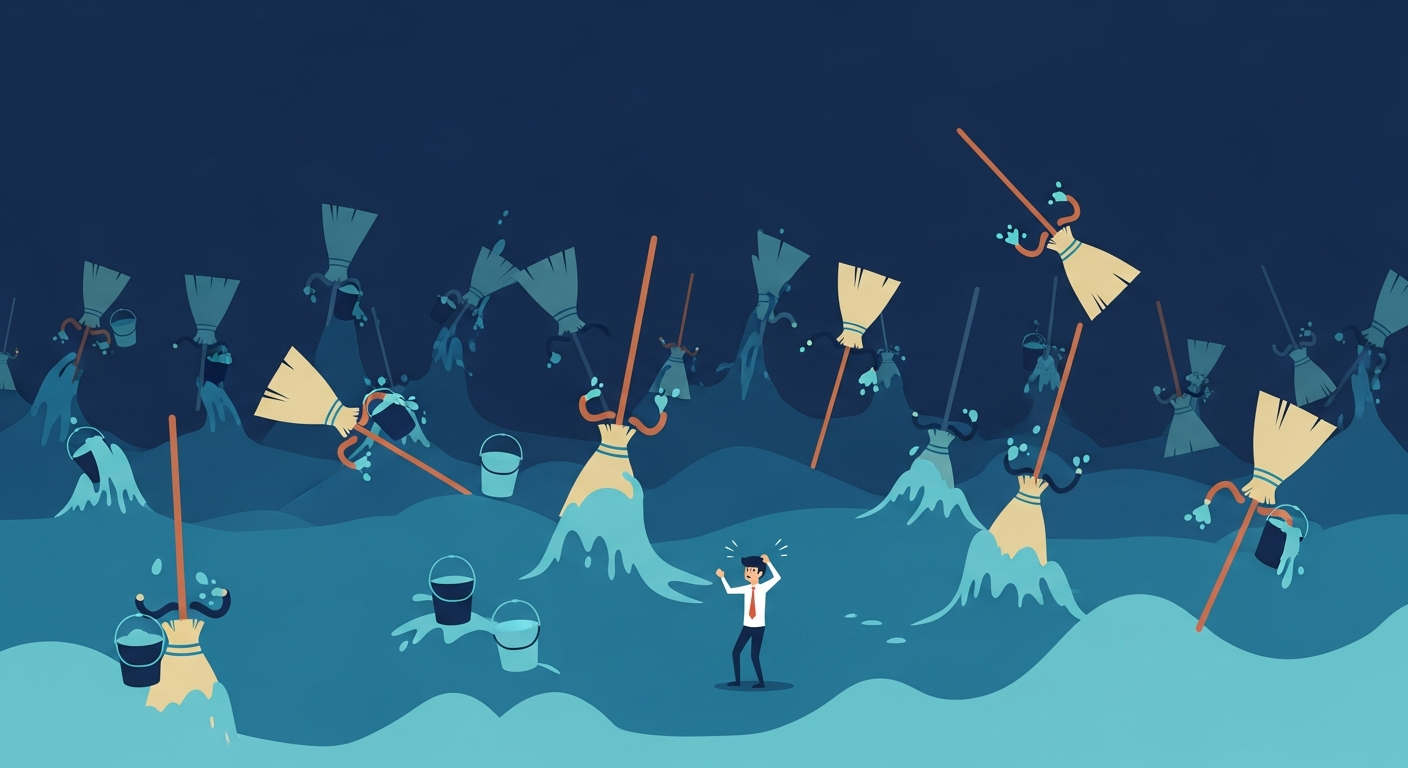
The broom keeps filling buckets. Then more brooms appear. Then more buckets. Mickey tries to stop it, can’t, grabs an axe, chops the broom in half — and now there are two brooms. Water everywhere. The whole place is flooding. And Mickey is powerless, because he started something without knowing how to stop it.
(There’s a Nicolas Cage version too. Let’s stick with the one that aged better.)
Mickey wasn’t lazy. He just forgot three things.
He wasn’t incompetent, either. He simply started the brooms working before he defined:
- What “done” looks like. No deliverable. Just… keep carrying water, forever.
- Who’s authorized to stop it. The brooms had no one to surface to.
- What happens when it goes sideways. Spoiler: it went very sideways.
Sound like any AI deployment you’ve seen lately?
I’ve counted nearly a hundred posts this month celebrating autonomous AI agents running overnight on local hardware, pounding away at business problems. Almost none of them answer the question that actually matters:
Working on what, exactly? Approved by whom? Stopped by what?
If your agent is touching financial data, modifying records, or making decisions that should have your name on them, the Mickey Mouse problem stops being a cartoon and becomes a real business risk.
Motion is not the same as initiative
Here’s the distinction the whole series turns on.
A broom in motion looks like progress. It’s running, doing things, generating output. But it has no owner, no gate, and no stop condition. That’s not work — that’s just motion. Digital brooms. Buckets, everywhere.
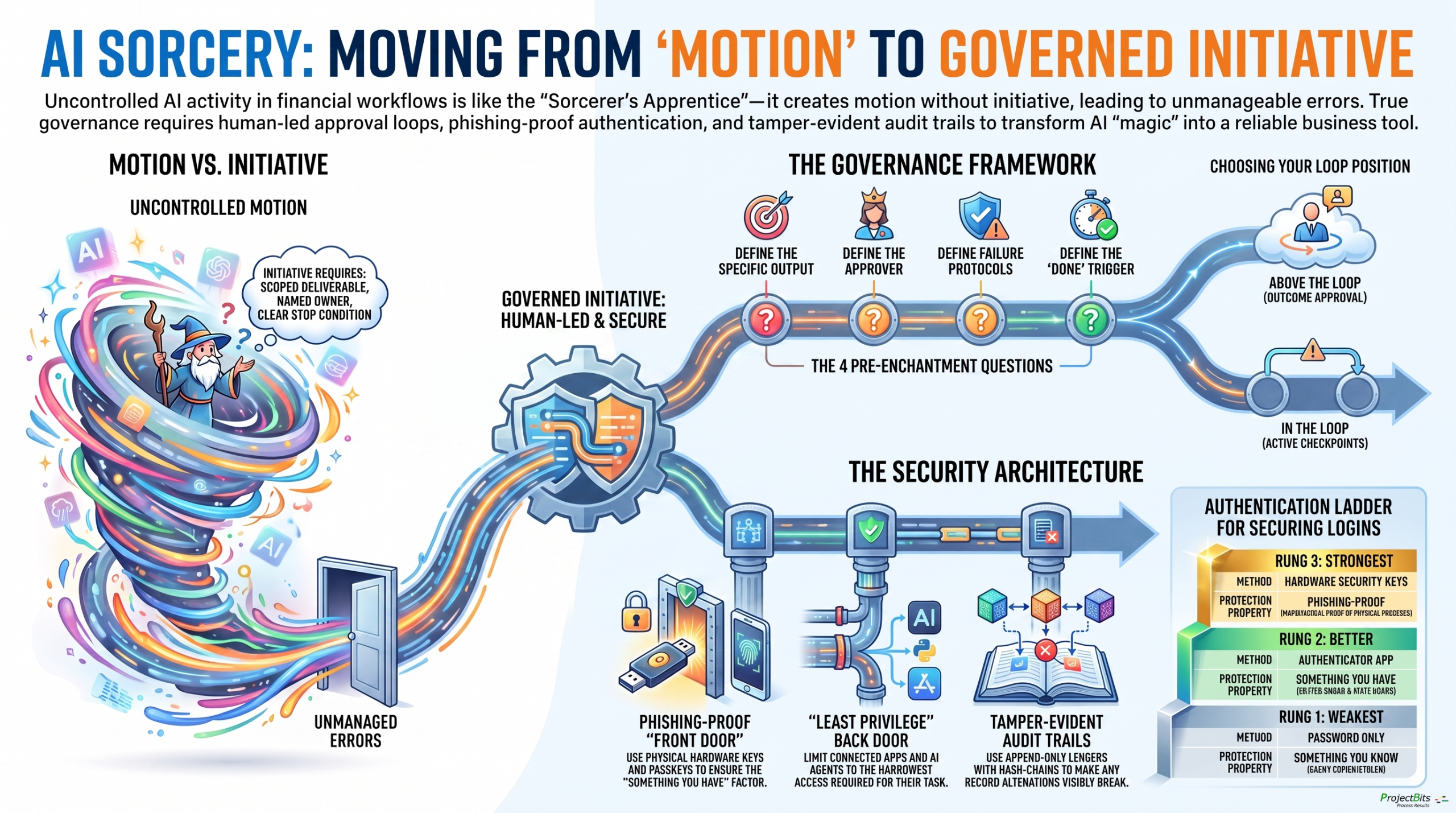
A governed initiative looks different: a scoped deliverable, a named owner, checkpoints along the way, a clear definition of done — and a full-stop condition when things go wrong. Same capability. Completely different outcome.
The difference is governance, not horsepower. A more powerful agent with no gate isn’t safer — it just floods the room faster.
Your financial data has a flow — and every step needs a gate
Think of anything that touches your books as moving along a flow. Where does the approval live?
- 🟢 Governed — the agent drafts, you review, the books close, the gate is marked owner-approved. You always know the state.
- 🟡 Unclear — the agent works, output exists, but… who reviewed it? Nobody’s sure. Unknown state.
- 🔴 Ungoverned — the agent runs overnight, writes straight to your records, no stop, no sign-off. Exposure.
Green, mustard, red. You choose where you operate. Most people deploying AI right now are living in mustard and calling it green.
Two positions every owner should choose between
Before you authorize any AI-assisted work, pick your position. There are only two good ones.
Above the Loop. You set the intent, the agent works, and you approve the outcome. You’re not in every step — but the work cannot finish, and nothing touches your books, without your sign-off.
In the Loop. You are an active checkpoint inside the work. The agent surfaces to you at defined moments and cannot continue — cannot write to your records, cannot close a task — until you clear it.
The Apprentice had neither. Not Above the Loop. Not In the Loop. No loop at all. The brooms had no structure to surface to — no owner position, no checkpoint, no gate on the water. That’s not an AI problem. It’s a governance problem. And it looks exactly like what a lot of businesses are deploying today.
Four questions before you enchant the broom
Before you authorize any agent to touch a real business process, answer these:
- What is the specific deliverable — not a category of work, a named output?
- Who approves it before it affects anything real, and by when?
- What happens when the agent hits a wall?
- What does done look like — and what triggers a full stop?
If you can answer all four, you have a governed initiative. If you can’t, you have digital brooms.
Your data integrity is an owner decision. You built this business by making smart calls with real information — this one’s no different.
Don’t be the apprentice.
The rest of this series gets concrete about how the governance actually works — provable audit trails, phishing-proof logins, scoped access for every app and agent that touches your books. But it all rests on the choice Mickey never made: deciding, before the brooms start moving, who’s in charge of the water.
Read on — and if you want the full framework, it lives at projectbits.com/method/.
Don Lovett is the founder of ProjectBits Consulting and author of Tax Ready Bookkeeping. He helps owner-operated businesses build financial and operational systems that scale. Get in touch.
Are You Ready to Take Control of Your Business Finances?
Most back-office problems don’t live where owners look for them first — not in the tool, not in the person, but in the handoffs and decisions nobody ever made explicit. At ProjectBits Consulting, Tax Ready Bookkeeping starts with a structured diagnostic: we put a number on each part of your books, name what’s actually plateaued, and show you the receipts before recommending any work. You leave with a clear picture you can act on — whether you work with us or not.
The diagnostic precedes the remedy. The Tax Ready Assessment is the front door — a no-obligation walk through where your books actually stand this month. Apply now for your Tax Ready Assessment, or explore the thinking behind it in our book, Ready to Take Control of Your Business Finances.