
You Can’t Fix What You Can’t See
How to read your business’s vital signs — and trust the numbers you’re reading
Our advice
Start with Paper Zero — find yourself first.
Before the frameworks land the way they’re meant to, see which of the five financial personas is running your business today — Which Financial Persona Is Running Your Business? is the recognition on-ramp: find yourself first, then read on. From there, The Two Perspectives names the disciplines — knowledge governance and operational data integration — that determine whether AI produces operating intelligence or expensive theater. The papers below build from that diagnosis to the lab result that tests it.
Reading order
- ★ Which Financial Persona Is Running Your Business? — find yourself first, then read on. ~13 minutes.
- The Two Perspectives — the AI-readiness diagnostic. ~16 minutes.
- Tax Ready Bookkeeping + The AI Stack — the bookkeeping-specific application. ~29 minutes.
- The CFO Operating System — the Stage-4 advisory layer; what clean books are for. ~15 minutes.
- ProjectBits Thought-OS™ — the full methodology umbrella. ~9 minutes.
- AI Debt: The Tax on Small Business — the cost of deploying AI without naming the decisions first. ~22 minutes.
- The Five Questions Test — the lab result: why clean books beat AI infrastructure. ~22 minutes.
- The Hill-Climbing Machine — the ecosystem view: what Satya Nadella got right, and the SMB foundation he skipped. ~20 minutes.
- The Third Perspective — People, Preparation & Readiness; the human discipline behind the harness, for change-management professionals. ~30 minutes.
- The Managed Initiative — the governance capstone: run an AI initiative the way product teams run products, translated for the $5M–$25M owner. ~30 minutes.
- Signal Clarity. Owner Amplification. — the owner’s time is fixed; the return on it is not. The governing layer that amplifies the owner’s judgment, proven on the practice’s own pipeline. ~28 minutes.
- The Trust Stack — an append-only record, rules written as code, managed secrets, an approval gate and observability: the single path every use of AI should pass through. ~30 minutes.
- The Provenance Ledger — what tax-ready books require beyond immutability: a record with two clocks and rules written as code. ~31 minutes.
Most owners don’t get blindsided because their business is bad. They get blindsided because they can’t call up their own vital signs on demand — and can’t be sure the numbers are even theirs to trust. This is a conversation about closing that gap: what your financial data is actually telling you, why the identity and access questions underneath it decide whether you can believe a single figure, and how to know when your business is genuinely ready for AI.
You won’t be handed conclusions. Below, an owner reasons his way to each one himself — the same way we walk clients through it.
~16-minute read. Five core movements, plus two optional ones: stewardship (for businesses with partners or investors) and delegation (for any owner who’s ever away from the office).
Movement One: The Owner Finds the Blind Spot
Business Owner: I keep hearing about businesses like mine getting into trouble they didn’t see coming. How do I actually know if my business is healthy?
Guide: Before I answer that — can I ask you something first? Off the top of your head, what are your business’s vital signs right now — your cash position, your margin trend, how fast money’s actually coming in versus going out?
Business Owner: …Honestly, not with any precision. I see the P&L every month, but I couldn’t call up the current numbers on demand.
Guide: That’s a really honest answer, and it’s the most common one I hear. So here’s the real question: if you can’t call up your own vital signs on demand, how would you catch a problem while it’s still cheap to fix?
Business Owner: I guess… I wouldn’t. I’d only find out once it was already expensive.
Guide: That’s the whole thing in one sentence: you can’t fix what you can’t see. And it turns out you can’t see it without numbers you actually trust — which is a different problem than most owners think they have.
Business Owner: What do you mean, different problem?
Guide: Most owners think the gap is "we need better software." But even with software — can you tell me, off the top of your head, exactly who can touch your financial records right now, and how you’d know if the wrong person changed something?
Business Owner: …No. QuickBooks, our email, our client files somewhere in the cloud. I couldn’t tell you who has access to what, exactly.
Guide: That’s exactly right — that’s what data governance actually is. Not a product you buy. It’s the discipline of always being able to answer three questions: where does sensitive data live, who can touch it, and how would you know if the wrong person did?
Business Owner: We’ve never written any of that down. Yet.
Guide: Here’s something worth thinking about: if an employee left your company tomorrow, how confident are you that every login they ever had would actually stop working?
Business Owner: …Not very confident at all. I don’t think anyone owns that checklist.
Guide: That’s the real gap — not a lack of tools, but a lack of ownership over a question nobody assigned. That’s always where we start with a new client: not buying anything, just building the map you don’t have yet.
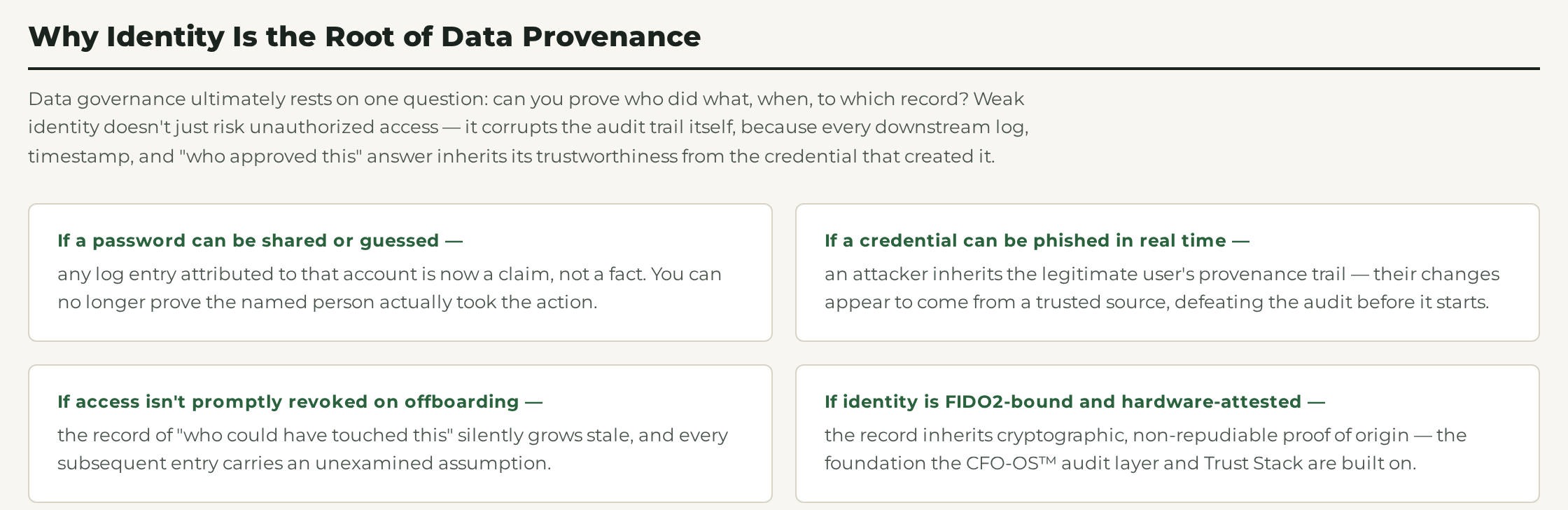
Why identity is the root of data provenance: every "who did what, when, to which record" answer inherits its trustworthiness from the credential that created it.
Movement Two: Discovering Why Passwords Aren’t Enough
Business Owner: Okay, say we build that map. What’s the next layer?
Guide: Let me ask you this instead: once you know what needs protecting, what’s the one thing standing between a stranger and that data?
Business Owner: The login. The password.
Guide: Right. So here’s a scenario — suppose someone builds a fake version of your bank’s login page, indistinguishable from the real one, and emails it to you disguised as an urgent notice. You type in your username and password without noticing anything’s wrong. What does the attacker have at that moment?
Business Owner: They’d have my actual password.
Guide: And your business does use two-factor authentication on some systems, doesn’t it — the kind that texts you a code?
Business Owner: Yes, on a few things.
Guide: Same scenario, but now the fake page also asks you for that code, and you type it in too, because it looks completely legitimate. What happens now?
Business Owner: …They’d have that too. In real time. Before it expires.
Guide: So here’s the question that matters: if a password can be typed into the wrong place, and a text-message code can also be typed into the wrong place — what kind of proof of identity would actually be safe from this? What property would it need?
Business Owner: It would need to be something I… couldn’t type in, even if I tried. Something that doesn’t leave whatever it’s stored on.
Guide: That’s the core idea behind a technology called FIDO2 (Fast IDentity Online 2). The proof of identity lives inside your device and never travels anywhere — not through email, not through a fake page, not even through you, by accident. The device and the real website essentially recognize each other directly.
Business Owner: So it’s not that the password is weak. It’s that anything I can hand over is automatically unsafe.
Guide: That’s the whole shift in thinking. Not weak versus strong — handed-over versus never-handed-over.
Business Owner: Okay, but my phone has a passcode, and so does QuickBooks Online now — it asks for its own PIN separately. Isn’t that the same idea? It never gets sent anywhere either.
Guide: Good instinct, and it’s half right. Your phone’s passcode does one smart thing: it’s checked locally, so it never travels over the internet during a normal unlock. But is it still something you know — something you could type into the wrong place, or have someone watch you enter?
Business Owner: …Yeah. It’s just a number I memorized. I could still hand it over, even by accident.
Guide: Right — so it’s a step in the right direction, not the same thing. FIDO2 goes one further: there’s no secret to hand over at all, even accidentally, even by you. Now — you mentioned QuickBooks has its own passcode, separate from your phone’s. How many of these separate app-level passcodes do you think actually protect your financial data right now — QBO, your bank portal, your email, whatever else?
Business Owner: …Honestly, probably five or six, at least. I never really added them up.
Guide: And if one of those got phished or guessed tomorrow, would the other five automatically be affected — or would you have to go find and fix each one separately?
Business Owner: Separately. They’re not connected to each other at all.
Guide: That’s the real cost of passcodes multiplying across apps — it’s not just that each one can be handed over, it’s that you now have five or six separate places that could leak, with no single lock to check and no single lock to change. Compare that to revoking one FIDO2 credential, the way we talked about with the hardware key — one action, and every door it opened closes at once.
Business Owner: So the goal isn’t more passcodes on more apps. It’s fewer secrets, standing on stronger ground.
Guide: That’s exactly it.
Want the mechanism behind this — how a login can prove "something you have" without ever transmitting it? The companion piece Something You Know, Have, or Are: The Idea Behind Every Login walks through the three factors and the math that makes FIDO2 phishing-resistant.
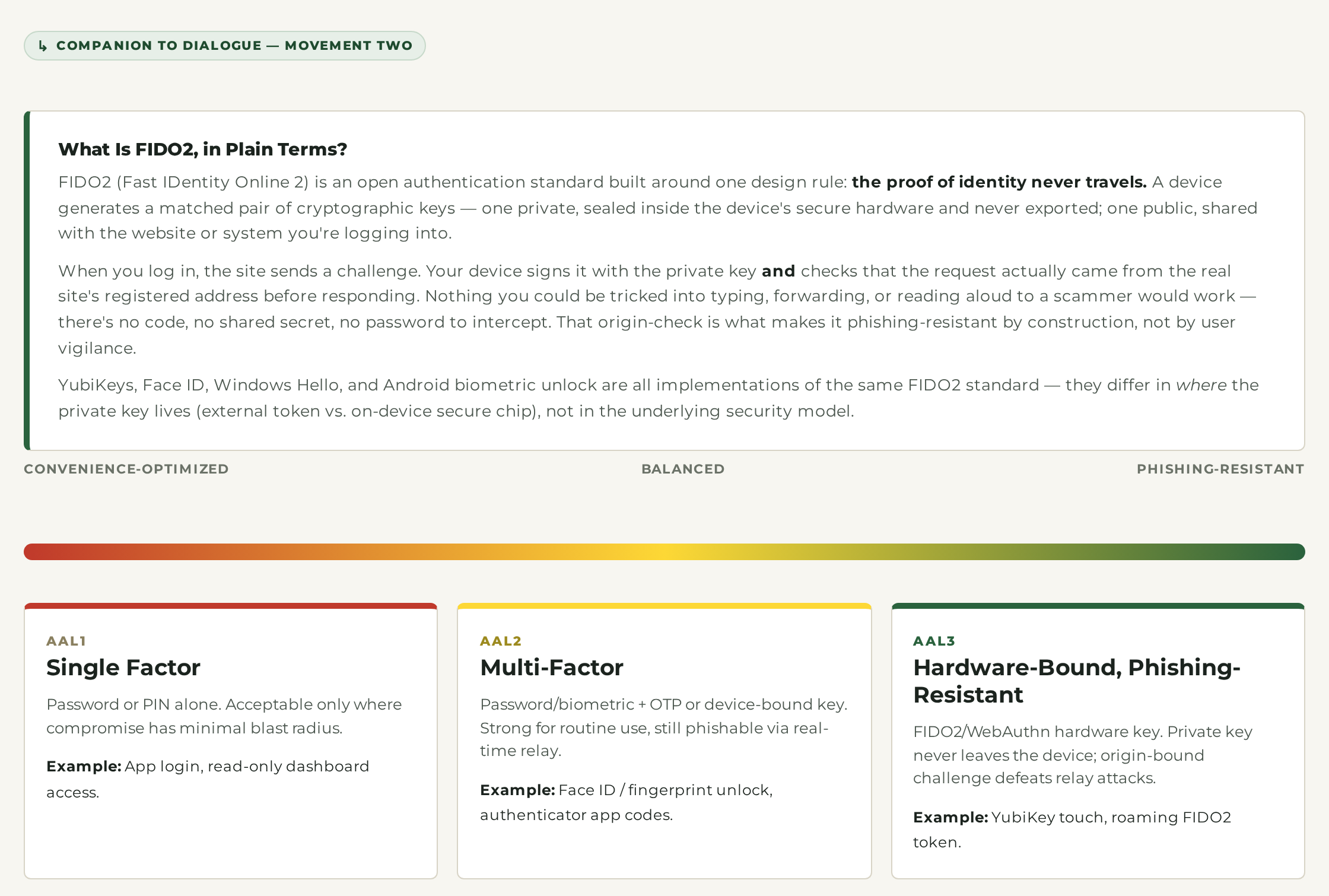
What FIDO2 is in plain terms, and the Identity Assurance Spectrum from AAL1 (single factor) to AAL3 (hardware-bound, phishing-resistant).
Movement Three: Discovering What’s Already In Their Pocket
Business Owner: Is that a special piece of hardware I’d have to buy?
Guide: Before I answer — when you unlock your iPhone with your face, or your Android with your fingerprint, where do you think that fingerprint or face data is actually stored?
Business Owner: I’d assume… on the phone somewhere?
Guide: More specifically, it’s sealed inside a dedicated security chip that’s isolated from the rest of the phone — nothing, not even Apple or Google, can pull it out. Given what we just worked through about proof that "can’t be handed over" — does that sound familiar?
Business Owner: That’s the same idea as the FIDO2 thing. My phone might already be doing this.
Guide: It is. Your Face ID and fingerprint unlock already meet that same standard in most cases. So here’s a harder question: if your phone can already do this, why would anyone still carry a separate physical key, like a YubiKey?
Business Owner: I don’t know — redundancy? In case you lose your phone?
Guide: Good instinct, but think about it from the business’s side, not yours personally. If an employee who has one of those hardware keys leaves the company tomorrow, what does it take to shut off their access?
Business Owner: You’d just… take the key back. Or really, revoke it in the system — even before you physically got it back.
Guide: Right — but what’s actually happening when you revoke it? Is that like taking the key away, or something else?
Business Owner: I guess it’s more like changing the lock. The key doesn’t matter anymore, because it doesn’t open anything.
Guide: Exactly right, and that’s not just a good analogy — it’s technically what’s happening. Revoking access means the system stops recognizing that key’s credential, the same way a locksmith rekeys a door. The old key still exists, but it’s just a shape now. Now do the same thing for an employee whose access is tied to Face ID on their personal iPhone.
Business Owner: That’s harder. It’s their phone. You can’t just take it.
Guide: Now you’ve found the actual difference, and it isn’t security strength — it’s ownership. A hardware key belongs to the business and can be issued, collected, and reissued in minutes. A phone belongs to the person. So let me ask you the real question this leads to: given that difference, where in your business would you want access tied to something the company controls, rather than something an individual carries home?
Business Owner: Probably… anything really sensitive. Wire transfers. Changing bank details. Not checking email.
Guide: You just built the entire policy yourself.
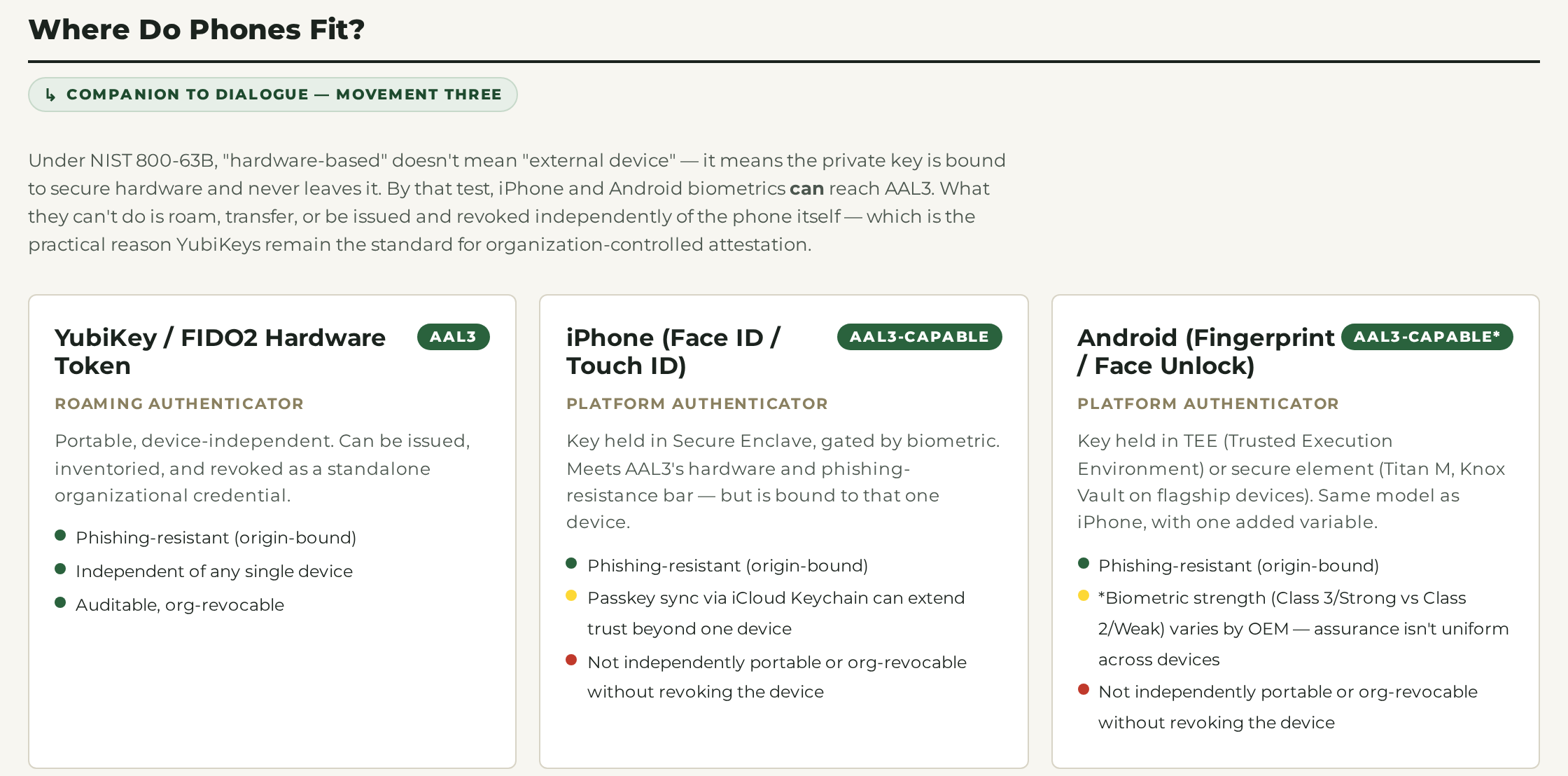
Where phones fit: YubiKey (roaming, org-controlled) vs. iPhone Face ID and Android biometrics (platform authenticators bound to the person’s device).
Movement Four: Discovering the Real Design Principle
Business Owner: This is more layered than I expected walking in. Is all of this really necessary for a company our size?
Guide: Let me ask it this way: would it make sense to put the same lock on your front door as you’d put on a bank vault?
Business Owner: No — that would be overkill for a house.
Guide: So security isn’t really about maximum strength everywhere — it’s about matching the strength of the lock to what’s actually behind the door. Given everything we’ve talked about, what’s the question you’d now ask about any single action in your business — email, payroll, a wire transfer — to decide how strong the "lock" needs to be?
Business Owner: I’d ask… what happens if the wrong person did this? Can it be undone?
Guide: That’s precisely the framework — and you arrived at it yourself. Reversibility and damage. Low-stakes, everyday actions get convenient protection, like Face ID. High-stakes, hard-to-undo actions get the strongest proof available. It’s the same logic the federal government formalized in its latest digital identity standards, and it’s the same logic we build into every system we architect for clients.
Business Owner: You mentioned "systems" — is this only about people logging in, or does it apply to something else too?
Guide: What do you think? If an AI assistant in your business could draft an email on its own, versus initiate a wire transfer on its own — using the exact question you just asked me — which one needs a human standing at the door with the strongest possible proof of who they are?
Business Owner: The wire transfer, probably worse — but honestly, a bad email isn’t nothing either. It could commit us to something we didn’t mean, or embarrass us in front of a client.
Guide: Good — don’t let me oversimplify it. Both can genuinely hurt you. So what’s actually different between them?
Business Owner: I guess… if the email’s wrong, I can usually call the person, explain, walk it back. The wire transfer might just be gone.
Guide: That’s the real distinction — not "harmless versus costly," but recoverable versus not. A damaged relationship can often be repaired. Money that’s left the account, or a commitment that’s already been acted on, usually can’t be undone. That’s what should decide how much proof of identity a given action needs — not how embarrassing the mistake would be, but how much of it you can still fix afterward. It’s the same principle applied to AI. Not a separate problem — the same question, asked of a new kind of actor in the business.
Business Owner: So where do we actually start?
Guide: My advice: start with the map you already told me you don’t have. Then place each system on the scale you just designed — reversibility and damage — and match the lock to the door.
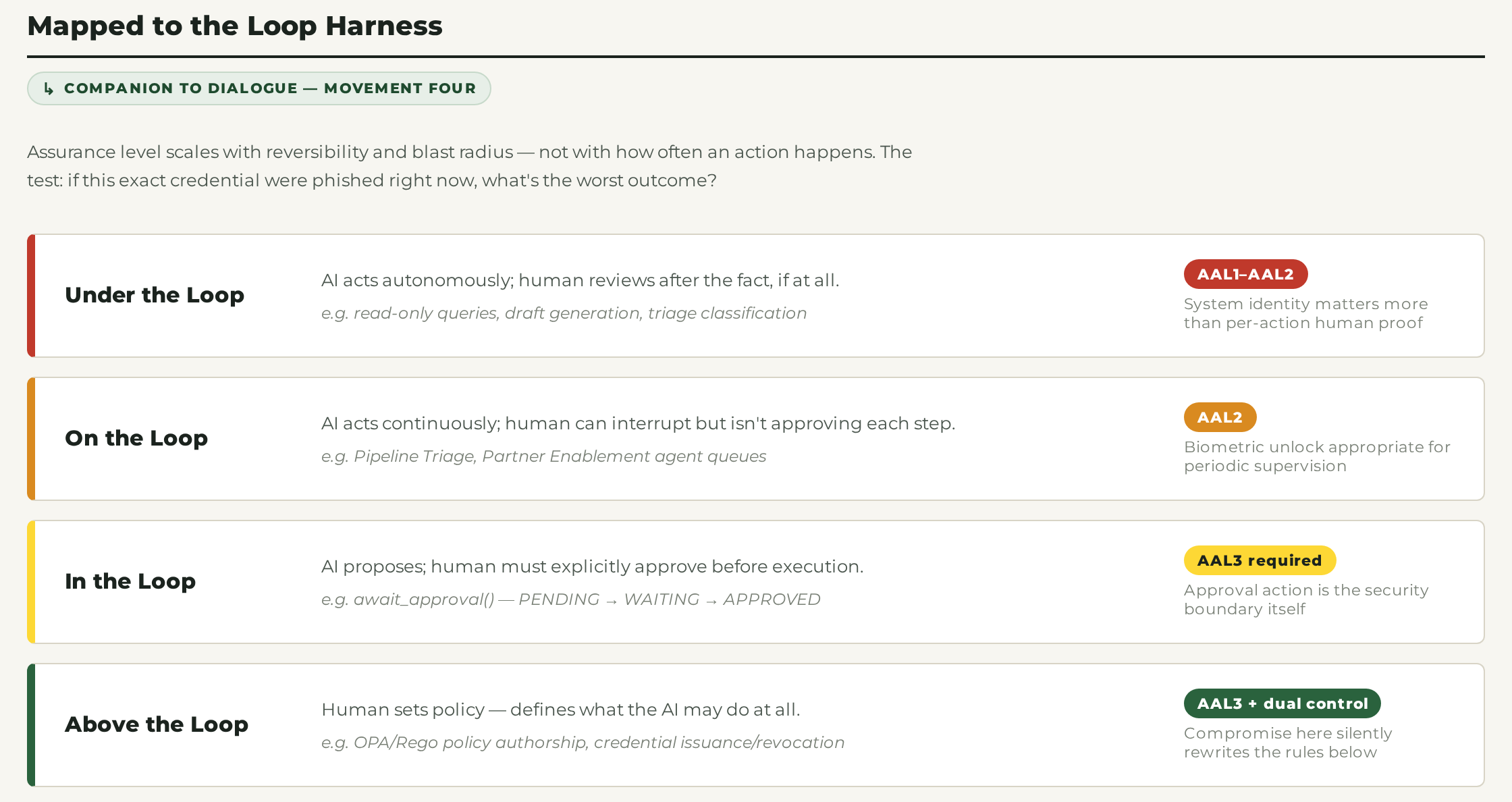
Assurance level mapped to the loop harness: under / on / in / above the loop, each tier matched to the authenticator strength the action’s reversibility demands.
Movement Five: Discovering When You’re Ready
Business Owner: This is a lot to take in. Everyone’s telling me I need to "adopt AI" in the business. Honestly, after this conversation, I’m nervous about it. How do I know when I’m actually ready?
Guide: Let me ask you something first. A few minutes ago, you told me you couldn’t confidently say who has access to what in your business. If I handed you an AI assistant today with broad access to your systems, what would actually be different about the risk, compared to hiring a new employee you also hadn’t fully background-checked or trained?
Business Owner: …Nothing, really. It’s the same blind spot. Maybe worse, because it could act faster than a person would.
Guide: So here’s the real question underneath "am I ready for AI": is it actually a question about AI at all?
Business Owner: No. It’s the same governance question from the start of this conversation. If I don’t know where my data lives or who can touch it, adding AI on top of that just… multiplies the problem.
Guide: Exactly. Readiness for AI isn’t a separate milestone — it’s a byproduct of the same maturity we’ve been building this whole conversation. Now, thinking back on everything we’ve covered — the data map, the phishing-resistant login, the reversibility question, the ownership question — what would you say is different about a business that’s "ready" versus one that isn’t?
Business Owner: The ready one actually knows its own systems. It’s already sorted out what’s low-stakes versus high-stakes. It already has the strong locks on the important doors.
Guide: So let me push you one step further. If a business has that in place, does that mean AI can immediately do everything — approve wires, change records, act completely on its own?
Business Owner: No… I’d guess you’d still want to ease into it. Maybe start with things where a mistake wouldn’t really cost you anything.
Guide: Which is exactly the same reversibility test you built earlier, just pointed at a new kind of actor. Let me describe four positions and you tell me which order they’d naturally go in, from least trusted to most trusted: the AI acts completely on its own with no review at all; the AI proposes an action but a human must approve it before anything happens; a human reviews the AI’s work after the fact but doesn’t block it in real time; a human sets the rules the AI is allowed to operate under in the first place, before it ever acts.
Business Owner: I’d say — the human sets the rules first. Then early on, everything needs approval before it happens. Once you trust it, you let it move on its own but you’re still watching. And only later does it act fully on its own for the low-risk stuff.
Guide: That’s a four-stage maturity model — and it’s the exact one we use with clients. That’s not a coincidence: AI trust and business maturity are the same climb. So here’s the real answer to your original question: you’ll know you’re ready to expand AI’s role not on a calendar, but the moment your controls catch up to the next stage. Readiness isn’t a date. It’s a state you can measure.
Business Owner: So the identity work we talked about earlier — the hardware keys, the approval steps — that’s not separate from the AI question. That’s the actual prerequisite.
Guide: That’s the whole thesis — and I want to be precise about the order, because it matters. The goal was never "adopt AI." The goal is a healthy business. The vital signs of your business are revealed in its signals and financial data — and translating them into action is where you excel. AI and identity security are just how we get you numbers that are fast, accurate, and actually yours to trust. The businesses that pull ahead aren’t the ones who moved fastest on the technology — they’re the ones who’d already answered the governance and identity questions you just answered yourself, before they needed to.
Business Owner: So the identity work isn’t really about AI at all. It’s about trusting the numbers in the first place.
Guide: Exactly. As your fractional CFO, we bring deep bookkeeping discipline together with technology: better financial data flows, efficiency from AI, and reliability from identity security most firms don’t have. None of that holds up if you can’t prove, with certainty, who authorized what — which is why the identity piece we walked through earlier isn’t a footnote. It’s the foundation the accuracy stands on.
That matters most where the stakes are highest — your books, your banking, your client billing. For us, that’s not a side risk we bolt security onto. It’s the center of what we do every day.
Business Owner: So where does that leave someone like me, starting from scratch?
Guide: Exactly where you are right now — at the beginning of the climb, with a clearer read on your own vital signs than you walked in with. My advice: don’t guess at your numbers, get them assessed. We’d look at where your financial data and your controls actually stand today, not where you assume they stand, and let that tell us which stage of AI trust your business has genuinely earned. Everything after that is just matching the next step to what you’ve already proven you can measure — and act on.
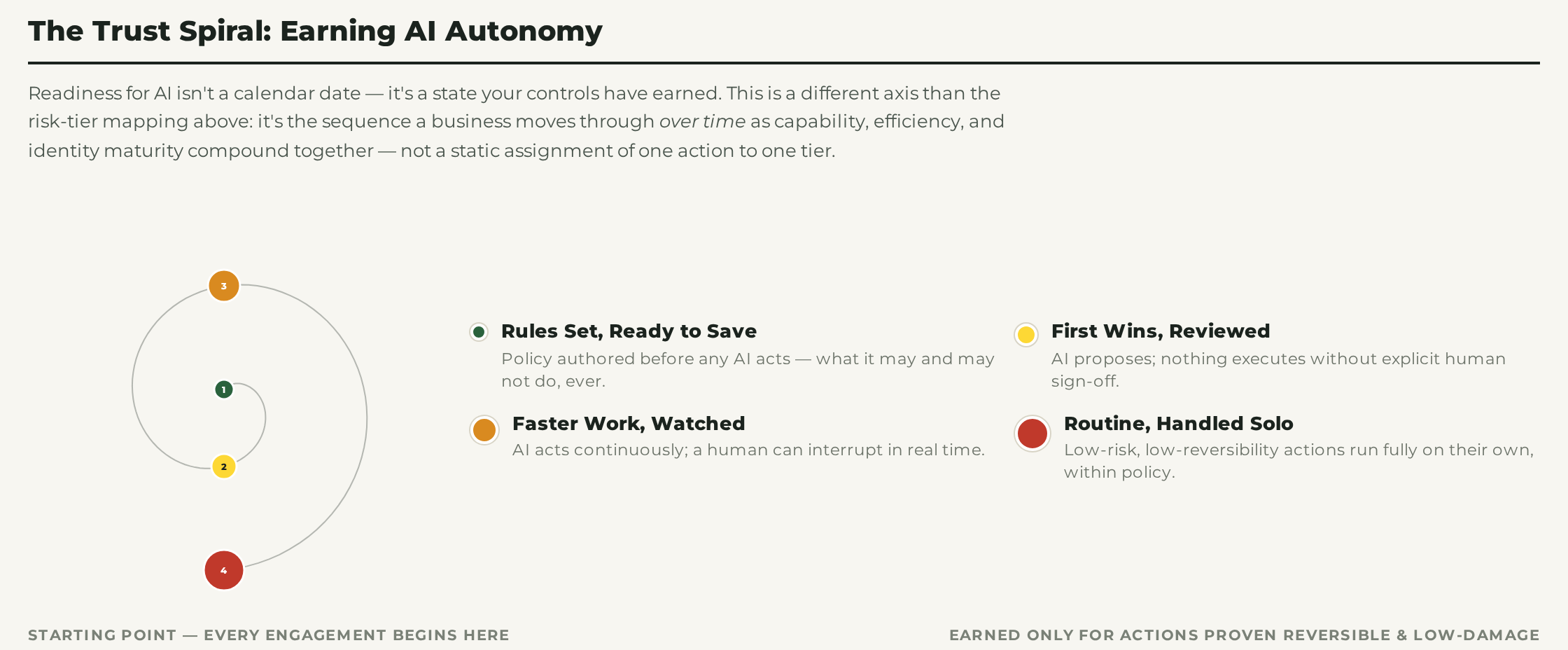
The Trust Spiral: AI autonomy earned across four stages — rules set, first wins reviewed, faster work watched, routine handled solo.
Movement Six: When It’s Not Just Your Money
This movement applies to businesses with equity partners or outside investors. Solo owners can skip ahead to the close.
Guide: One more question, since it changes the stakes. Is it just you, or are there partners or investors relying on these numbers too?
Business Owner: Actually — I do have two partners who put capital in early on. Does any of this change for us?
Guide: It changes the stakes, not the method. Right now, when you look at your own numbers, you’re trusting yourself. Your partners can’t do that the same way — they’re trusting numbers they didn’t produce and usually can’t independently verify. What does that make your role, the moment someone else’s capital is riding on what you report?
Business Owner: …I guess it’s not just my business anymore. I’m accountable for what I tell them, whether they can check it or not.
Guide: That’s stewardship, in one sentence — you’re not just managing money, you’re managing trust you were given. And it raises the bar on everything we just walked through. A phished credential isn’t just your problem anymore. A number you can’t fully vouch for isn’t just an internal question anymore — it’s something you’d have to explain to people who trusted you with their capital.
Business Owner: So the identity work and the vital signs — that’s not just protecting me. It’s protecting them too.
Guide: Exactly. And it’s usually the fastest way to see why "good enough" bookkeeping stops being good enough the moment someone else’s money is involved.
Movement Seven: When You’re Not There
This movement applies to any owner who is ever unreachable — travel, illness, or simply time off. Which is to say, it applies to everyone.
Guide: One more scenario worth thinking through. What happens on the day you’re on a plane, or in the hospital, or just genuinely unreachable — and someone needs to approve a payment or sign off on something urgent?
Business Owner: Honestly… either it waits until I’m back, or someone just uses my login to get it done.
Guide: And if someone uses your login, what does the record show afterward?
Business Owner: It shows me. Even though I didn’t do it.
Guide: That’s the real problem with delegation done the easy way — sharing your own credentials doesn’t just create a security risk, it destroys the very thing we’ve spent this whole conversation building: an accurate record of who actually did what. So if you couldn’t share your own login, what would delegation look like instead?
Business Owner: I guess… give them their own access, but only when they need it, and only for that one thing.
Guide: That’s exactly it — temporary, scoped, and tied to their own credential, not yours. It can expire on its own once the need passes, and afterward the record still tells the truth: they acted, with your authorization, not as you.
Business Owner: So it’s not really about trusting people less. It’s about the record staying honest either way.
Guide: That’s stewardship again, from a different angle. The business doesn’t stop functioning just because you stepped away — and it doesn’t lose the truth of who did what while you were gone.
This conversation illustrates the arc your Guide walks clients through — you’re never handed conclusions, only the questions that let you find them yourself.
Don’t guess at your numbers. Get them assessed.
You just watched an owner find his own blind spots by answering a few honest questions. The next step is to do it with your real books and your real controls — not where you assume they stand, but where they actually stand today.
That’s what a ProjectBits assessment is: we read your vital signs with you, place each of your systems on the reversibility-and-damage scale you saw the owner build, and tell you which stage of AI trust your business has genuinely earned. It’s a starting line, not a report card.
Book a free 10-minute conversation about what your numbers are telling you → projectbits.com
Companion visual: "The Identity Assurance Spectrum" — each movement above is tagged in the diagram for two-way reference.