

Part of the AI Governance & Security series
The AI Governance & Security Series
★ Start here (the story), then read Parts 1–7 in order.
| # | Post | Read |
|---|---|---|
| ★ | AI Sorcery: Don’t Be the Apprentice | Read |
| 1 | The Ledger Question (you are here) | — |
| 2 | Can You Prove What Your AI Did to the Books Last Night? | Read |
| 3 | The Boundary a Local AI Model Won’t Give You | Read |
| 4 | What Quantum Computing Does to Your AI Audit Trail | Read |
| 5 | Something You Know, Have, or Are | Read |
| 6 | Lock the Front Door: Secure Your QuickBooks Login | Read |
| 7 | The Back Door: Who Can Reach Into Your Books | Read |
The Ledger Question
Someone at a conference told you that AI governance requires blockchain.
They said it with confidence. They had slides. They used immutable, decentralized, and consensus mechanism in the same breath — as if the three words mean the same thing.
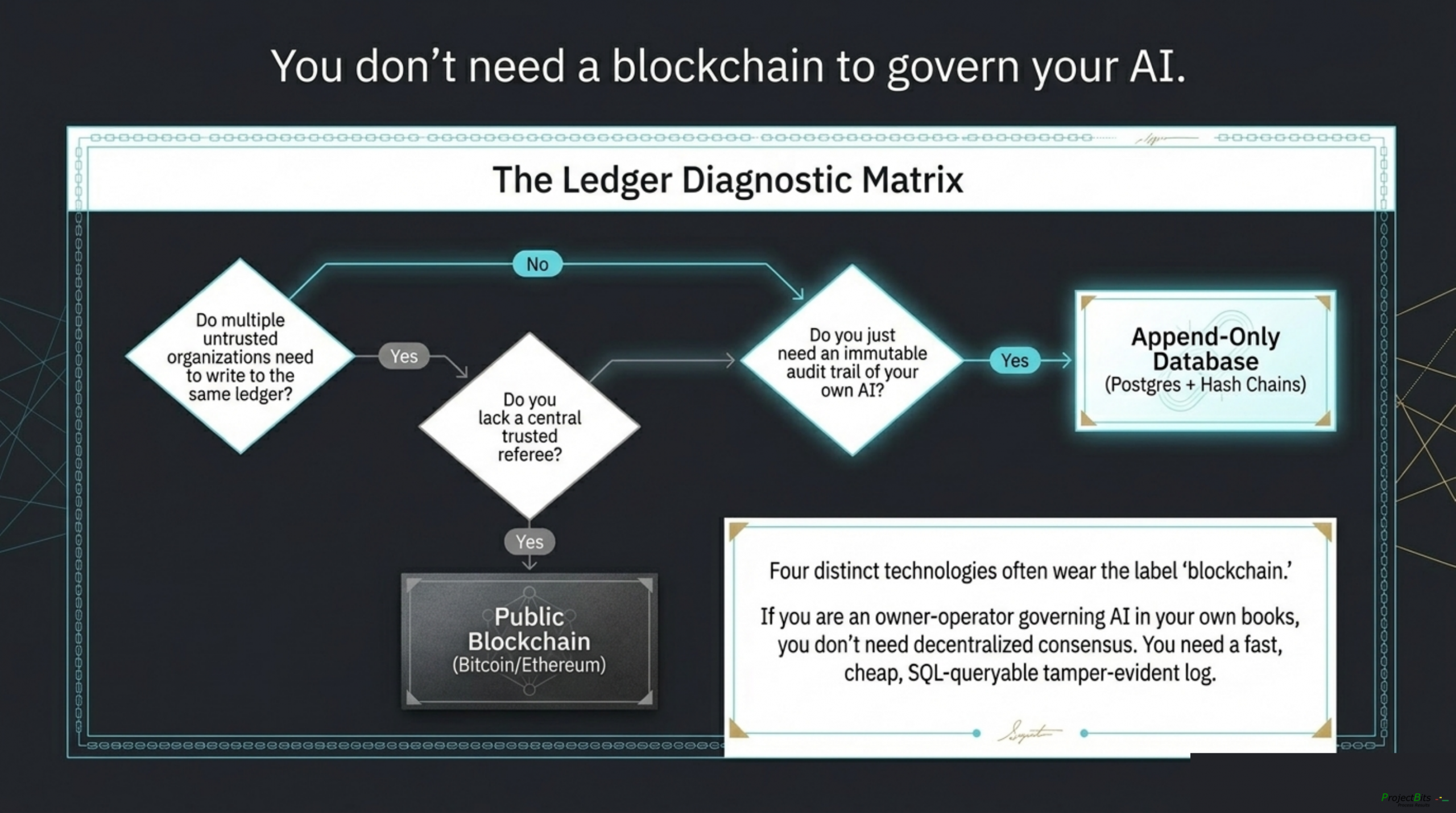
They don’t. And in the room, four separate technologies quietly got collapsed into one: public blockchain, permissioned distributed ledgers, append-only databases, and write-once storage. Different problems, different tools, one invoice.
The useful question isn’t “do I need blockchain?” It’s “what trust problem am I actually solving?” — because the answer usually points somewhere much smaller.
If you need to prove who authorized an AI action, that’s a signed audit log. If you need tamper-evident records your CFO can query in SQL, that’s an append-only table with a hash chain — Postgres will do it. It’s only when two organizations have to share a ledger with no neutral authority between them that you’re genuinely in distributed-ledger territory: Corda, Hyperledger, something built for known counterparties who don’t fully trust each other.
Public blockchain — Bitcoin, Ethereum — solves a narrower thing still: anonymous parties who trust neither each other nor any central institution. That’s a real problem. It’s just rarely the problem an owner-operator running AI in their books actually has.
What most of them need is unglamorous and buildable today: a tamper-evident log, a policy gate, key management, a human approval step above the risk threshold, and observability over every decision the AI makes. None of that requires a blockchain. All of it you can stand up now.
Requirements first. Technology second. The owner who works in that order isn’t just saving money — they’re not paying for the wrong tool to solve a problem they were talked into having.
Once you’ve named the trust property you actually need, the next question is how to supply it — the append-only log, the policy gate, the key management, the human approval step. That’s a separate piece.
This is how we think about the plumbing under AI governance — the layer beneath our method.
Tax Ready Bookkeeping™ · CFO Operating System™ · Thought-OS™